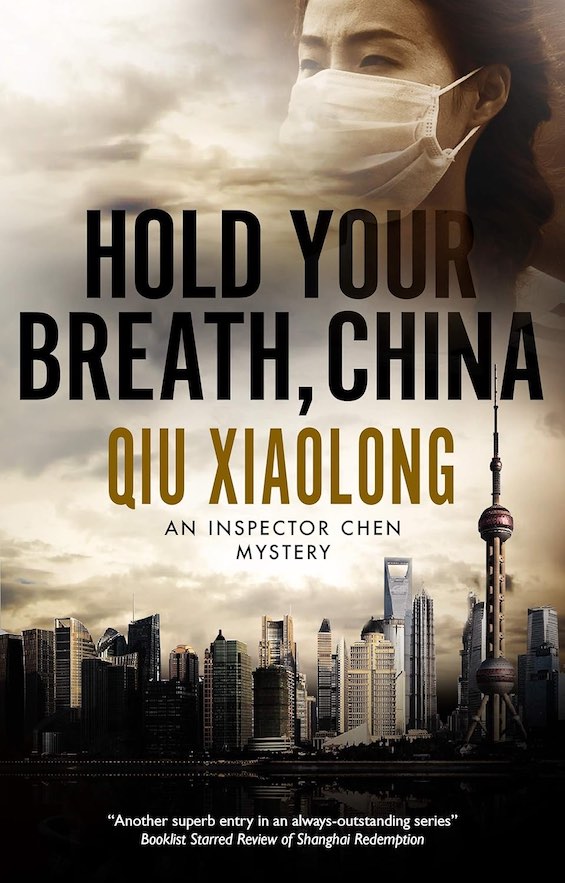
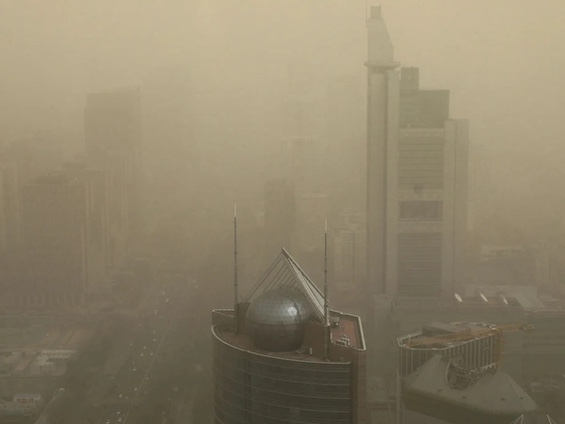
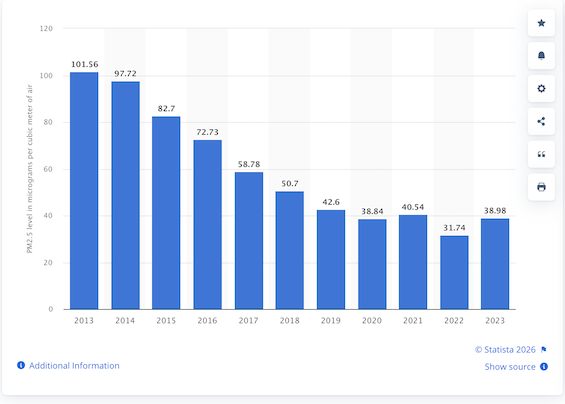
Through the rapidly industrializing nations of eastern and southern Asia, air pollution has become a major issue. For example, air pollution in India is estimated to kill some two million people a year. It’s most intense in Delhi, the capital. And when Xi Jinping took the reins of the Chinese Communist Party late in 2012, the air quality in Beijing was poisonous, too. Over the ensuing decade, however, resolute action by Xi’s government slashed the incidence of smog by two-thirds. Before that, vulnerable people were dying there, too. And Chinese American author Qiu Xiaolong tells a compelling story about the political maneuvering in China before Xi’s pollution-control policies took effect. It’s the theme in Hold Your Breath, China, the 10th book in his historical detective series featuring Chief Inspector Chen Cao of the Shanghai Police Bureau.
Familiar characters help Inspector Chen tackle the air pollution issue
Readers of previous books in this series will recognize the familiar characters who work with Inspector Chen. His able junior partner, Detective Yu Guangming. Yu”s resourceful wife, Peiqin. Yu’s father, Old Hunter, a retired cop. Party Secretary Li, Chen’s meddlesome and resentful boss. Unnamed officers of Internal Security, which often meddles in Chen’s cases to ensure political correctness. Chen’s Big Bucks (millionaire or billionaire) businessman friend, Mr. Gu. And Comrade Secretary Zhao, the retired first secretary of the Party Central Discipline Committee. They all play important roles in the two investigations that engage Inspector Chen in this novel.
Hold Your Breath, China (Inspector Chen #10) by Qiu Xiaolong (2019) 207 pages ★★★★☆
The story in a nutshell
Inspector Chen has been sidelined, not for failure but for his success in uncovering corruption among influential Party members and their friends in business and government. He has ruffled too many feathers. Detective Sergeant Yu now runs the Special Case Squad, which is designated to investigate politically sensitive crimes. But Party Secretary Li has instead assigned the biggest case now confronting the Shanghai Police Bureau—the serial murder of three citizens at one-week intervals, apparently at random—to the Homicide Squad. However, after three weeks the homicide detectives have made no progress, and Li details Sergeant Yu to assist them as a “consultant.” And Yu, as always, turns for help to Inspector Chen, even though his boss is out of favor and supposedly engaged in other affairs.
It turns out, though, the Chen truly is otherwise occupied. His patron in Beijing, Comrade Secretary Zhao, has enlisted him in a top-secret investigation that involves activists working to expose the government’s coverup of the increasing number of deaths from air pollution. A prominent environmental activist named Yuan Jing is preparing a documentary on the subject, and it promises to be explosive. Zhao wants Chen to determine the identities of the activists assisting her and to obtain a copy of the unfinished documentary. It”s unclear whether Zhao wants to expose the government and Party’s coverup or to suppress the activists’ work. But Chen has no choice.And, to complicate matters, Chen was personally involved with Yuan Jing on an earlier case. Then, he knew her as Shanshan. And they had had a brief love affair.
Are the two cases related?
Only once Chen’s investigation has begun to near its end, and Sergeant Yu has made progress on the serial murder investigation with Chen’s help from afar, will we begin to see the link between the two cases. Of course, this is fiction, and naturally the detectives will solve both of them. Ironically, though, this novel portrays action early in the second decade of the 21st century. And it was precisely then that Xi Jinping’s government began to take resolute action to combat the air pollution in China’s biggest cities. Within a decade, their efforts had cut the incidence of the toxic particles in the air by two-thirds. Centralized government does have its advantages.
About the author
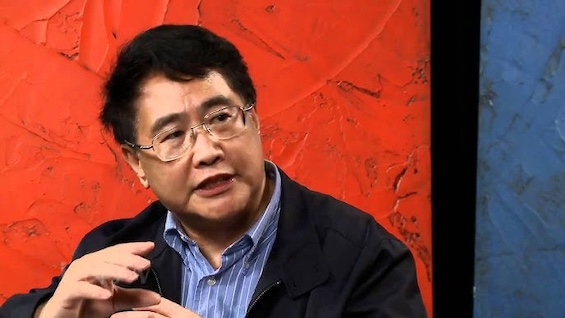
Qiu Xiaolong (1953-) moved to St. Louis from Shanghai in 1988 to study the work of T. S. Eliot at Washington University. Prevented from returning to China by the Tiananmen Square Massacre and the repression surrounding it, he remained in St. Louis, where he and his family live to this day. He obtained both an MA and a PhD in Comparative Literature there and joined the faculty. He left the university in 2005. From 2000 until 2025, he wrote a series of 14 novels in the Inspector Chen series. But he is also a prolific translator of classical Chinese poetry and has written several other books as well, both nonfiction and novels.
For related reading
I’ve reviewed most of the other books in this series in The best Chinese detective novels.
In an earlier novel (#7 in the series) the author explored another environmental issue in China. See Don’t Cry, Tai Lake (Inspector Chen confronts environmental crime in a Chinese city).
See also:
- The best mystery series set in Asia
- The 8 best historical mystery series
- Top 10 historical mysteries and thrillers
And you can always find the most popular of my 2,400 reviews, and the most recent ones, on the Home Page.