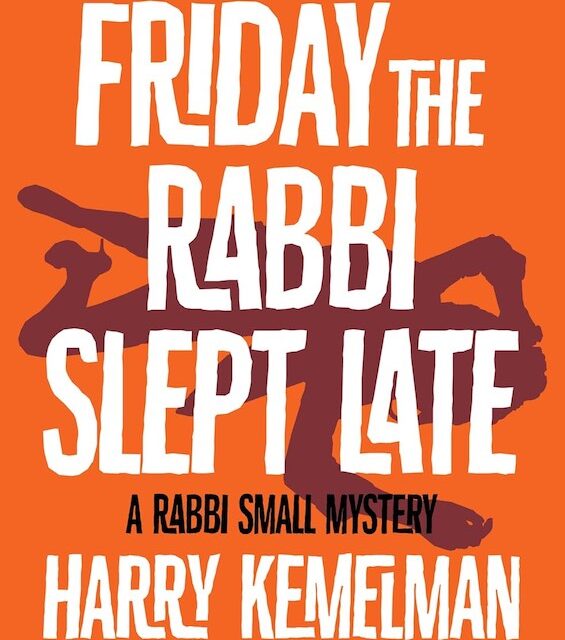
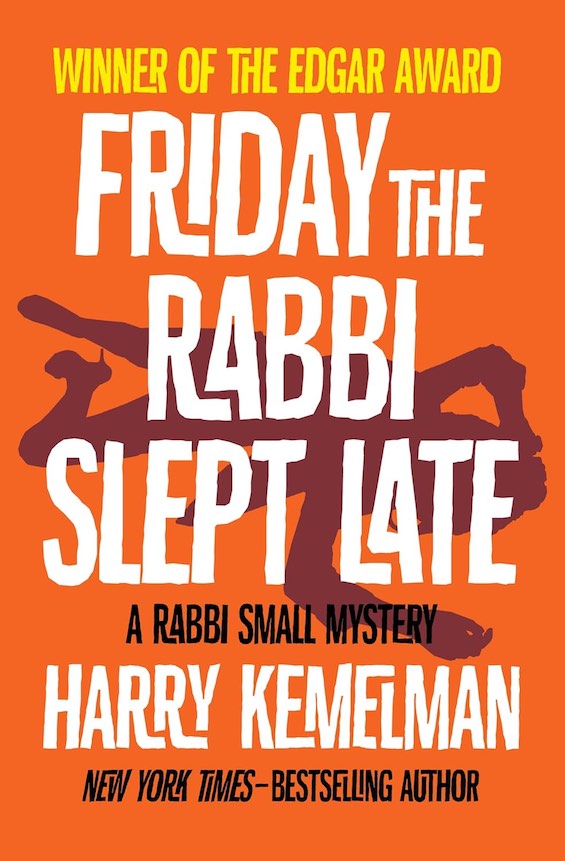
Over the course of three decades from the 1960s to the 1990s, a Boston-area professor of English named Harry Kemelman published a series of 12 crime novels featuring a young rabbi working as an amateur sleuth. But Rabbi David Small is no run-of-the-mill religious leader. He’s a scholarly Jew in the classical mold cast as the spiritual guide of a modern Conservative congregation. Some 300 families are at least nominally affiliated with the temple where he serves and few of them understand him. In Friday the Rabbi Slept Late, the award-winning series debut, Rabbi Small reluctantly pushes aside the books of the Talmud to help Hugh Lanigan, the town’s chief of police, solve a baffling murder case.
A young woman’s murder rattles this picturesque little town
The Rabbi Small mysteries unfold in the camera-worthy seaside town of Barnard’s Crossing. As Kemelman makes clear in an introduction, the town is modeled on Marblehead, Massachusetts, on Cape Cod. The Boston-born author moved there with his wife around the time he launched the series. Fewer than 20,000 people lived in Marblehead at the time (though not many more today). The 300 Jewish families, which included a great many professionals and businesspeople, thus played a leading role in the community. But they amounted to a small minority, vulnerable to antisemitism. And that threat rises to the fore in Friday the Rabbi Slept Late. Only if the rabbi and his friend the top cop can solve the case can they make that threat go away.
Friday the Rabbi Slept Late (Rabbi Small #1 of 12) by Harry Kemelman (1964) 235 pages ★★★★★
Winner of the Edgar Award for Best First Novel

A puzzling whodunit
The body of a young woman of 19 or 20 turns up on the grounds of the temple adjoining the parking lot where the rabbi’s car had remained overnight. Someone had strangled her with the necklace she’s wearing. And the police lieutenant who caught the case is ready to arrest the last man she’d been seen with at a bar. But his boss finds when looking into the case that there are other suspects—including the rabbi. In fact, Rabbi Small convinces the chief that the prime suspect was not responsible for the murder. And this only raises his own profile as a suspect. Steadily, though, the rabbi and the chief explore other possibilities as they develop rapport. And Rabbi Small helps him systematically narrow down the list of suspects until only the murderer remains. Which, of course, is a huge surprise . . . to everyone except the rabbi.
Meanwhile, members of the temple’s large board are agitating to let the rabbi’s contract lapse without renewal. He doesn’t fit their image of the PR-conscious religious leader who deals on an equal footing with the ministers and priests who lead the town’s Christian communities. Rabbi Small is too young. He just doesn’t look or dress the part. He’s no orator. And it seems as though his only defender is the aging president of the congregation who hired him. Then the threat of antisemitism rises sharply as hotheads in town begin muttering that jews murdered that young woman. It will take every ounce of Talmudic logic and investigative skill on the rabbi’s and the chief’s part to solve the case and tamp down the threat of attacks on members of the congregation.

A summary of the novel
I’ve long since stopped summarizing the books I review here because the chatbot Claude-AI does a much better job of it in seconds. Here, then, is the result of my request to Claude (Sonnet 4.5) for such a summary. It’s accurate in every respect and contains many details I’ve skipped or ignored above.
Friday the Rabbi Slept Late is Harry Kemelman’s 1964 debut mystery novel that won the Edgar Award for Best First Novel and launched the beloved Rabbi Small series. The book introduces Rabbi David Small, the young, unconventional leader of a Conservative Jewish congregation in the fictional suburban Massachusetts town of Barnard’s Crossing
Rabbi Small possesses wisdom, a deep sense of Jewish tradition, and Talmudic training that enables him to see multiple sides of complex problems. However, his scholarly nature puts him at odds with some congregants who find him rumpled, absent-minded, and insufficiently social. The temple board is debating whether to renew his contract when tragedy strikes.
The rabbi has no alibi
A young woman’s body—that of a nanny named Elspeth Bleech—is discovered in the temple’s parking lot, and her handbag is found in Rabbi Small’s car. With the murder occurring late at night while the rabbi was alone in the temple studying, he has no alibi and becomes a prime suspect. The circumstantial evidence threatens to destroy both his reputation and the entire Jewish community’s standing in Barnard’s Crossing.
The investigation brings together an unlikely duo: Rabbi Small and Irish-Catholic Police Chief Hugh Lanigan. Their developing friendship becomes central to the story as they engage in thoughtful discussions comparing their religious traditions while working to solve the crime. The rabbi must apply his Talmudic reasoning—the same logical approach he uses to settle disputes among congregants—to uncover the real killer.
A complex, multi-level story
The novel operates on multiple levels. Beyond the murder mystery, Kemelman explores synagogue politics, interfaith relations, and the Jewish experience in 1960s suburban America. The story examines how communities react to the “other” and addresses issues of prejudice and misunderstanding. Through various viewpoints, including temple president Jacob Wasserman and other community members, readers gain insight into the dynamics of temple life and the pressures facing a young rabbi trying to serve his congregation while maintaining his scholarly integrity.
The solution to the murder mystery emerges through Rabbi Small’s methodical reasoning rather than dramatic action, staying true to the book’s character-driven approach and cozy mystery style.
About the author
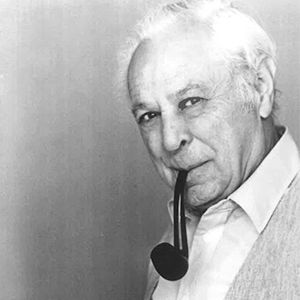
Harry Kemelman (1908-96) was for a time a professor of English at Boston-area colleges. However, he was best known as the author of the 12 Rabbi Small Mysteries published from 1964 to 1996.
Kemelman was born in 1908 in Boston. He earned a BA in English Literature from Boston University and an MA in English philology from Harvard. He worked stateside for the US Army during World War II. Around the time he published his first novel, he moved with his wife to Marblehead, a Boston-area suburb, with his wife. He lived there until his death at the age of 88.
For related reading
The following list includes other great books about Jewish themes: Worthy books about Jewish topics.
For another series of mystery novels grounded in the Jewish experience, see The Ritual Bath – Peter Decker and Rina Lazarus #1 (An unusually strong start to the Faye Kellerman series of detective novels)
You’ll find other great reading at:
- 10 top novels about private detectives
- Top 10 mystery and thriller series
- 20 excellent standalone mysteries and thrillers
- 30 outstanding detective series from around the world
- Top 20 suspenseful detective novels
And you can always find the most popular of my 2,400 reviews, and the most recent ones, on the Home Page.