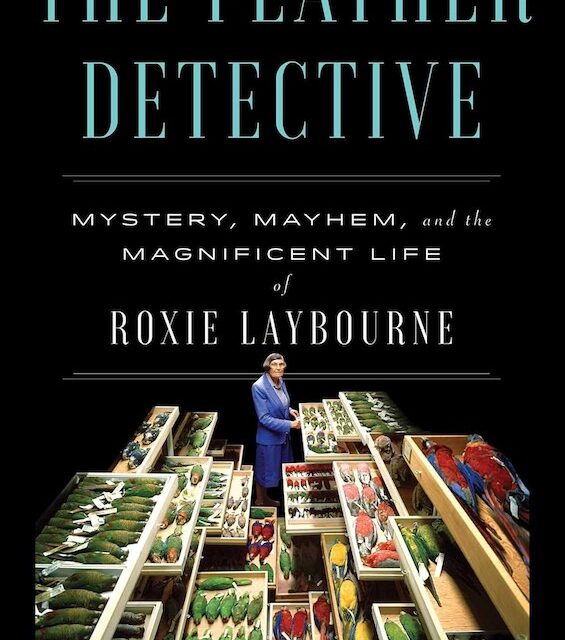
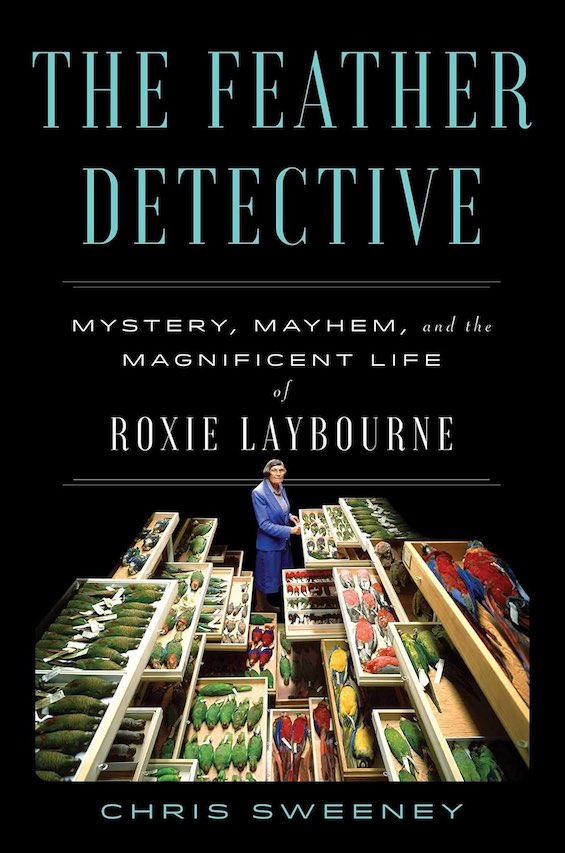
You’ve probably never heard her name before. But if you fly frequently she may have saved your life. Her name was Roxie Laybourne, and she was of all unlikely things the world’s first forensic ornithologist. In 1960, when Eastern Air Lines Flight 375 crashed on takeoff from Logan International Airport in Boston, remains of dead birds were discovered in two of the aircraft’s four jet engines. And investigators turned to Roxie at the Smithsonian Institution to identify the species involved and, crucially, how much the birds had weighed. It was her first task as a forensic scientist. But thousands of others followed in her long career in ornithology. And investigating bird strikes on airplanes was just one of several remarkable challenges she faced over the years. Journalist Chris Sweeney tells her astonishing story in The Feather Detective. And it’s endlessly fascinating.
A major contribution to airline safety
Roxie Laybourne (1910-2003) never earned a PhD. And for most of her time at the Smithsonian she was unpaid. But she was the world’s leading expert in her field for decades. Again and again, she proved capable of identifying bird remains by species even when all she had to study was the fragment of a feather. As Sweeney notes, “The New York Times would dub her ‘the Miss Marple of eiderdown.’” And her arcane ability often proved pivotal when investigating bird strikes for the US Air Force as well as commercial airlines. Her skills in forensic ornithology helped solve around 1,000 cases of bird-related airplane incidents a year.”
Those skills also equipped her to provide decisive testimony at murder trials for the FBI and other law enforcement agencies when feathers turned up among the evidence. Yet almost throughout her career at the Smithsonian Roxie was treated with disdain by colleagues and superiors alike. And it was not until the closing years of her long life that she received public recognition for her achievements.
The Feather Detective: Mystery, Mayhem, and the Magnificent Life of Roxie Laybourne by Chris Sweeney (2025) 320 pages ★★★★★
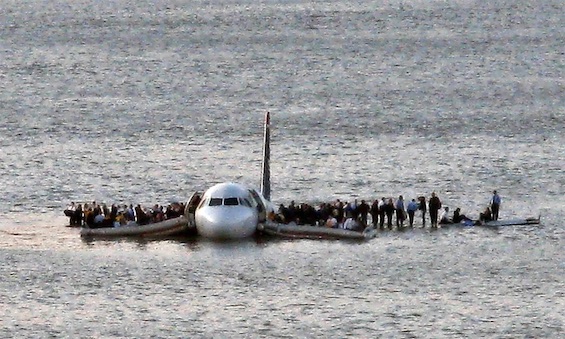
Bird strikes on airlines aren’t quite as rare as you might think
In just the four years “[b]etween 1983 and 1987,” Sweeney reports, “military aircraft collided with birds on at least sixteen thousand different occasions. Costs associated with damaged aircraft came in at nearly $320 million, and six crew members had died as a result of bird strikes during that time period.” And the National Wildlife Strike Database, the world’s largest publicly available dataset of airplane-wildlife strikes, counts nearly 300,000 such incidents. But don’t write off air travel as a result.
“In 2022,” Sweeney notes, “the FAA recorded 17,190 wildlife strikes, or 330 such incidents a week. That same year, though, the FAA managed 16.4 million flights, or 315,384 a week. In the grand scheme of modern air travel, bird strikes are rare and ones that cause airplanes to crash are exceedingly so.” But they would be far more common had it not been for Roxie Laybourne’s ability to estimate the weight of birds involved in crashes and provided the evidence needed to strengthen aircraft manufacturing standards.
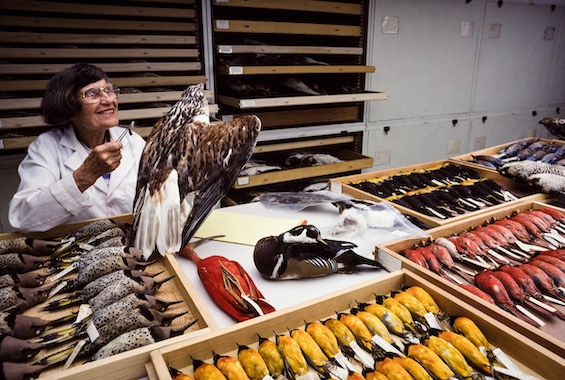
A “magnificent life”
Roxie Laybourne was born in Fayetteville, North Carolina, four years before the start of World War I. Throughout her life, she had a pronounced Southern drawl that sometimes disadvantaged her when dealing with the PhD scientists from elite Northern universities who dominated the field of ornithology. It was at times a challenge for her when testifying for the FBI, too. And she was largely self-taught.
Roxie was a graduate of Meredith College in Raleigh, North Carolina, and earned a master’s degree in plant ecology from George Washington University. Neither credential helped much. And she was a woman at a time when women were extremely rare both in the field of ornithology and at the Smithsonian. But she proved herself to be a meticulous scientific researcher with admirers throughout the world. And she mentored three younger scientists in her specialized field of feather identification. Today they serve as the leading experts in that specialized pursuit at the Smithsonian, the FBI, and the National Wildlife Research Center.
Despite her obsessive commitment to her work at the Smithsonian, Roxie married twice and gave birth to two sons, one from each husband. Both survive her.
A great reading experience
You might think that a book about such an obscure subject as The Feather Detective would be challenging to read, Not so. Sweeney writes very well, and he squeezes every ounce of drama out of his subject. If you read this book, you’re unlikely to forget Roxie Laybourne.
For additional details
If you want more information about this book, read the following summary prepared by the chatbot Claude-AI (Sonnet 4.5). It’s completely free of “hallucinations.”
The Feather Detective by Chris Sweeney tells the remarkable story of Roxie Laybourne, who became the world’s first forensic ornithologist. The biography chronicles how this overlooked pioneer transformed an unusual expertise in feather identification into a groundbreaking scientific field that would revolutionize aviation safety and criminal investigations.
Laybourne’s career began in 1960 when a commercial flight struck a flock of birds and crashed into Boston Harbor, killing sixty-two people. The bird remains were sent to the Smithsonian’s National Museum of Natural History, where Laybourne worked as a taxidermist. Using her microscope, she determined that the plane had ingested a flock of European Starlings, launching her extraordinary career in forensic ornithology.
No expeditions, no promotions
While male colleagues embarked on expeditions and received promotions, Roxie stayed with her birds, developing unparalleled expertise in identifying species from tiny feather fragments. Her work extended far beyond aviation. She helped prosecute murderers, kidnappers, and poachers, and assisted aerospace engineers and Air Force crews in bird-proofing airplanes. She even helped identify feathers used when white supremacists tarred and feathered a Civil Rights activist. One year, she analyzed evidence from forty-five different criminal cases.
Sweeney’s biography, drawn from archival material, court documents, and exclusive interviews portrays Laybourne as a complex figure who was once divorced, once widowed, and sometimes surly, yet who shattered stereotypes and pushed boundaries throughout her career. The narrative combines elements of courtroom drama and crime thriller while exploring the broader context of government-funded science and the Smithsonian’s inner workings.
An extraordinary career
The book highlights not only Laybourne’s scientific contributions to ornithology—from feather identification to migration patterns—but also the workplace sexism she endured and overcame. Her self-taught skills and dedication created an entirely new field of expertise, making lasting contributions to both aviation safety and criminal justice while inspiring future generations of scientists.
About the author

The Feather Detective is the second of Chris Sweeney‘s two nonfiction books to date. He is a journalist whose reporting has appeared in a number of prominent American magazines. He has also worked as a senior editor at Boston Magazine and has taught at Tufts University, Regis College, and Western Connecticut State University. A graduate of the University of Massachusetts, Amherst, and Northwestern University’s Medill School, Sweeney now lives in Somerville, Massachusetts, with his wife and two young daughters.
For related reading
For a detailed obituary of Roxie Laybourne published by the Smithsonian, click here.
Roxie Laybourne often served as an expert witness at trial. For other great books about similar scenes, see Great courtroom dramas.
You’ll find other great reading at:
- Top 10 mystery and thriller series
- 20 excellent standalone mysteries and thriller
- Top 20 suspenseful detective novels
- Top 10 historical mysteries and thrillers
And you can always find the most popular of my 2,400 reviews, and the most recent ones, on the Home Page.