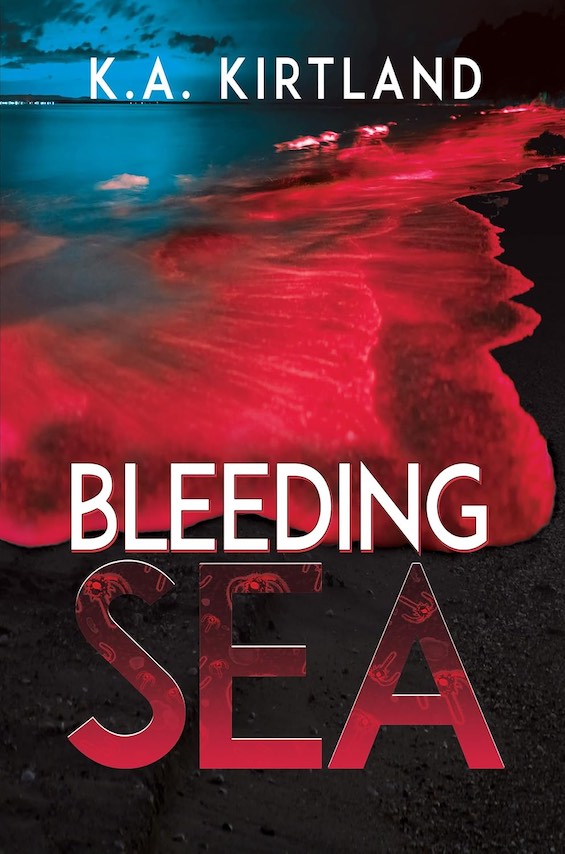
If you’re the sort of person who worries a lot, as I am, there’s no end of fodder today for your troubled brain. Climate change. The threat of nuclear war. A new pandemic. The end of democracy. And so many other grim possibilities. But, chances are, you’re not worried about toxic algae. And you may not have a clue what it is. I certainly had none. But as epidemiologist K. A. Kirtland shows in her heart-stopping environmental thriller, Bleeding Sea, the threat is there. And, unchecked, it might lead to the death of the sea. Which would pose as great an existential threat to human life as any nuclear war.
The Gulf of Mexico is turning red
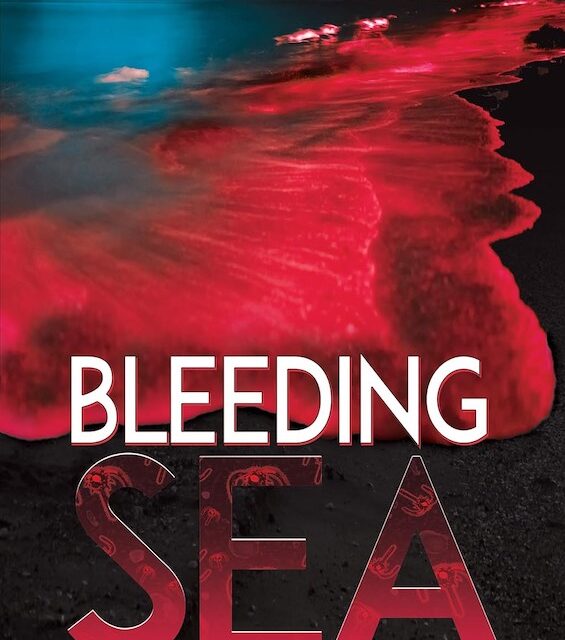
Bleeding Sea opens in Pensacola, Florida. An older man known as Bo and a young boy named Henry are fishing on the coast. An aerial view of the Gulf that lies before them shows “the shoreline covered in bright red slime with sprawling slivers of crimson-colored algae that looked like gnarled, bloody fingers pointing toward the sea.” And a fish Henry hauls out on his hook “had a couple of faint pinkish-red spots and a small bloodred gash.” Worse, one of two boys fishing near them on the beach is in bad shape, too. His “arms were swollen with red blotches, [and he] looked up, his eyes watery, and choked out, “I can’t breathe.”
Bleeding Sea by K. A. Kirtland (2024) 323 pages ★★★★★
A threat of global proportions
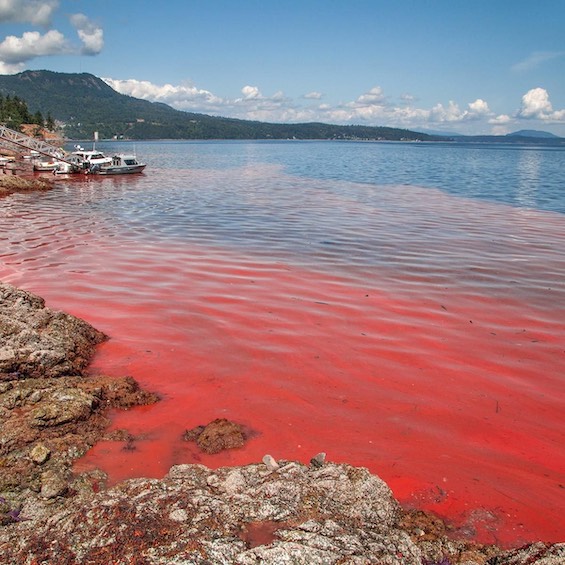
The story abruptly shifts from Bo and Henry to the boy’s sister, Dr. Diane Nelson. She’s a post-doc in marine biology who’s going to work for the Ocean Science and Climatology Foundation, or OSCF (pronounced oh-sif). It’s located in Fort Lauderdale, nearly 700 miles by car to the south and east on the Atlantic Coast. Diane is arriving there at a critical time. Because she’s an expert in dinoglagellates, one-celled aquatic organisms which can reproduce rapidly to form red tides that discolor the water and may poison fish and other animals.
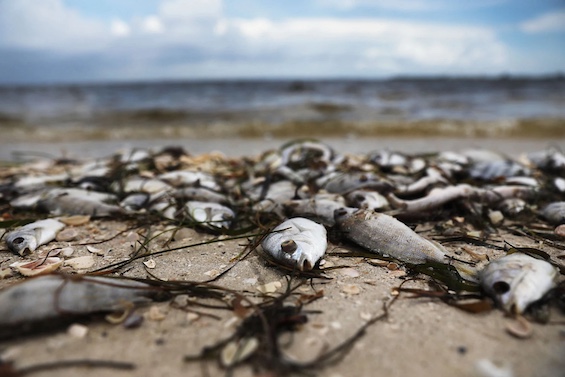
In fact, that’s exactly what’s happening off the coast of Florida, as even animals as large as manatees are floating dead on the Gulf. Reports have even surfaced in the news that “toxins in the water system are causing paralysis of the respiratory system. There have been fatalities.” And “over the past few weeks, the bloom had spread into the Atlantic. The number of floating carcasses was doubling each day.” It’s a threat of global proportions.
Two mysteries to solve
The story unfolds in Bleeding Sea as Diane takes her place at OCSF. Apart from members of her family and Diane herself, the tale centers around the founders of OCSF, Dr. Shaun Jenson and Dr. Susan Landry, and Diane’s colleagues there, chiefly a young computer wizard named Brandon, with whom she will fall in love. But there’s something amiss at the foundation. Diane’s predecessor as a postdoc there, a brilliant chemist named Matthew Toft, had been fired recently. And soon after she arrives he bursts into the lab and begins shooting wildly, destroying his workspace and all that he had been working on. So Diane is now faced with two mysteries to solve: what caused Matt to go berserk, and what is the source of the mutated dinoflagellate that is releasing such abnormally high levels of toxins?
The two mysteries will, of course, converge. But long before Diane manages to connect the dots, she will face one threat to her life after another. The suspense will build . . . and as the story approaches its end, there will be surprises. As thrillers go, Bleeding Sea is a shocker.
Toxic red algae blooms are increasingly common
For a tutorial on the subject underlying this novel, I turned to the website Columbia Riverkeeper. Here’s what it tells us: “Algae are simple, photosynthetic organisms that play an important role in the food web in freshwater systems. Algal blooms are overgrowths of algae or algae-like bacteria in the water. They can be green, red, pink, blue, or brown and can be scummy or slick “spilled paint” looking and may or may not produce a musty, foul, or “rotten-egg” smell. Harmful algal blooms (HABs) are algal blooms that produce dangerous toxins. Not all algal blooms are toxic, but even non-toxic blooms can be problematic. HABs can occur in freshwater, brackish, and saltwater. You may have heard of HABs called red tides, blue-green algae, or cyanobacteria.”
These toxic algal blooms “can produce extremely dangerous toxins that can sicken or even kill people and animals. . . The most common health effects come from drinking contaminated water or ingesting it while swimming or recreating. HABs can also cause problems for drinking water treatment systems.” And if the toxins released in the process can harm or even kill people, think what they can do to marine life. And just imagine what might happen if one such toxic bloom spins totally out of control and spreads far across the oceans.
About the author
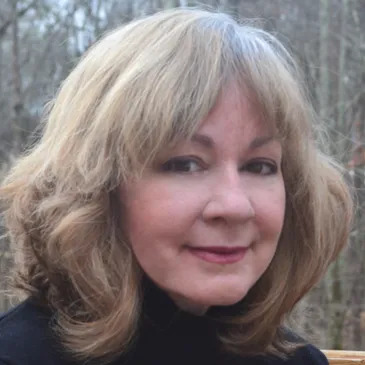
K. A. Kirtland‘s bio blurb on Amazon reads in part as follows: “K.A. Kirtland is the debut author of Bleeding Sea, an environmental thriller that won the Gold Medal in the 2025 Readers’ Favorite International Book Contest. The story was inspired by research expeditions she participated in across the Gulf of Mexico and the Weddell Sea in the Antarctic.
“Kirtland’s graduate studies focused on the intricate balance of ecosystems, which heavily influenced the novel’s gripping narrative about a toxic dinoflagellate bloom. She is a public health professional and epidemiologist based in Atlanta, Georgia, where she continues to advocate for environmental sustainability.”
For related reading
For more good reading, check out:
- The ultimate guide to the all-time best science fiction novels
- The top science fiction novels
- The top 10 dystopian novels
- 10 new science fiction authors worth reading now
- The best techno-thrillers
And you can always find the most popular of my 2,400 reviews, and the most recent ones, on the Home Page.