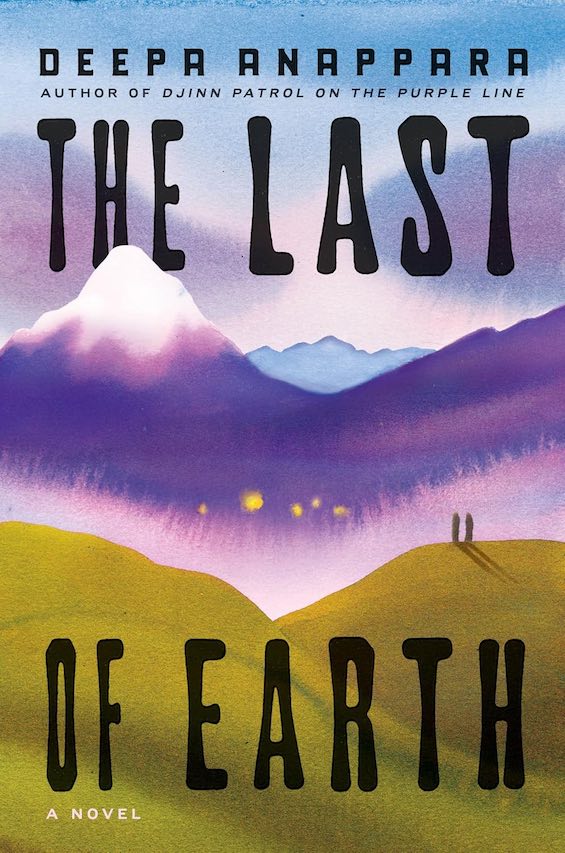
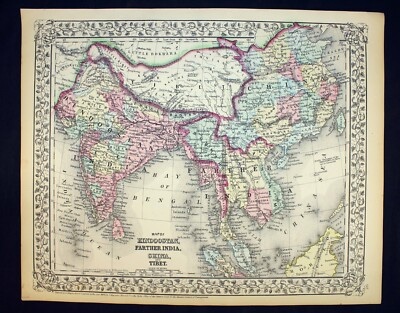
Explorers today plumb the oceans’ trenches and the vast reaches of solar space. For the truly adventurous who seek to cross humanity’s last frontiers, few if any big challenges remain on land. But a century and a half ago, the opportunities for Western explorers to make their mark were still abundant. On polar ice. In the profound depths of the African heartland and the Amazon basin. And in that enormous white space on maps and globes that represented the forbidden kingdom of Tibet. It was closed to non-Asians because Tibetans “didn’t want the British or Russians preaching Christianity, or annexing their country and calling it a colony.” And that’s where we’ll travel in 1869 in The Last of Earth, the captivating second novel by the award-winning Anglo-Indian journalist and novelist, Deepa Anappara.
Two souls on secret missions in forbidden territory
Anappara’s story revolves around an unlikely pair. A young Indian man enlisted as a spy for the British in Tibet. And a half-caste Anglo-Indian woman in middle age who is unnerved by the recent death of her younger sister back home in England.
- “Balram had never been on a surveying mission to Tibet with a white man.” In the past, he and his friend Gyan had always ventured into Tibet as surveyors on behalf of the British, counting their steps and sketching out the contours of the land. But on their last trek they had separated. And Gyan had been arrested as a spy. Now he was reportedly a slave in a monastery. So Balram had agreed to accompany the captain on a perilous mission in hopes of breaking away to rescue his friend.
- “A month after her fiftieth birthday, Katherine Westcott walked on a mountain track that was as narrow as the snake king coiled around Lord Shiva’s blue-tinted throat.” Dressed in a Tibetan robe, shielded by the brown skin that was her birth mother’s gift, and aided by an Indian boy named Mani who passed as her son, she had breached the Tibetan border in hopes of becoming the first Western woman to reach Lhasa. And she would write a book about the experience, gaining the attention of the Royal Geographical Society. In the process, she would redeem herself for her failure to attend her dying sister in her last moments of life.
The Last of Earth by Deepa Anappara (2026) 334 pages ★★★★☆
Historical fiction that engages from first to last
Katherine struggles with guilt about failing her sister. And Balram fights the knowledge that he loves both his wife and Gyan in equal measure. These two lost souls slowly make their way deeply into Tibet on separate but intersecting paths. Both face the prospect of death from bandits, sickness, the altitude, and the threat that Tibetan troops will capture and even kill them. But nothing will stop them from the tasks that obsess them, freeing Gyan and reaching Lhasa. Will they succeed? It’s a long, long time before we know the answer.
The Last of Earth is a story of adventure at the top of the world, endlessly eventful and suffused with an intimate knowledge of the land and its history. It’s a thriller of a sort, historical fiction that engages from beginning to end.
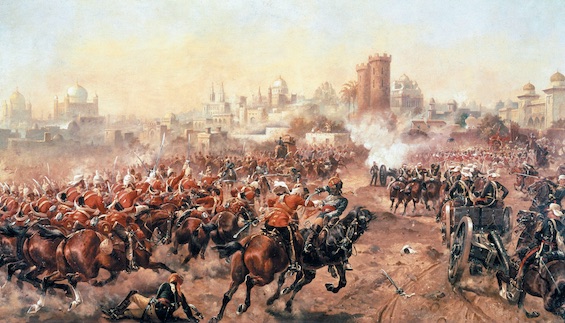
The historical context
The events in this novel unfold in the 1860s, the time of civil war and reconstruction in the United States. But South and Central Asia were equally tumultuous then. The Great Game was underway, as the British and Russian Empires jockeyed for supremacy in Central Asia. Much of the action in this military and diplomatic tug-of-war took place in Persia and Afghanistan. But Tibet, too, was in contention. The captain who leads Balram’s expedition fears Russian interference. And his fear is well-founded. Russian explorers had penetrated the ill-defined norther border, as had the British to the south and west. Only the kingdom’s determined effort to exclude foreigners kept them from advancing far into Tibet’s interior. The punishment for non-Asians to breach the border was death.
Events in India
But international rivalry was only one dimension of the conflicts portrayed in the novel. The Sepoy Mutiny in 1857 had brought seething discontent with British rule to the surface in India. Indian troops (sepoys) in the service of the British East India Company had rebelled, but the revolt spread. Within India today it’s called the Indian Rebellion of 1857, or the First War of Independence. A decade later the anti-British sentiments the rebellion stirred up were clearly evident among the bearers Balram commands on the captain’s behalf. And they’re brought to the fore in the person of a mysterious Indian man who is following both expeditions.
Events in China
Now, you might wonder what the Chinese were doing about Tibet in that era. And the answer appears to be, not much. Today’s regime might pretend otherwise, but that’s propaganda. The Qing Empire was then dying, the victim of the Opium Wars of the 1840s and 50s and the devastating Taiping Rebellion (1850-64). It would gasp its last less than half a century later when Dr. Sun Yat-sen established the Republic of China in 1911.
About the author

According to Google Books, “Deepa Anappara ‘s debut novel, Djinn Patrol on the Purple Line, was named as one of the best books of the year by the New York Times, Washington Post, Time, Guardian and NPR. It won the Edgar Award for Best Novel, was longlisted for the Women’s Prize for Fiction, and shortlisted for the JCB Prize for Indian literature. It has been translated into over twenty languages. Anappara is the co-editor of Letters to a Writer of Color, a collection of personal essays on fiction, race, and culture.” The Last of Earth is her second novel.
The author’s website adds, “Anappara was born in Kerala, southern India, and worked as a journalist in India for eleven years. Her reports on the impact of poverty and religious violence on the education of children won the Developing Asia Journalism Awards, the Every Human has Rights Media Awards, and the Sanskriti-Prabha Dutt Fellowship in Journalism.”
A website for the University of London states that “Dr. Deepa Anappara, Lecturer in Creative Writing, is an academic at the School of Communication and Creativity of City University of London. She has an MA in Creative Writing (Prose Fiction) and a PhD in Creative-Critical Writing from the University of East Anglia, Norwich.”
For related reading
I’ve reviewed the first of the author’s novels, Djinn Patrol on the Purple Line (A deeply affecting tale of child trafficking in India today).
’ve also reviewed a number of other books about India. You’ll find them in Good books about India, past and present. You might also care to scan The best Indian detective novels.
For other great reading, see: 25 most enlightening historical novels and Top 10 historical mysteries and thrillers.
And you can always find the most popular of my 2,400 reviews, and the most recent ones, on the Home Page.