
Once upon a time, not so long ago, really—it was 1999—there was a group of three exceedingly smart men whom Time Magazine called The Committee to Save the World. In fact, these three men— Alan Greenspan, Larry Summers, and Robert Rubin—seemed to think they were the smartest people in the whole wide world. Together, they had put in place the economic policies of the Clinton Administration. And, boy, did things look rosy then, back in 1999. There was a huge federal budget surplus, and the Dow Jones averages were heading for Neptune!
Oops! Something went wrong. Catastrophically wrong.
So, a decade later seemed to be a good time to reassess those three men in light of the economic events of 2008, 9, and 10. The result, of course, was that they didn’t look so smart anymore. But, guess what? Larry Summers had yet to exit the Obama White House. He’d been the driving force behind the Administration’s economic policymaking. And Robert Rubin was reported to be on the short list to replace him!
Of the three men, only Alan Greenspan, finally retired in 2006 as head of the Federal Reserve Bank after three decades and four Presidents, had actually apologized after a fashion. For years, he had persisted in his stubborn refusal to face economic facts. Facts that were obvious at the time to anyone well versed in finance who wasn’t blinded by greed, willful incompetence, stupidity, or right-wing ideology. The other two men? Well, we haven’t heard so much as a hint of an admission of responsibility from Summers even three decades later. And only a generalized expression of “regret” from Rubin.
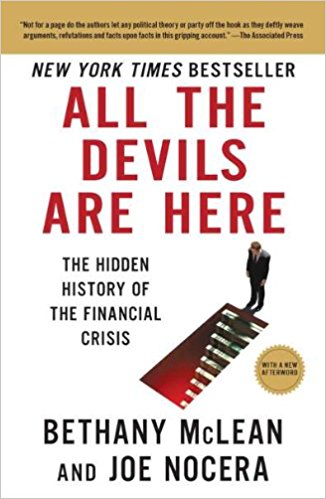
All the Devils Are Here: The Hidden History of the Financial Crisis by Bethany McLean and Joe Nocera (2011) 557 pages ★★★★★

So, why did it happen?
So, what did “The Committee to Save the World” do to lay the foundations for the 2008 financial crisis? As best I can tell, collectively they made three fateful errors:
- They engineered the repeal of consumer protections put in place during the Great Depression (the Glass-Steagall Act).
- They routinely deferred to Wall Street when shaping economic policy, paying special attention to the effect of their actions on the bond market. (That’s where the really big money is to be found.)
- They stubbornly refused to recognize the dangers in the alarming growth of the unregulated “derivatives” market. (If you don’t understand what a derivative is, don’t sweat it. Nobody else does, either, not really.)
Not so incidentally, these same three geniuses were also instrumental in fashioning “The Washington Consensus” that guided the work of the International Monetary Fund and the World Bank. It was this constellation of restrictive policies that caused tens of millions of people to starve in dozens of developing nations for years afterward. But back to Topic A: the financial crisis.
Blame falls on “The Committee to Save the World”—among others
We’ve identified three of the principal culprits. But, in fairness to Greenspan, Summers, and Rubin, there were many other characters who played leading roles in the tragedy. Some of their actions merely reflected changes set in motion years before. And nobody in any government position, including the Oval Office, calls all the shots. But the buck stops . . . somewhere. When it comes to the public policy that foreshadowed the financial crisis, the committee that “saved” the world bears a lot of the blame.
Now about those other leading characters in this modern immorality play. Chief among them were a mixed bag of people both in and out of government. And if your memory of such things runs to the years when George W. Bush and Barack Obama were in the White House, you’ll recall that there was loud and persistent agitation for the government to prosecute many of these people. Millions (including me) strongly believed that a passel of financial executives deserved long prison sentences for their roles in the crisis.
Senior financial executives
On Wall Street, there were dozens of senior executives at such financial powerhouses as Goldman Sachs, Merrill Lynch, Lehman Brothers, Bear Stearns, AIG, Citibank, and many others whose shared delusion that money is life’s greatest good helped set the course for economic ruin. Some of these men (and a very few women) were brilliant and found ways to make lots of money even when conditions were really, really bad.
Others were—well, not to put too fine an edge on things—downright stupid. Their firms (principally, Bear Stearns, Lehman, AIG, and Merrill Lynch) either disappeared entirely in a whirlwind of worthless paper or took refuge under someone else’s wing. By contrast, the champion money-maker, Goldman Sachs, racked up billions in profits by victimizing some of its biggest clients. Being Goldman Sachs, of course, none of its partners faced criminal charges, as they clearly would have done in a marketplace guided by reason and fairness.
Non-bank co-conspirators
On Main Street, there were also dozens of co-conspirators. For the most part, these were the people who ran the “non-bank financial companies” like Countrywide and other firms that sold mortgages to people who couldn’t possibly afford them. Some were outright crooks running fly-by-night operations, many of them classic bucket-shops, others simply self-deluding or (again that word) stupid. Most of them got filthy rich, though, at least for a time. Dozens should have gone to jail, but did they? What do you think?
Fannie Mae and Freddie Mac
Back in our nation’s capital, two institutions unfamiliar to most of the American public found themselves in the middle of the maelstrom: the two quasi-private mortgage repositories, Fannie Mae and Freddie Mac. Don’t feel sorry for them, though, because, to cop a phrase from an earlier practitioner of misdirection, “mistakes were made.” The leadership of both institutions grabbed at opportunities to make a quick buck. They succeeded, for a time, but only until the profits disappeared—and we taxpayers paid the bill to the tune of hundreds of billions of dollars.
George W. Bush
Don’t forget George W. Bush. The decider-in-chief may not have played a meaningful role in economic decision-making (if only because it’s highly doubtful he had a clue about what was going on). But, dazzled by the argument that the “free market” would regulate the financial sector all by itself, Bush II deliberately appointed to key regulatory positions such world-class ignoramuses as Christopher Cox to head the Securities and Exchange Commission. It wasn’t enough that the regulatory agencies’ teeth had dulled considerably over the years and that the powers-that-were in the Clinton Administration had refused to sharpen them. No, George W. Bush insisted on appointing financial regulators whose stated intention was not to do their jobs.
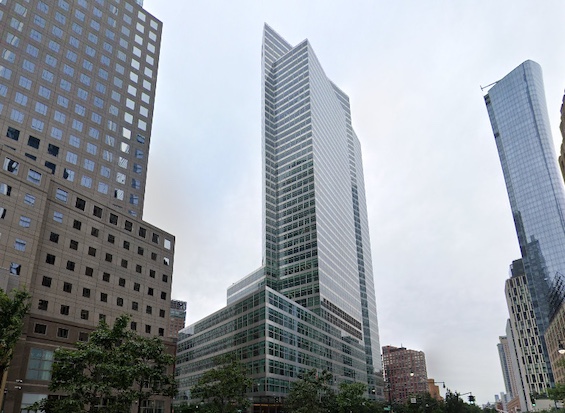
This book untangles the complexities of the financial crisis
So, what does all this bloviating have to do with All the Devils Are Here? This is, after all, (ostensibly) a book review. It’s simple, really: Bethany McLean and Joe Nocera’s superb book brought into high relief the roots of the financial crisis like no other book I’ve read and made it possible for me to untangle in my mind the complex interrelationships among Wall Street, Main Street, the Fed, and the Treasury Department.
In previous months, I’d read:
- Too Big to Fail: The Inside Story of How Wall Street and Washington Fought to Save the Financial System–and Themselves by Andrew Ross Sorkin
- The Big Short: Inside the Doomsday Machine by Michael Lewis
- The Devil’s Casino: Friendship, Betrayal, and the High Stakes Games Played Inside Lehman Brothers by Vicky Ward
Among others, all of them excellent books. But McLean and Nocera’s treatment of the crisis from a long-term perspective, with its roots in the evolution of housing policy as well as greed and excess on Wall Street, put the whole question into perspective. If you’re looking for the best way to begin understanding the financial meltdown of 2007-2008 that came close to tanking the global economy, start with All the Devils Are Here.
About the authors

Bethany McLean is an American financial journalist and contributing editor for Vanity Fair magazine. Her coverage of the Enron scandal and the 2008 financial crisis won widespread praise. Before joining Vanity Fair, she was an investment banking analyst for Goldman Sachs. McLean was born in 1970 in Minnesota and educated at Williams College. She is the author or coauthor of five books.
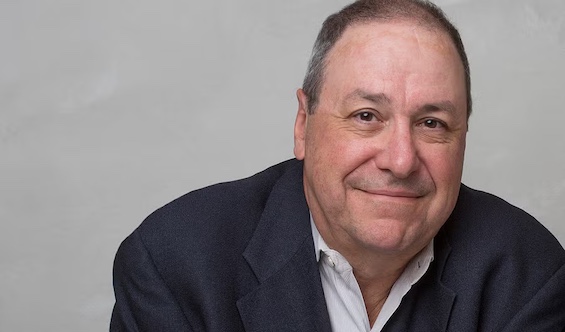
Joe Nocera is the author of five business books, three of them coauthored. He has also written a column for The New York Times since 2005. Nocera was born in Rhode Island in 1952 and earned a BS degree in Journalism from Boston University.
For related reading
This is one of 7 insightful books that explain what caused the Great Recession.
This is one of My 10 favorite books about business history.
If you enjoy reading nonfiction in general, you might also enjoy:
- Science explained in 10 excellent popular books
- 12 great biographies
- Top 10 nonfiction books about politics
And you can always find my most popular reviews, and the most recent ones, on the Home Page.













At the end of 2007, I really saw this coming: (see my blog posting in January 2008: http://andykoenigsberg.blogspot.com/2008/01/meltdown.html)
Why? – I had witnessed and had been a victim of) the last real estate driven financial bubble in the late ’80’s. I got a mortgage on a condo (that the Citigroup loan originator told me I barely qualified for) in 1987. My condo was worth half its value a year later and it did not recover its original market price until 2001, the beginning of the next real estate bubble, at which time I sold it and paid staggering capital gains taxes because I had rented it out all that time and had depreciated it.
My gut feeling is that we have not done enough to prevent this from happening again – the foxes still rule the hen house.
Thanks, Andy. My experience was different, but I felt queasy, too. In fact, I left a financial advisor because he refused to believe my pessimism was warranted.