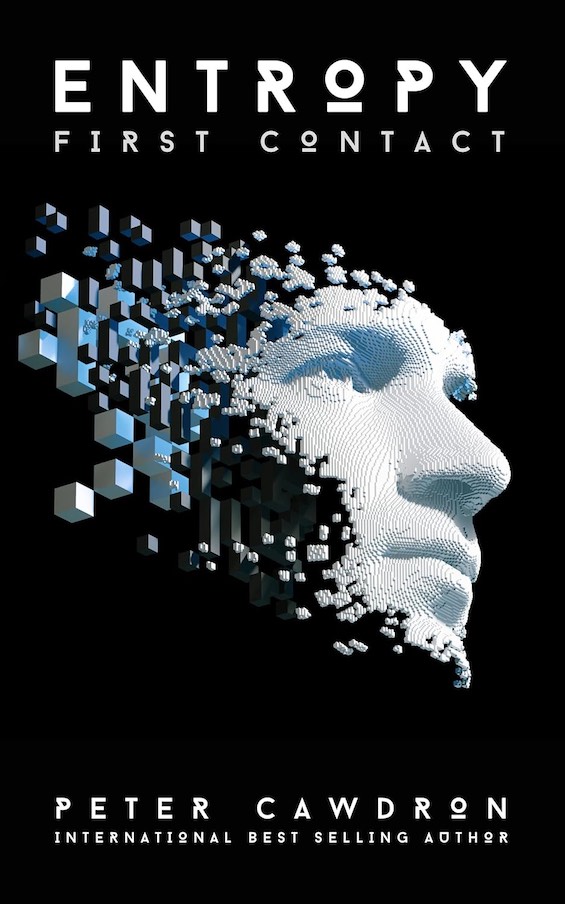
What can I say about a book that could have been great but isn’t? In Entropy, the 31st entry in his long-running series of standalone novels about First Contact with alien intelligence, Australian author Peter Cawdron tells a gripping story about the crash of a private jet deep in the Amazon rainforest and a rescue operation sent to recover the remains. Then, just as two survivors of the crash are about to begin First Contact with one of the more than 100 “uncontacted” tribes in the Amazon, Cawdron turns tail and launches into a fantasy involving highly advanced interstellar visitors. And he does so merely to subject readers to long lectures about the foibles of the human race. It’s profoundly disappointing. I know how screwed up we are. I don’t need to be reminded of it again.
Philosophical discussion mars this disappointing novel
Truth to tell, Cawdron has a long history of interjecting unbelievably articulate philosophical discussions into otherwise straightforward science fiction tales. I’ve tolerated it before because I loved the action and character development in previous books in the series. And Cawdron writes well. This time, however, I felt cheated that he dodged the opportunity to apply the logic of First Contact to that between wealthy and educated Americans and the hunter-gatherer tribespeople of the rainforest. Well told, that story could have been outstanding. Too bad.
In fairness, Cawdron does confront criticism of this sort. In an afterword explaining the sources of the facts he cites in the novel, he writes, “One common complaint about my novels is that they come across as preachy. And I get it. Readers are looking for an escape, not a sermon. The problem is… what would an intelligent extraterrestrial species make of the clusterfuck that is Homo sapiens’ recent dominance of Earth?” Fair enough. But that rejoinder comes across as lame to me in this context. Because he could have told a brilliant story here without introducing any extraterrestrials.
Entropy (First Contact #31) by Peter Cawdron (2026) 324 pages ★★★☆☆
The story in a nutshell
A “multi-centi-billionaire” named John Teitel is flying on a private jet from the European Space Agency base in French Guiana to Lima, Peru. (He has an estimated net worth of more than $600 billion, which is somewhat less than Elon Musk’s fortune of $833 billion that Fortune estimates as I write.) Teitel is accompanied by his young trophy wife and 17-year-old daughter, Jillian. Also on an the luxurious Gulfstream G800 are pilot Mick Anders, the copilot, and a flight attendant. A massive storm causes the aircraft to plummet into the Vale do Javari in the western reaches of the Amazon rainforest, near the borders of Brazil, Peru, and Colombia. Only Mick and Jillian survive the crash. But as they walk away from the wreckage a young local warrior named Anuk captures them and forces them to walk to his village.
It turns out, however, that the elders of the village are furious with Anuk for bringing outsiders into their community. While the two Americans are confined to the village hall, the elders subject Anuk to a tongue-lashing. But he is defiant. Because Anuk has a plan. He wants to use Mick and Jillian as bait to draw out into the open the white-skinned “ghost” the elders believe is a god. And that ghost—of course!—is extraterrestrial.
More intruders enter the tale
Meanwhile, outsiders including Teitel’s family and business associates as well as the United States government are moving quickly to send a rescue mission. The team dispatched to the Amazon includes an intrepid investigative reporter named Lisa Mendes who is an expert on the rainforest and a team of Army Rangers led by Major James McCallum. Naturally, Lisa’s lover is none other than Mick Anders. She’s earning $100,000 to join the rescue effort, but Mick is more important to her. So, of course—of course!—the two will reconnect in the forest. And all will work out in the end . . . after their fateful encounter with extraterrestrials. Need I say more?
Setting the context
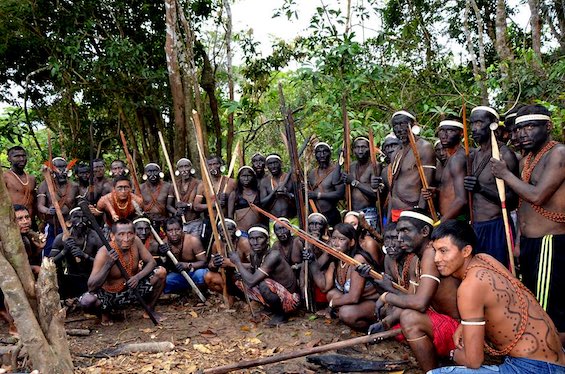
The nonprofit Survival International explains the logic of the “uncontacted” tribes’ refusal to allow outsiders to visit them. “Very little is known about these peoples. What we do know is that they wish to remain uncontacted: they have shot arrows at outsiders and airplanes, or they simply avoid contact by hiding deep in the forest. . . Their decision not to maintain contact with other Indigenous peoples and outsiders is almost certainly a result of previous disastrous encounters and the ongoing invasion and destruction of their forest home.” And years of headlines about violence inflicted by loggers and ranchers in Brazil makes clear exactly why the tribes behave as they do.
According to scholar Alexander Hinton’s 2002 book, Annihilating Difference: The Anthropology of Genocide, “Over eighty indigenous tribes were destroyed between 1900 and 1957, and the overall indigenous population declined by over eighty percent, from over one million to around two hundred thousand.” And the history of violence against native populations in the rainforest goes back hundreds of years to the arrival of Europeans in South America. Uncounted millions more died then. Disease was the major cause. But deliberate violence has always been part of the picture. Both the Portuguese and the Spanish were notorious for the genocide they inflicted on native peoples in the name of religion.
About the author

As Amazon tells us (in the author’s words), Peter Cawdron is a New Zealand-born Australian “science fiction writer specializing in making hard science fiction easy to understand and thoroughly enjoyable. His First Contact series is topical rather than character-based, meaning each book stands alone. These novels can be read in any order. But they all focus on the same topic of First Contact with extraterrestrial lifeforms.
“Hard science fiction is a misnomer as far as categories of literature go, as it sounds harsh and difficult to understand, but that is far from reality. Hard science fiction is simply plausible science fiction, fiction that is written in such a way that it conforms to the known laws of science, and that makes it more interesting, as there’s no magic wand the protagonist can wave to get out of trouble.”
Cawdron has lived in Queensland, Australia, for many years.
For related reading
This is one of the books in Peter Cawdron’s insightful First Contact book series.
For more good reading, check out:
- The top 10 dystopian novels
- These novels won both Hugo and Nebula Awards
- The ultimate guide to the all-time best science fiction novels
- The top science fiction novels
- 10 new science fiction authors worth reading now
And you can always find the most popular of my 2,400 reviews, and the most recent ones, on the Home Page.