
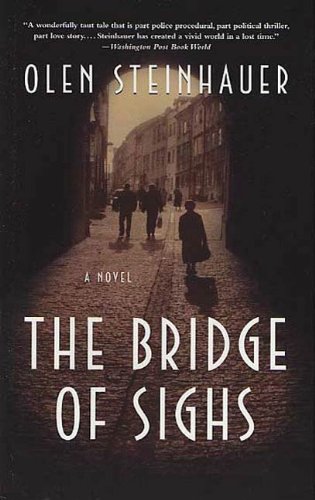
It has been three years since the Second World War ended, leaving his country still in ruins. But the people languish under the rule of a one-party Communist government headed by Comrade Mihai. The despised Germans and their sympathizers have been driven out or executed, but their legacy taints daily life at all levels of society in post-war Europe. And the country’s new rulers mimic some of the Nazis’ worst tendencies.
Just 22 and fresh out of the police academy, Emil Brod reports for duty to the homicide department in The Capital. There, unaccountably, he is thrown, unaided, into investigating the murder of one of the country’s leading citizens. Treated to hostility by his fellow officers, Brod stumbles headlong into the murky circumstances surrounding the murder.
An earnest young detective faces official disapproval
Soon, he finds himself in the arms of the murdered man’s wife. She helps point him to a connection with a celebrated war hero rumored to be a candidate for the Politburo and a possible successor to Comrade Mihai. The Bridge of Sighs tells the tale of Brod’s persistence on this case in the face of official disapproval and several attempts on his life.
The Bridge of Sighs (Yalta Boulevard #1) by Olen Steinhauer (2010) 288 pages ★★★★☆
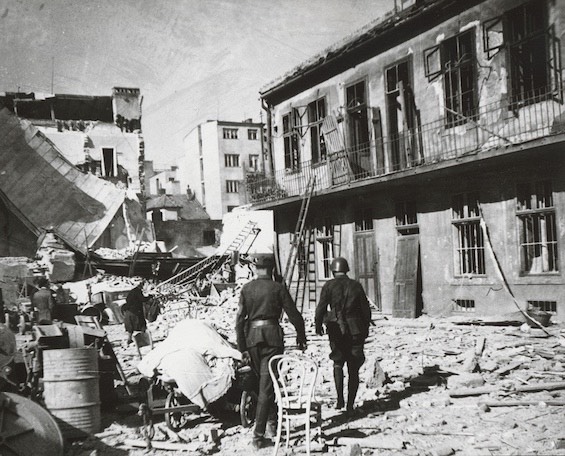
The first of five novels in a brilliant historical mystery series
This deeply satisfying novel joins complex characters with a credible story in a well-researched setting. The book was nominated for five literary awards, and it’s not difficult to see why. Published in 2003, with the action taking place in 1948, The Bridge of Sighs was the first in a five-novel series set in a fictional Central European country most closely resembling Slovakia.
The Bridge of Sighs was followed in successive years by The Confession (set in 1956), 36 Yalta Boulevard (1966), Liberation Movements (1968 & 1975), and Victory Square (1989). The series thus spans the duration of Communist rule in Central and Eastern Europe.
Immediately after finishing his Central European saga, Steinhauer wrote an espionage trilogy featuring Milo Weaver in 2009-12: The Tourist, The Nearest Exit, and An American Spy.
About the author
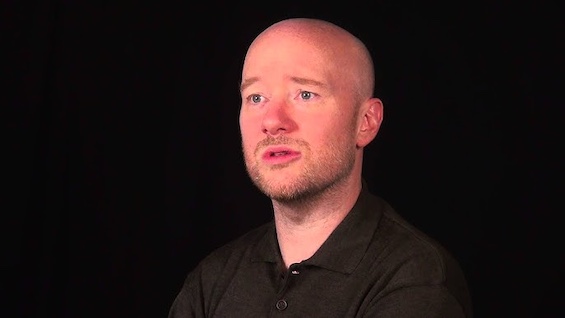
Olen Steinhauer has written the four novels of the Milo Weaver series of espionage novels as well as the Yalta Boulevard cycle and three standalone spy novels. Steinhauer also created the TV series Berlin Station, He was born in 1970 in Baltimore and attended university at Lock Haven University of Pennsylvania, and the University of Texas, Austin. He received an MFA in creative writing at Emerson College in Boston.
For related reading
I’ve also reviewed the author’s spy novels, The Cairo Affair (A complex spy novel worthy of John Le Carre) and All the Old Knives (A terrorist hijacking, the CIA, and two former lovers at dinner).
This is one of The 8 best historical mystery series.
I’ve reviewed all five novels in this series at Olen Steinhauer’s brilliant Yalta Boulevard cycle set in Eastern Europe.
You might also enjoy my posts:
- Top 20 suspenseful detective novels
- Top 10 historical mysteries and thrillers
- The six best police procedurals
And you can always find the most popular of my 2,400 reviews, and the most recent ones, on the Home Page.









I recently read two of his books: Liberation Movements in the same series as this and The Tourist about a US spy. Both were really good although pretty dark
china