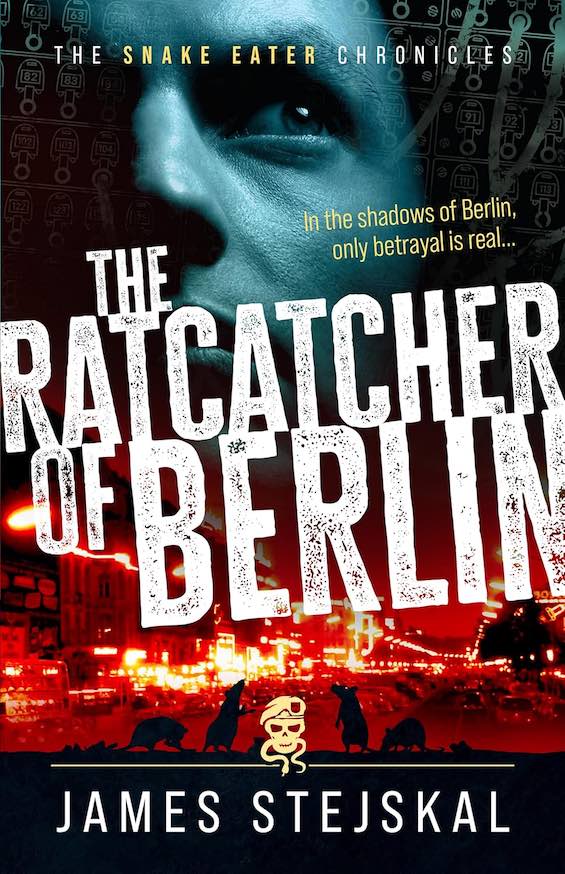
Veterans of intelligence agencies and the special forces crowd the ranks of spy novelists. Some have rightfully been hailed as masters of the craft—John le Carré, for example. Or, more recently, David McCloskey. Others have written worthy and suspenseful novels that illuminate the world of espionage over the past century. They all give us a sense of what it’s like to operate secretly overseas in hostile territory. But they’re not all accomplished novelists. Take James Stejskal, for example. In the fifth of his standalone spy novels in the Snake Eaters Chronicles, The Ratcatcher of Berlin, he successfully conveys what it’s like to operate secretly behind enemy lines but stumbles as a novelist.
A complex story that’s difficult to follow
James Stejskal clearly knows his subject. His experience in Cold War Europe as both a Special Forces operator and an officer of the CIA gives him (and us) a window on the reality of secret operations that few can offer. But I found the story a challenge to follow. It’s peopled by US Army officers, almost all of whom are colonels, and several play important roles. There’s a major, too, but no junior officer to help the reader keep them all straight. And the action revolves around a mutually distrustful collaborative effort between the US Special Forces and the CIA. On many occasions, I couldn’t figure out which of the two organizations was involved. And all those colonels kept getting in the way.
The Ratcatcher of Berlin (Snake Eater Chronicles #5) by James Stejskal (2025) 364 pages ★★★☆☆
A quick summary and assessment of the novel
I can’t resist the temptation to reproduce verbatim a summary of The Ratcatcher of Berlin by Claude-AI (Version Opus 4.6). It’s right on target in every respect. And it’s so much clearer than the story was to me as I read the book. I’ve only added subheads to break up the text.
Set in Berlin in 1957, the novel unfolds in a city split in two and teetering on the edge of conflict, where Soviet and Allied forces glare at each other across barbed wire and crumbling streets while spies, traitors, and assassins move unseen in the murky half-light.
The murder of a US official sets off the action
When a brutal murder threatens to ignite an international crisis, an uneasy alliance is forged: a hardened CIA officer and a Special Forces operative, each carrying his own secrets, must track the killer through the deadliest streets in Europe—those of communist East Berlin. In a world where trust is a commodity and betrayal is currency, the hunt forces them into a high-stakes game of deception where every move could be their last.
Stejskal, a former Special Forces and CIA veteran, brings formidable authenticity to his storytelling. His Berlin is a city perpetually on the edge, where the threat of an international flashpoint is never more than a heartbeat away. The novel is rich with operational detail—dead drops, coded messages, and the intricate choreography of surveillance and counter-surveillance—while also exploring the psychological toll that espionage takes on its practitioners.
A haunting picture of bombed-out Berlin
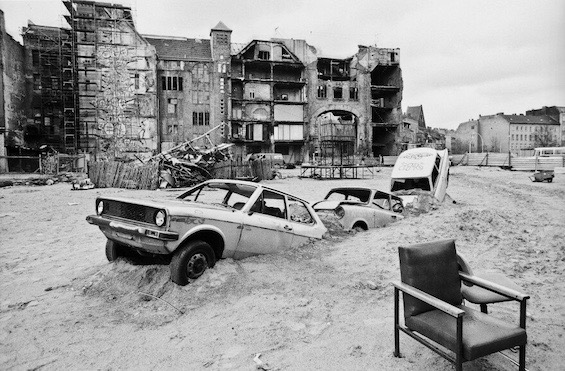
Where Stejskal shines brightest is in his rendering of the city as an active, almost sentient presence—its bombed-out ruins, garish neon, and bleak tenements feeding the sense of moral and literal fog. The “ratcatcher” metaphor captures the paranoia of the era: everyone hunting, and being hunted, in a maze of shifting loyalties and unnamed dangers.
The novel draws partly on files Stejskal retrieved from the East German Ministry of State Security—the Stasi—and features the legendary East German spymaster Markus Wolf in its conclusion. Equal parts action thriller and atmospheric character study, The Ratcatcher of Berlin is a gripping portrait of Cold War tension at its most raw and human.
The historical context
The action in The Ratcatcher of Berlin takes place in Berlin in 1957. Memories of Hitler’s war were still vivid, and veterans of the war dominated the scene. But the line of division between East and West ran through the city, and that reality was uppermost in the minds of the 3.3 million people who lived on both sides of the dividing line.
The Cold War was at its most intense then. Nikita Khruschchev, who had only recently become the undisputed leader of the Soviet Union, was intent upon expelling the Western powers from Berlin. In 1948-9, Stalin had failed to do so when the Berlin Airlift saved the day for the beleaguered people of West Berlin. This novel tells of a desperate plot hatched by Moscow to try again in an even more imginative way. Of course, we know from history that all such attempts failed. And the result was the erection of the Berlin Wall four years later.
About the author
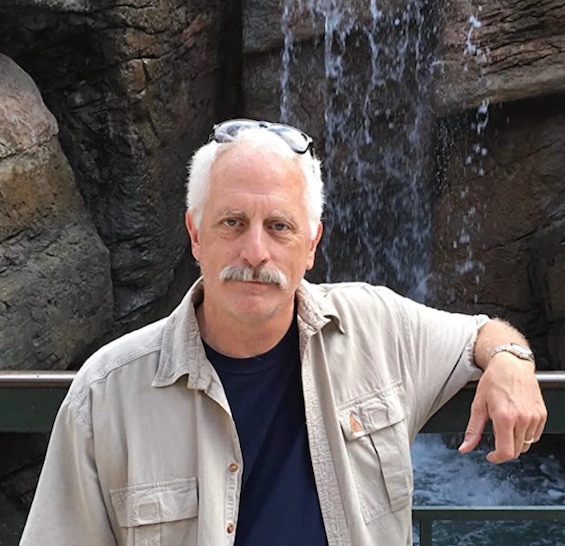
Amazon’s bio for the author reads in full as follows: “James Stejskal is an author, military historian, and conflict archaeologist. To gain inspiration and research his writings, he spent 35 years serving with the US Army Special Forces and the Central Intelligence Agency in interesting places like Africa, Europe, the Balkans, the Near and Far East.
“He is the author of the five books to date in his Snake Eater Chronicles, a Cold War military & espionage thriller series, as well as the nonfiction books Special Forces Berlin: Clandestine Cold War Operations of the US Army’s Elite, 1956–1990 and Masters of Mayhem: Lawrence of Arabia and the British Military Mission to the Hejaz.“
Stejskal lives in Virginia with his wife Wanda.
For related reading
You’ll find other great reading at:
- The 15 best espionage novels
- Good nonfiction books about espionage
- Best books about the CIA
- The best spy novelists writing today
- 10 top WWII books about espionage
And you can always find the most popular of my 2,400 reviews, and the most recent ones, on the Home Page.