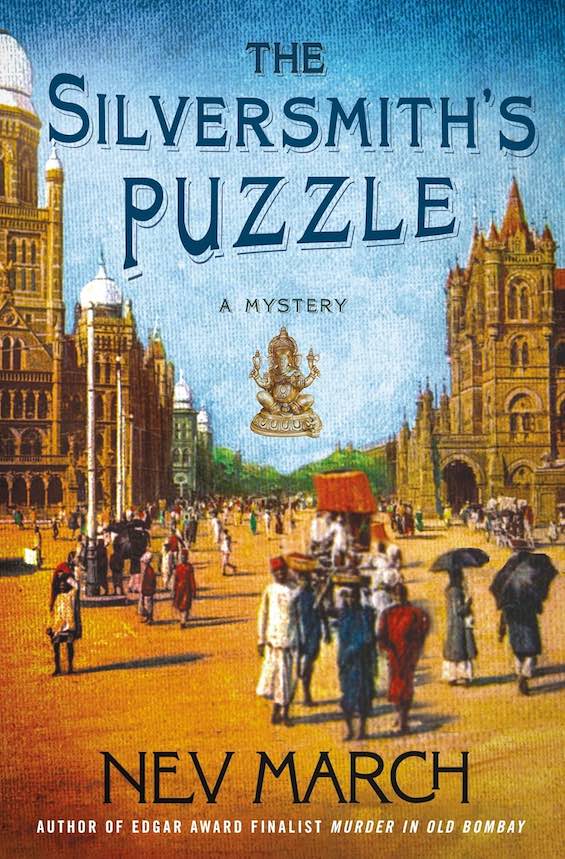
Britain was nearing the peak of its imperial power in the final years of Queen Victoria’s reign as the turn of the 20th century approached. But all was not well in the Empire. Clamor for local control was rising in India, the “Jewel in the Crown,” as the decade-old Indian National Congress gathered steam. And on the streets of Calcutta, Bombay, and Delhi, out-of-work laborers and disgruntled servants were beginning to mutter ominously about the vast gulf between them and their European overseers. It’s this unfamiliar reality that confronts Captain Jim Agnihotri and his Parsi wife, Diana Framji, as they return to Bombay after a two-year hiatus in exile in Boston. They’ve come to help Diana’s beloved brother, Adi, defend himself against a murder charge in Nev March’s Victorian mystery novel, The Silversmith’s Puzzle.
A disappointing turn in this series
March might have mined the growing sentiment for home rule that presaged the later independence movement spearheaded by Mohandas Gandhi. That could have served as the substance of a fascinating story. But she chose not to do so. The agitation for change simmers in the background as instead she builds a multi-layered whodunit around the murder of a young businessman. The story revolves around the gold and silver trade and delves into the customs of the tiny Parsi community. It’s contrived and unnecessarily complicated. And It’s filled with unlikely twists and turns. New characters materialize along the way to fit the needs of the plot. I was sorely disappointed after the great promise of the first two books in this series.
The Silversmith’s Puzzle (Captain Jim and Lady Diana #4) by Nev March (2025) 320 pages ★★★☆☆
A summary of the plot
The chatbot Claude-AI (Sonnet 4.5) offers the following summary of the story. It’s completely accurate with one very minor exception. Diana Framji is not a Lady in the formal sense, as neither her father nor her husband is a Lord. Chicago newspapers dubbed her Lady Diana when she played a pivotal role in a high-profile investigation in that city during the couple’s time in the US.
A silversmith’s murder
The Silversmith’s Puzzle by Nev March is the fourth installment in the Captain Jim and Lady Diana mystery series, set in colonial India in 1894. The story follows Anglo-Indian detective Captain James Agnihotri and his wife, Lady Diana Framji, as they rush back to Bombay after receiving an urgent telegram from Diana’s brother, Adi, who stands accused of murdering his business partner, silversmith Satya Rastogi.
The couple’s return to India is complicated by the fact that Diana’s traditional Parsi Zoroastrian community has shunned them for her marriage to Jim, an outsider who violated cultural taboos. Additionally, Diana’s family has lost their fortune in a global economic downturn, making the stakes even higher.
Cryptic dying words
The mystery centers on the victim’s cryptic dying words. Before succumbing to his wound, the silversmith managed to gasp something about gold, warning not to let them sell it. As Captain Jim investigates, he discovers a murky trail surrounding the dead man’s life, including financial troubles and hidden secrets. Adi and Rastogi had been manufacturing surgical instruments together but struggled to find buyers for their Indian-made products as doctors preferred British-manufactured tools.
The investigation proves challenging initially, with Jim relying on his connections from his time in the army, police, and journalism. Eventually, he mobilizes the entire Framji family to help solve the puzzle. The novel employs elements of classic detective fiction, with March drawing inspiration from Sherlock Holmes, incorporating deduction, disguise, and adventure.
Identity, caste, and tradition
Beyond the murder mystery, the novel explores deeper themes of identity, caste, tradition, and loyalty within late-Victorian India. The story examines how Jim and Diana navigate the rigid caste system and the consequences of Diana’s choice to sacrifice her inheritance for love. The city of Bombay itself serves as a vivid backdrop, bringing historical authenticity to the narrative. The resolution hinges on finding which person within their tight-knit community holds the key to unraveling this complex puzzle.
About the author

Nev March‘s writing career began when she won the First Crime Novel Award from the Mystery Writers of America for the excellent 2020 debut of this series, Murder in Old Bombay. She only began writing fiction In 2015 after a long career as a data scientist in business, she returned to her passion, writing fiction. March teaches creative writing at Rutgers University’s Osher Institute. Born in Mumbai in 1967, she is herself, like Lady Diana, a Parsi Zoroastrian. Sh lives with her family in New Jersey.
For related reading
I’ve also reviewed the first two books in this series:
- Murder in Old Bombay (Captain Jim and Lady Diana #1)—A brilliant debut novel based on an unsolved murder
- Peril at the Exposition (Captain Jim and Lady Diana #2)—Terrorism in Gilded Age Chicago
You’ll find similar and related books at:
- The best Indian detective novels
- The best mystery series set in Asia
- Good books about India, past and present
There are much better historical novels to be found at:
You’ll find other great reading at Top 10 historical mysteries and thrillers and The 8 best historical mystery series.
And you can always find the most popular of my 2,400 reviews, and the most recent ones, on the Home Page.