Next to William Shakespeare, Agatha Christie was the bestselling author of all time. Not even J. K. Rowling, Danielle Steele, or James Patterson come even remotely close. So it’s a fair bet that, if you read mysteries, you’re likely to be aware she disappeared for 11 days in December 1926. When she fled her husband, Mrs. Christie had published the first half-dozen of her 66 detective novels. And a seventh was on the way. But she had not then achieved anything resembling the fame she would later attain. The furor created by her disappearance no doubt played a role in catapulting her into bestsellerdom. And many books, both novels and nonfiction, speculate about the motives for her disappearance. In The Christie Affair, novelist Nina de Gramont attempts to explain why Agatha Christie disappeared. She advances what has to be one of the most fanciful explanations.
A cast of characters, both fictional and non
The principal actors in The Christie Affair include:
- Agatha Christie (1890-1976) herself (of course), who was 36 years of age when she disappeared in 1926
- Col. Archie Christie (1889-1962(, a World War I pilot who became a success in finance following the war. Like Agatha, he was of the entitled upper crust.
- Nan O’Dea, the 26-year-old woman who had become Archie’s mistress. Presumably, Agatha was unaware of the liaison. Nan is the daughter of an Irish father and a British mother and grew up poor.
- Teddy Christie, Agatha and Archie’s five-year-old daughter, whom they almost always leave in the charge of her nanny
- Finbarr Mahoney, a young Irishman, a fisherman’s son, who served on the Western Front with the British Army in the war. He was Nan’s adolescent love interest.
- Inspector Frank Chilton, who retired from the police force in the city of Leeds but is recalled to duty to assist in the search for Mrs. Christie
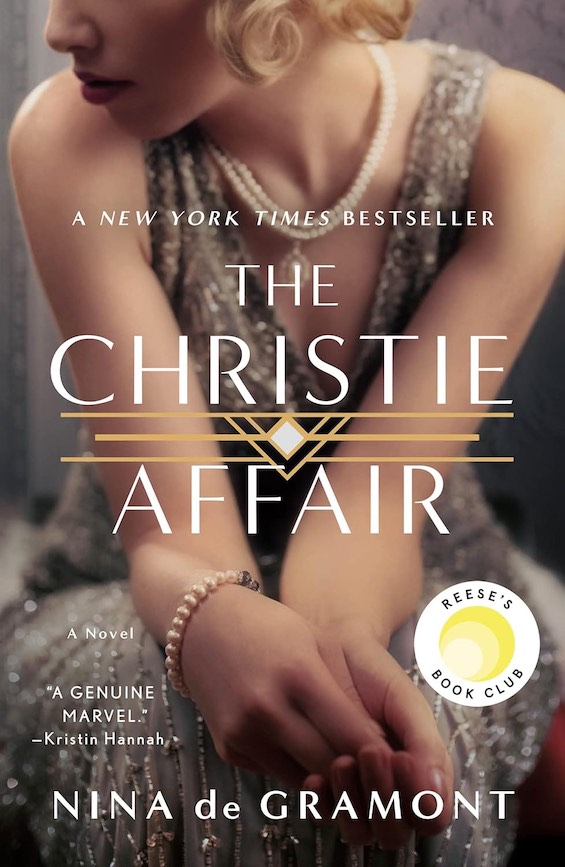
The Christie Affair by Nina de Gramont (2022) 379 pages ★★★☆☆
A disappointing contribution to the genre
Nina de Gramont is obviously a talented stylist. The Christie Affair is beautifully written, with prose that’s a pleasure to read. But the plot is so contrived that I ended the book feeling disgusted. Without spoiling the story, suffice it to say that De Gramont has meticulously constructed a succession of improbable events expressly designed to “explain” Mrs. Christie’s disappearance. It’s about as likely a story as the most far-fetched tale to emerge from the keyboard of a fantasy author.
Marie Benedict’s similar work, The Mystery of Mrs. Christie, is far, far better. I strongly recommend it in place of this novel.
Fact check (spoilers here)
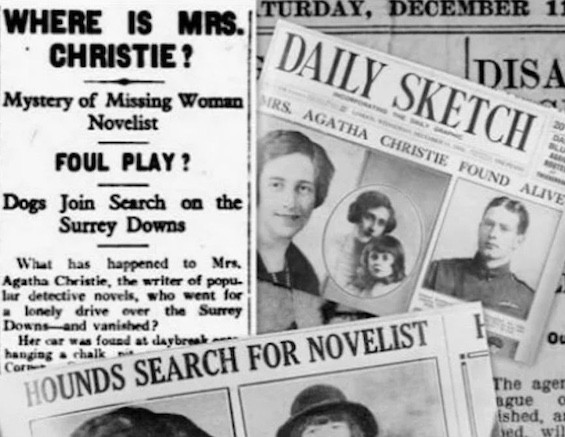
Historical fiction—at least those novels I favor—hew closely to the historical record as a rule. Nina de Gramont’s fictional account of Agatha Christie’s disappearance does not. Here’s how reality stacks up against the author’s imagination . . .
- It’s true that Agatha Christie disappeared for 11 days in December 1926. And when found she offered as the only explanation that “I can’t remember.”
- It’s also true that Archie Christie had a mistress, announced to Agatha that he wanted a divorce the night before she disappeared, and later married the mistress. However, the other woman’s name was not Nan O’Dea. It was Nancy Neele (1899-1958).
- The backstory De Gramont invents for Nan O’Dea is entirely fanciful. Neither of Neele’s parents was Irish. And there is no evidence whatsoever that she ever lived in Ireland, or fell in love with a young Irishman, or had his baby (and lost her) in a convent.
- Retired police Inspector Frank Chilton plays a large role in the novel. There was no such person in reality. And it was not a police officer who found Mrs. Christie. That honor went to a banjo player (of all things) on the staff of the hotel in Harrogate where Mrs. Christie landed in mid-December. He called the police, who returned with Col. Christie to escort her back home.
Of course, it’s clear why the author wreaked havoc on the facts in this way. While Agatha Christie is a pivotal figure in the story, it’s Nan O’Dea who is the narrator. And it’s she whose tragic story about her time in Ireland, the loss of her baby daughter, and her scheming to marry Col. Christie, is the heart of this story. No wonder this novel is a favorite among women who read romance novels!
About the author

Nina de Gramont is the author of four adult novels and several for young adults. She “is a writer, teacher, and mom, not necessarily in that order,” according to Google Books. “Her work has appeared in Redbook, Harvard Review, Nerve, and Seventeen.” De Gramont also writes under the pen name of Marina Gessner. Amazon notes that she teaches creative writing at the University of North Carolina Wilmington. De Gramont lives in coastal North Carolina with her daughter and her husband, the writer David Gessner.
For related reading
I’ve also reviewed The Mystery of Mrs. Christie by Marie Benedict (Where did Agatha Christie go when she disappeared?), which was published two years earlier than de Gramont’s novel. It’s a much better book.
For two lists of excellent historical novels, see Top 10 historical mysteries and thrillers and 25 most enlightening historical novels.
You might also care to check out 20 excellent standalone mysteries and thrillers.
And you can always find the most popular of my 2,400 reviews, and the most recent ones, on the Home Page.