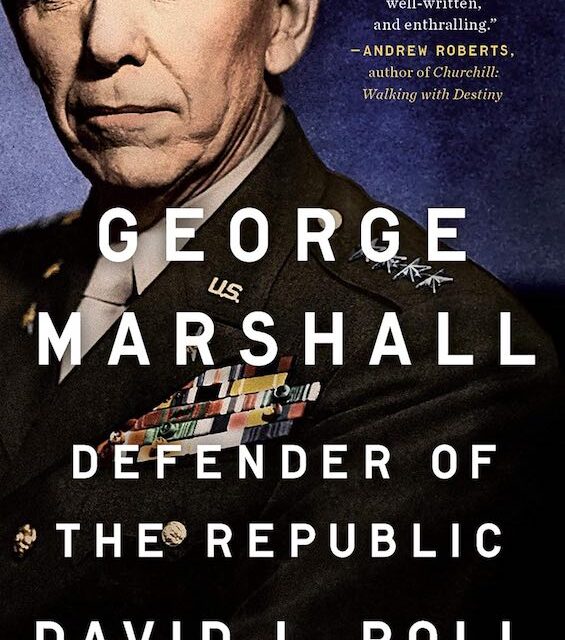
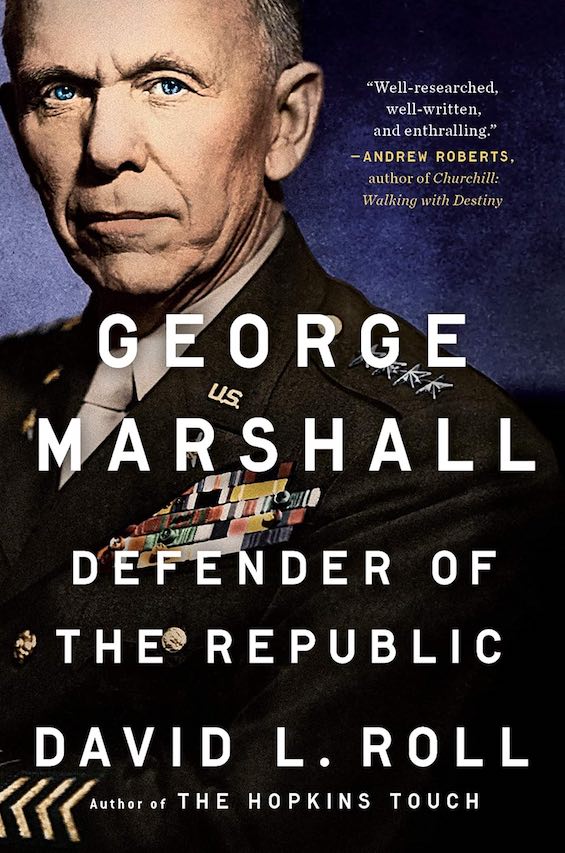
You may recognize the Marshall Plan as one of the most outstanding episodes in our diplomatic history. But you’re less likely to be familiar with the man who gave his name to the project. When we think of our greatest heroes in World War II, the name George Marshall doesn’t spring to mind. Yet as Chief of Staff of the United States Army from 1939 to 1945, Marshall built the 8.3-million-strong Army almost from scratch. He populated the ranks of our generals with men he’d trained and led (including Dwight Eisenhower). And he dominated the Allied Joint Chiefs of Staff who set Allied strategy both in Europe and the Pacific. Next to FDR, he was arguably the most powerful man in the world for several years. And biographer David L. Roll does him justice in his deeply researched account, George Marshall: Defender of the Republic.
A pivotal role in American history for 50 years
For all that he accomplished in World War II, it would be a mistake to think of George C. Marshall (1880-1959) exclusively as a wartime leader. In a half-century career as both soldier and statesman, Marshall played a pivotal role in American history in the First World War, the European recovery after 1945, and the Korean War. Shortly following the Japanese surrender in September 1945, he ceded his job as Army Chief of Staff to his protegé, Dwight Eisenhower. He served under President Truman as Secretary of State as the Cold War gathered steam and as Secretary of Defense during the first tumultuous year of the Korean War. And throughout his career, both his colleagues and most observers regarded him as a man of peerless integrity and unsurpassed ability as a military strategist.
George Marshall: Defender of the Republic by David L. Roll (2019) 712 pages ★★★★★

The most significant episodes in Marshall’s life
In a life overflowing with significance, five episodes stand out for their impact on history.
Planning the Allied breakthrough in World War I
Then-Colonel George Marshall planned the disposition of forces in the Meuse–Argonne camoaign (September 26 to November 11, 1918) during the final Allied offensive of World War I. It was the largest in United States military history, involving 1.2 million American soldiers, sailors, and marines, along with 800,000 French combatants. And it broke the back of the German Army, forcing its surrender in the Armistice that ended the war. Marshall had gained the strategic leadership of the campaign under the mentorship of General John J. Pershing, who commanded the American Expeditioinary Force in the war. Two decades later, Pershing weighed in with the decisive voice recommending Marshall as Army Chief of Staff.
Building the US Army
When Marshall was sworn in as US Army Chief of Staff on September 1, 1939, the day Nazi Germany invaded Poland, the US Army was smaller than Portugal’s and lacked modern equipment. During the two years that followed, he built a force of more than eight million men and women from fewer than 200,000. And he bypassed seniority to promote talented young officers (like Dwight Eisenhower) to the most crucial positions of command. (Eisenhower was a lieutenant colonel when Marshall rose to lead the army; he ended the war a five-star general six years later.)
Leading the Allies in World War II as principal strategist
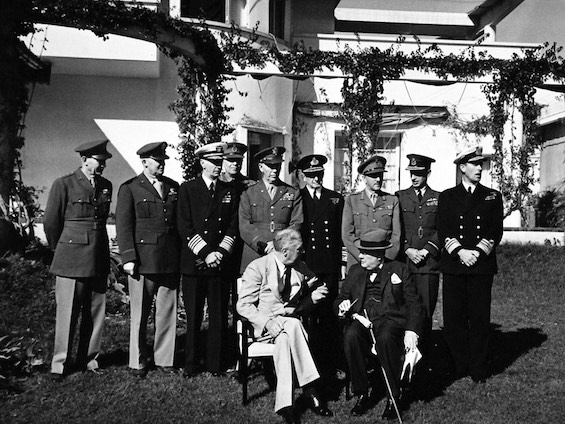
Winston Churchill called Marshall the “organizer of victory.” This, after bitterly tangling with Marshall for three years over the general’s insistence on invading northwestern France. (Churchill had demanded action in the Eastern Mediterranean, the Balkans, and Italy instead of France and repeatedly tried to torpedo plans for the Normandy Invasion.) But this ongoing battle merely reflected Marshall’s dominant voice in the Allied Joint Chiefs of Staff, which set strategy for the global war.
Leading the recovery of Western Europe
Following V-E Day, Europe was a shambles from the Pyrenees to the Urals. East of the Elbe, the Soviet Red Army occupied more than half the continent. And Communist forces stood poised to seize power in the rest of the continent. Revolutionary parties were especially strong in France, Italy, and Greece. And it quickly became clear to President Truman and his advisers that the United States needed to act. George Marshall, then Secretary of State, charged a small group led by George F. Kennan and Dean Acheson with planning an American initiative to provide the funds needed for European recovery.
In protracted negotiations, the Soviets steadfastly refused to allow the plan to proceed in the countries they occupied. This limited the scope of the plan to Western and Southern Europe. Then, once the talks finally broke off, Marshall faced an equally big hurdle: Republican control of Congress. But Marshall forged a partnership with Senator Arthur Vandenburg (R-MI), who bucked the dominant isolationist forces led by Senator Robert Taft (R-OH). With consummate legislative skill, Vandenburg guided the enabling legislation through the Congress.
For his central role in this unprecedented act of enlightened self-interest, Marshall received the Nobel Peace Prize in 1953.
An influential voice in the Korean War
Marshall was ailing and had less than a decade to live when Truman recalled him to service in 1950 as Secretary of Defense. For the most part, he carefully limited his interventions in military policy. Himself a soldier for 50 years and a former five-star general, he believed the Joint Chiefs of Staff deserved to guide military policy unmolested. But Marshall played a central role in two of the most important decisions taken during the first year of the Korean War. Weighing in against the Joint Chiefs, he approved General Douglas MacArthur‘s bold and risky plan for the decisive Inchon Landing. And, once MacArthur had amply demonstrated his insubordination and refusal to follow national policy toward China, Marshall reluctantly signaled his approval for President Harry Truman to fire him. Truman would not have done so otherwise.
Marshall had his critics
George Marshall: Defender of the Republic is no hagiography. Author David Roll has immense respect and admiration for his subject. But he freely reveals Marshall’s errors, and he devotes ample space to his many critics. Because Marshall had enemies both during World War II and afterward. For example, he gets credit for championing the Normandy Invasion. But he did so prematurely, advocating a landing in northern France in 1943, when it was impractical. And he stoutly resisted the British insistence on invading North Africa instead because he believed it would make the cross-Channel operation impossible. That operation in November 1942 brought American troops into the war in large numbers for the first time. And it led to the expulsion of Field Marshall Erwin Rommel from the African continent.
After the war, Marshall served for nearly a year as President Truman’s special envoy to China. His mission was to negotiate a settlement between the Nationalist forces under Generalissimo Chiang Kai-shek and Mao Zedong. Because the opposing forces were irreconcilable, there was no prospect that Marshall could succeed. Eventually, he recognized the reality and returned to the United States. But the so-called China Lobby howled in protest. They grabbed headlines, charging that Marshall and the “Communists and fellow travelers” in the State Department had “lost China.”
The China Lobby called him a traitor
Of course, China was never America’s to lose. The charge was nonsense. But it stuck in conservative circles and remained high on the list of issues that animated the Republican Right for years to come. In fact, if Marshall had committed any errors in China, it was that he stayed too long. Some of his advisers realized from the start that the mission was never to succeed. But Marshall was unfailingly loyal to President Truman and the responsibilities he had taken on.
Other episodes proved controversial, too. For instance, Marshall opposed the early recognition of the state of Israel. And late in his life there was a lapse in his customary modesty when, he took even more credit than he deserved for the Marshall Plan. He did acknowledge Vandenburg’s central role. But he downplayed the work of some of the men in the Truman Administration who had also been influential in shaping the plan.
About the author

David L. Roll‘s biographical blurb on Google Books reads in part, “David L. Roll is the author of [biographies of several US Government officials]. After serving as an Assistant Director in the Bureau of Competition at the FTC, Roll practiced law as a partner at Steptoe & Johnson LLP and founded Lex Mundi Pro Bono Foundation, a public interest organization that continues to provide pro bono legal services to social entrepreneurs around the world. He lives in Washington, D.C.” He was born in 1940.
For related reading
You’ll find similar and related books at:
- 12 great biographies
- Top 20 popular books for understanding American history
- 10 top nonfiction books about World War II
- 25 top nonfiction books about history
And you can always find the most popular of my 2,400 reviews, and the most recent ones, on the Home Page.