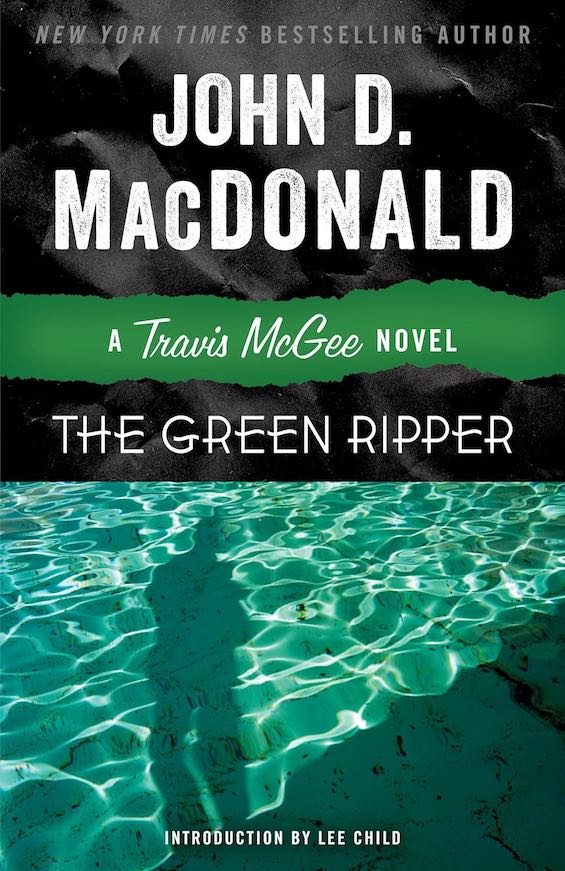
Our society’s relentless push for progress sometimes blinds us to what the past has to offer. And for many American readers that means spurning great books written decades (or centuries) ago in favor of the newest bestseller. Of course, that’s often a mistake. And again and again I’ve discovered that to be the case when I take a look back at the mysteries and thrillers of the mid-to-late 20th century. For example, the Lew Archer novels of Ross Macdonald or Ross Thomas’ witty spy stories work just as well today as they did so many years ago. And now, I’ve found belatedly, so does the work of John D. MacDonald, whose Travis McGee crime stories outsold them both. My introduction to the series comes with The Green Ripper, the 18th in MacDonald’s 21-book series. And it’s an example of great suspense fiction as good as any in recent years.
A private sleuth faces a monstrous conspiracy
For starters, MacDonald’s protagonist, Travis McGee, is a fascinating character. I’m unfamiliar with what he might have been like earlier in the series, but in the 18th book McGee is a middle-aged man who clearly relies more on his wits than his fists. He lives on a houseboat in a marina outside Fort Lauderdale, Florida, and styles himself a “salvage consultant.” As McGee explains, “I do my little knight-like thing, restoring goodies to the people from whom they were improperly wrested, doing battle with the genuinely evil bastards who prey on the gullible, helpless, and innocent.”
McGee is a gifted observer. For example, here he is speaking about two men who arrived on his boat to question him about his lover’s disappearance. “They were almost too perfect,” he notes. “The necktie knots were wrong. Frenchmen tie them that way. When [one] cleaned his glasses and held them up to the light, I looked through them too, and I saw no distortion.” And “their pants were too long.” No detail escapes Travis McGee. And that gift will help propel him into the midst of a monstrous conspiracy—and place him face-to-face with the diabolical men who promote it.
The Green Ripper (Travis McGee #18 of 21) by John D. MacDonald (1979) 257 pages ★★★★★

The story in a nutshell, courtesy of Claude-AI
What follows is the chatbot Claude’s brief summary of the novel. I’ve added subheads to make the text easier to read. Otherwise, it’s verbatim.
A darker turn than previous books in the series
In The Green Ripper, the story takes a darker turn than typical McGee adventures when Gretel, Travis’s love interest who appeared in the previous novel, dies under mysterious circumstances. Initially attributed to an unknown illness, Travis becomes suspicious when he learns she may have uncovered information about a dangerous organization shortly before her death.
Consumed by grief and determination, McGee investigates and discovers Gretel likely encountered a radical survivalist cult operating in California. This group, presenting themselves as a self-sufficient commune, actually serves as a front for terrorist activities and violent extremism. They’ve been recruiting vulnerable individuals and training them in combat tactics under the guise of preparing for societal collapse.
A man of many disguises
Travis infiltrates the compound, adopting a false identity to gain the group’s trust. Once inside, he experiences firsthand their brutal indoctrination methods and witnesses the psychological manipulation used to control members. The cult’s charismatic leader maintains power through intimidation, isolation, and ideology that justifies violence against perceived enemies.
As McGee gathers evidence about the organization’s criminal activities and their role in Gretel’s death, he must carefully navigate the dangerous environment while planning his revenge and escape. The novel builds toward a violent confrontation as Travis systematically dismantles the group from within.
Vengeance, extremism, and the cost of violence
The book explores themes of vengeance, the psychology of extremism, and the personal cost of violence. It’s notably more intense and emotionally raw than earlier McGee novels, reflecting both the character’s profound loss and MacDonald’s concerns about domestic terrorism. The title refers to death itself—the “green ripper,” or Grim Reaper—and the story examines how tragedy transforms even a careful, philosophical man into someone capable of calculated retribution.

Incisive intelligence and serious intent
I’m back. This is me writing, not Claude.
John D. MacDonald began his career at the close of World War II writing for the pulp magazines. But in later years he began to show the incisive intelligence and serious intent of his fiction. For example, Travis McGee’s best friend is a man named Meyer, a retired economist whose brilliant analyses of world affairs often dominate their conversations.
Here’s Meyer lamenting the pressure of overpopulation, for instance. The world is, he asserts, “all too close to the doom anticipated by the Club of Rome, no matter how we switched the data around. It comes down to this, Travis—there are too many mouths to feed. One million three hundred thousand more every week!” That was a prescient observation in the late 1970s, when the world’s population stood at about 4.3 billion. It’s truly compelling now, with 8.2 billion often-hungry people and climate change fast shrinking the land and water we need to grow our food.
About the author

John D. MacDonald died in 1986 at the age of 70. He left behind the 21 novels in the widely praised Travis McGee series of crime novels and scores of standalone novels and other books. He sold an estimated 70 million copies of his books during his lifetime.
MacDonald was a veteran of World War II. He served as a rear-echelon staff officer, leaving the US Army in 1945 with the rank of lieutenant colonel. Instead of following his father into the corporate sector, despite his Harvard MBA. Instead, he opted for a life as a starving writer. And success came slowly. As Wikipedia notes, “MacDonald spent four months writing short stories, generating some 800,000 words and losing 20 pounds (9.1 kg) while typing 14 hours a day, seven days a week. He received hundreds of rejection slips.” The dry spell ended the following year, when he sold his first short story. Four years later he wrote the first of his many standalone crime novels as an original paperback. The Travis McGee series began only in 1964, with the publication of The Deep Blue Good-By.
MacDonald was born in Pennsylvania and died in Wisconsin. But he lived most of his life in Florida, where he set the Travis McGee series. He was survived (briefly) by his wife as well as a son.
For related reading
I’ve also reviewed The Deep Blue Good-By (Travis McGee #1 of 21) by John D. MacDonald (Suspense authors look to this classic thriller series as a model).
You’ll find other great reading at:
- Top 10 mystery and thriller series
- 30 outstanding detective series from around the world
- Top 20 suspenseful detective novels
- 10 top novels about private detectives
And you can always find the most popular of my 2,400 reviews, and the most recent ones, on the Home Page.