Kiran Bedi became India’s first female police officer in 1972 and distinguished herself in a 35-year career. But the Anglo-Indian mystery author Vaseem Khan instead imagined that someone like her had joined the Bombay police two decades earlier. In five suspenseful historical detective novels, he traced Persis Wadia’s trajectory through the early years of Indian independence. Now, after a year of headlined successes and ill treatment in Bombay, Persis has been exiled to India’s tumultuous far Northeast. Assigned to the Naga Hills District of Assam Province, Persis must do her job in the face of officials who have made her unwelcome . . . amidst a violent insurrection by fierce local tribespeople who seek to carve out their own state. Khan tells the story in The Edge of Darkness, the sixth novel in his Malabar House series.
The governor’s body is missing his head
Here she is, “banished from Bombay, sent three thousand kilometers eastwards to the very edge of the country, to lose herself in these godforsaken hills. . . The cases that she had investigated back at the Malabar House station in Bombay—beginning, just over a year ago, with the murder of a prominent English diplomat—had catapulted her to national attention, a star at the tender age of twenty-eight.” But those headlines mean little to the powers that be in the Naga Hills. Both of the top officials—the governor and the military commander—think she is miscast as a police officer. Then the governor turns up dead in a bathtub inside a locked room in a luxury hotel. His head is missing. And Persis is the ranking investigator in the local police. To say the least, it’s a thankless job.
The Edge of Darkness (Malabar House #6) by Vaseem Khan (2026) 342 pages ★★★★☆
The principal characters in this puzzling mystery
In addition to Persis Wadia herself, a passel of other characters play significant roles in the story. These include both three other recurring characters as well as a number of those who first enter the story in The Edge of Darkness.
Recurring characrers
Superintendent Roshan Seth, who had been Persis’ boss at the Malabar House police station in Bombay. He too is an exile in the Naga Hills. He is a highly capable detective with many years of service behind him. But the new Indian leaders of the Indian Police Service had banished him to Malabar House, the graveyard for police careers. They believed him too close to the British officers who had preceded them. Seth has become a drunk and is of little help to Persis now.
Archie Blackfinch, a British criminalist who had moved to India. He is there to help the Indian Police Service build a network of forensic labs around the country. He and Persis had fallen in love at a time and place when their careers would both be ruined if the public were to learn of their relationship. In this story, Archie lies in a coma in a Bombay hospital, the victim of a political assassin whom Persis had killed in her last case in Bombay.
Sam Wadia, Persis’ cantankerous father. He owns a bookstore in Bombay and watches every customer with suspicion, convinced they steal his books. He uses a wheelchair.
Local characters
Governor Mohan Sinha is a prominent politician close to Prime Minister Nehru, who had sent him to impose order on the Naga Hills.
Colonel Hiten Shroff commands the Indian Army detachment in the hills. He is fiercely suspicious of the local people and threatens a massacre after the governor’s murder. He and almost everyone else are convinced Naga separationists had carried out the murder. Only Persis believes otherwise.
Sub-inspector James is the able local police officer who is Persis’ deputy.
The suspects
The principal suspects are five foreigners who, like Persis herself, are housed in the luxurious Victoria Hotel in Kohima, along with Governor Sinha. They include an American long resident in the Naga Hills who owns a large mining company, a young Italian woman who is a foreign newspaper correspondent, a couple who are American Baptist missionaries, and a young British man who is Mohan Sinha’s personal aide.
Combine all these characters in a single, locked-room murder mystery, and you’ve got a fascinating case. It’s a thrilling ride. And it illuminates an important chapter in India’s post-independence history.

The historical background
The early 1950s were one of the most eventful periods in India’s long and wildly colorful history. Partition and India’s declaration of independence from the British Empire had taken place only in 1947.
Now, most of the massive subcontinent is easing into acceptance of its new status under the democratic governments of Prime Ministers Liaquat Ali Khan in Pakistan and Jawaharlal Nehru in India.
As many as 10 million Hindu and Sikh refugees were adjusting to new lives inside the new borders. Nehru’s central government was struggling to buy off the rulers of the more than 500 princely states and integrate them into the fledgling nation. C
onflicts over caste and class were raging as a high-level committee led by an Untouchable politician crafted India’s 395-article constitution.
Meanwhile, Nehru’s socialist government struck out on a path to navigate between the West and the Communist Bloc. But there was even more going on.
Violent separatist movements
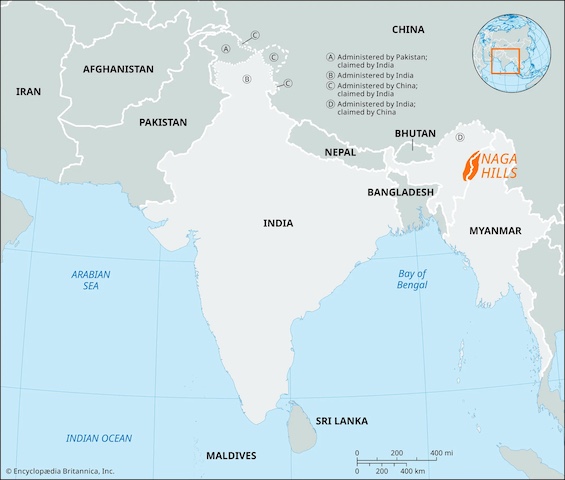
The remnants of the two million Indian soldiers who had served the Empire in World War II had made their way back home. There, they had amplified the cry for independence. But pockets of resistance to the new order had erupted in violence, abetted in some places by veterans of the war. And nowhere was the resistance fiercer than in the far northeast of India. There, unruly mountain tribes doggedly held out for an independent state of their own. Much of the violence centered in the Naga Hills. There, Nehru’s representatives struggled to keep order just as their British predecessors had done. It was a losing battle for a long time.
Warring tribes and linguistic diversity
Today, India’s northeast encompasses a patchwork quilt of eight states, bordering China, to Mizoram in the south, abutting Bangladesh, Myanmar, and Bhutan. The messy-looking map resembles nothing more than an American state carved up by gerrymandering. It reflects the extraordinary ethnic and linguistic diversity of the area. The center of the earlier violence has become the state of Nagaland, a tiny enclave between the much larger state of Assam and the nation of Myanmar.
Note: India recognizes 22 major, or “scheduled,” languages, but 122 are spoken by more than 10,000 people, However, there is a grand total of more than 1,500 languages and dialects in use throughout the country.
About the author

More readers know the British detective author Vaseem Khan for his gimmicky six-book series of Baby Ganesh Detective Agency novels. It’s about a retired Mumbai detective and his sidekick, a baby elephant. The five books published to date in his lesser-known Malabar House series are far better, in my opinion.
Khan was born in London in 1973 and educated at the London School of Economics. He worked for ten years as a management consultant to an Indian hotel group building environmentally-friendly hotels around the country. Since 2006, he has worked at University College London for the Department of Security and Crime Science.
For related reading
This series is included in The 8 best historical mystery series.
I’ve reviewed the five previous entries in the Malabar House series:
- Midnight at Malabar House (A compelling murder mystery set in India after Partition)
- The Dying Day (A baffling mystery based on ciphers)
- The Lost Man of Bombay (A baffling murder mystery in post-Independence India)
- Death of a Lesser God (Murder in the shadow of Partition)
- City of Destruction (War with Pakistan looms in post-independence India
You’ll find other great reading at:
- Top 10 mystery and thriller series
- 30 outstanding detective series from around the world
- Top 20 suspenseful detective novels
- Top 10 historical mysteries and thrillers
And you can always find the most popular of my 2,400 reviews, and the most recent ones, on the Home Page.