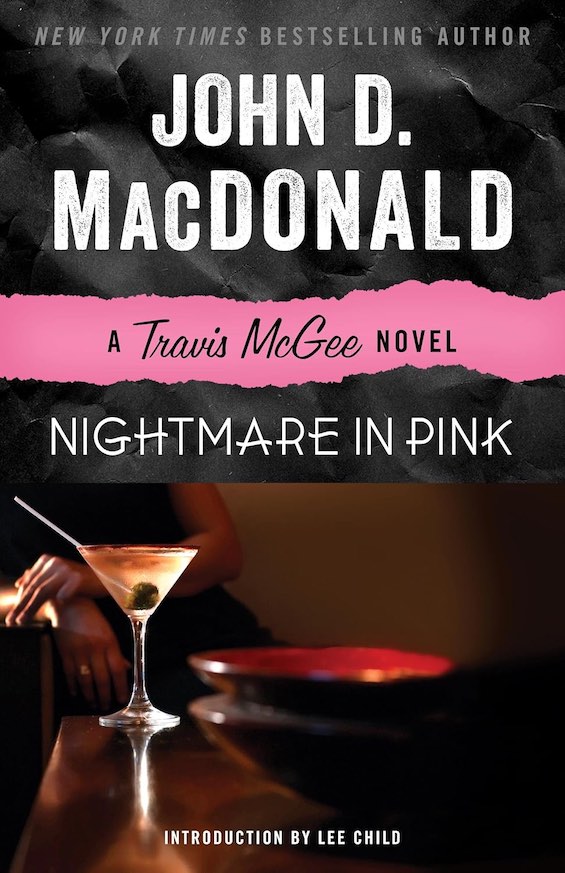
Check out your favorite writers of mysteries and thrillers whose careers began after, say, 1970. You’re likely to find that several turn to the work of John D. MacDonald as a model of the craft. In his time—the 1940s through the 1980s—he was one of the world’s most admired and bestselling authors of suspense fiction. His fame rested to a large degree on the series of 21 novels in the Travis McGee series. And it all began in 1963 with the publication of The Deep Blue Good-By, which introduces Travis McGee.
Travis McGee is no cookie-cutter PI
McGee is no run-of-the-mill hard-boiled, tough-guy PI battling the demons of the big city. He styles himself as a “salvage consultant” who recovers stolen property for a 50 percent cut of the action. He takes on clients only when his funds run low. And he lives on the Busted Flush, a 52-foot barge-type houseboat anchored in Fort Lauderdale, Florida.
Now, don’t get me wrong. He’s tough, all right, a combat veteran of the Korean War. McGee is a big guy, six feet plus and 180 to 200 pounds. He can usually hold his own in a close encounter. And he has a tendency to hook up with any desirable female who drifts into his orbit. But he’s no palooka. He can acquit himself well in serious conversation about philosophy or world affairs. Travis McGee is a very complicated man.
The Deep Blue Good-By (Travis McGee #1 of 21) by John D. MacDonald (1963) 242 pages ★★★★★

One crime compounds another, and another
Chookie McCall is a dancer and choreographer who practices her routines on the Busted Flush. And her friend Cathy Kerr is the victim of a monstrous crime. A charismatic ex-con named Junior Allen had inveigled himself into her life and stolen what she believed to be an enormous fortune her father had hidden somewhere on their property. Whatever it was, he had gotten it illegally as a soldier in World War II Burma. Now he was serving five years in Fort Leavenworth for the crime. And Junior, who knew her dad at Leavenworth, had inserted himself into Cathy’s life to hunt for the treasure. Allen proved to be physically abusive. And once he’d dug up every corner of her land, he’d cleared out.
To compound the outrage, Allen showed up three weeks later back in town, dressed in finery and flashing money around. Soon he took up with Lois Atkinson, a wealthy and beautiful widow living in a grand new home. And after repeatedly beating her to a pulp, and subjecting her to his humiliating sexual demands, he’d left her, too, and disappeared. Now Cathy Kerr wants McGee to recover whatever it was Allen stole from her.
In the story that ensues, McGee will, of course, confront Junior Allen, and not once but several times. And the conflict will be violent, indeed. But the venue will shift several times, up the coast to New York and across the Caribbean. And there’s nothing simple or straightforward in the way it all unfolds. The Deep Blue Good-By will engage your interest from the first page to the last.
MacDonald is an intoxicating stylist
Here’s the author describing New York City in late summer: “Manhattan in August is a replay of the Great Plague of London. The dwindled throng of the afflicted shuffle the furnace streets, mouths sagging, waiting to keel over. Those still healthy duck from one air-conditioned oasis to the next, spending a minimum time exposed to the rain of black death outside.”
And here he is while observing a clutch of young, college-age women:
“Bless them all, the forlorn little rabbits. They are the displaced persons of our emotional culture. They are ravenous for romance, yet settle for what they call making out. Their futile, acne-pitted men drift out of high school into a world so surfeited with unskilled labor there is competition for bag-boy jobs in the supermarkets. They yearn for security, but all they can have is what they make for themselves, chittering little flocks of them in the restaurants and stores, talking of style and adornment, dreaming of the terribly sincere stranger who will come along and lift them out of the gypsy life of the two-bit tip and the unemployment, cut a tall cake with them, swell them up with sassy babies, and guide them masterfully into the shoal water of the electrified house where everybody brushes after every meal.”
There are precious few writers of suspense fiction who can sling together prose like that.
About the author
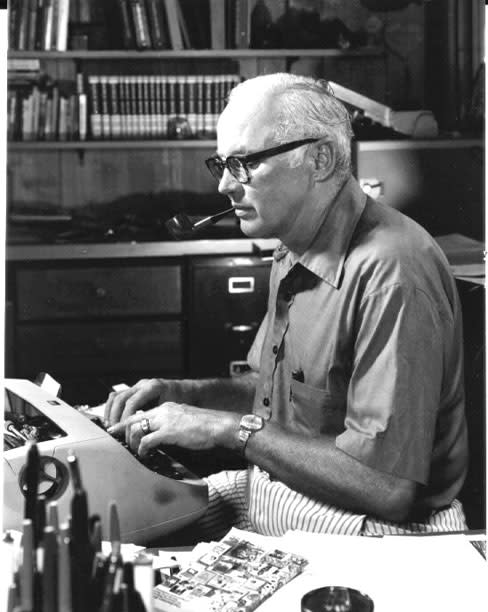
John D. MacDonald (1916-86) served as a Stateside staff officer in the US Army in World War II. He mustered out as a lieutenant colonel, faced with multiple opportunities to snag senior executive positions in major American companies. Instead, he decided to turn to writing fiction full-time. And he and his wife flirted with starvation as he wrote 800,000 unpublished words over four months before he sold his first short story. Hundreds more followed over the succeeding years, as well as scores of novels. His most notable efforts were the 21 books in the Travis McGee series and the novel The Executioners, which made its way to movie screens twice as Cape Fear. He sold an estimated 70 million books in his five-decade career.
MacDonald was born in 1916 in Sharon, Pennsylvania. His father was a corporate executive. He earned a bachelor’s from Syracuse University and an MBA from Harvard University. In 1951 he moved his family from Utica, New York to Florida, eventually settling in Sarasota. He was survived by his wife and a son.
For related reading
I’ve also reviewed The Green Ripper – Travis McGee #18 of 21 (An outstanding classic thriller that resonates today).
You’ll find other great reading at:
- Top 10 mystery and thriller series
- 30 outstanding detective series from around the world
- Top 20 suspenseful detective novels
- 10 top novels about private detectives
And you can always find the most popular of my 2,400 reviews, and the most recent ones, on the Home Page.