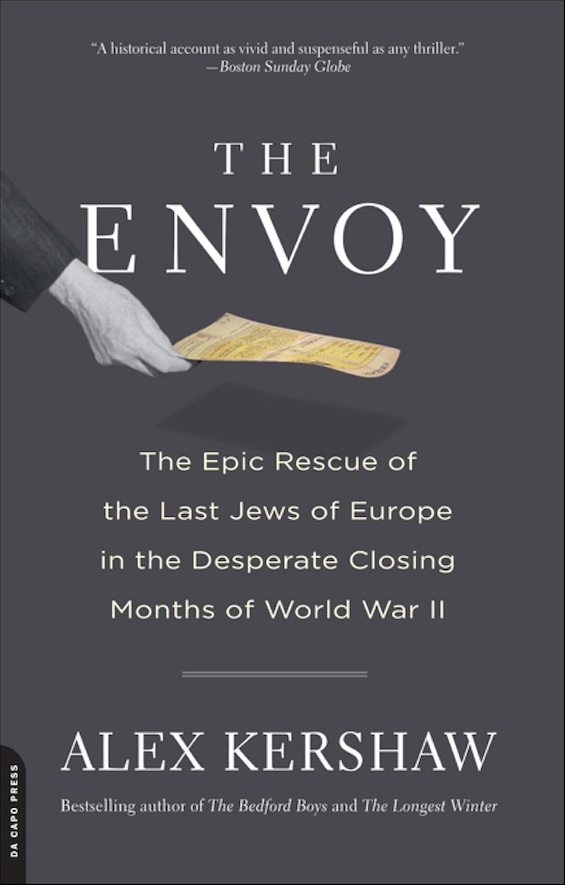
On a hill named Mount Herzl in Jerusalem lies Yad Vashem, the World Holocaust Remembrance Center. Within this moving memorial to the six million Jews murdered in the Holocaust lie a synagogue, a children’s museum, and research facilities as well as a garden commemorating the Righteous Among the Nations. The Righteous, non-Jews who risked their lives to save Jews from extermination, currently number 28,707. But most Americans today recognize only one of their names. Oskar Schindler (1908-74), a German industrialist, saved an estimated 1,200 Jews from the Nazis. Steven Spielberg’s memorable 1993 film, Schindler’s List, lionizes the man. He was, without question, one of the most deserving of recognition. But his efforts paled beside those of a heroic young Swede named Raoul Wallenberg (1912-45), the subject of author Alex Kershaw’s terrific 2010 biography, The Envoy.
Facing off against Adolf Eichmann
If The Envoy were a novel, the protagonists would be Raoul Wallenberg and Adolf Eichmann (1906-62). As anyone with even a cursory knowledge of the Holocaust is painfully aware, Eichmann attended the notorious Wannsee Conference, in January 1942, where he helped plan the extermination of Europe’s Jews. His boss, Reinhard Heydrich, charged him with carrying out the policy. In the following two years Eichmann sent hundreds of thousands of Polish, Czech, and Slovak Jews, among others, to Poland’s death camps or to slave labor designed to kill them. Then he arrived in Budapest with the German occupation in March 1944 to finish the job. And it was there that the two men’s paths crossed.
The Envoy: The Epic Rescue of the Last Jews of Europe in the Desperate Closing Months of World War II by Alex Kershaw (2010) 326 pages ★★★★★
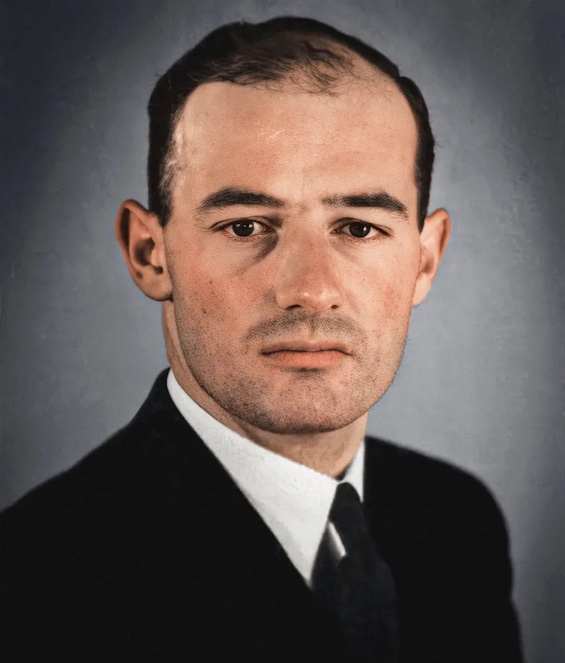
A man of fierce courage and determination
Raoul Wallenberg was 32 years old when an American diplomat representing FDR’s newly established War Refugee Board went looking in Stockholm for a Swede willing to organize the rescue of Hungary’s Jews. Wallenberg fit the bill to perfection. His family was one of the wealthiest and most powerful in Sweden. So he had the connections necessary to secure an appointment as a secretary in the Swedish Embassy in Budapest. And he was eager to do the job.
Six months of constant exposure to danger
Kershaw details how Wallenberg set to work without delay upon arriving in July 1944, and he sustained the effort with little sleep until the Red Army captured Budapest in February 1945. Few of his colleagues in the embassy were helpful. But Wallenberg devised a clever means to protect Jews from deportation by issuing passes that declared them Swedish citizens. Somehow that worked until the dreaded Arrow Cross seized power in the Hungarian government. Fascists and antisemites to the core, the Arrow Cross reversed the policy of prime minister Horthy preventing deportations—and began their own policy of murdering Jews wherever they could find them.
Facing off against the Architect of the Holocaust and gun-toting teenage thugs
Wallenberg managed to survive for nearly a year of confrontations with the gun-wielding teenage thugs of the Arrow Cross and Eichmann’s henchmen. He met personally with Eichmann and Hungarian government officials on numerous occasions. It was dangerous and usually frustrating work, but he persisted. And in the end he managed to save somewhere between 20,000 and 100,000 Jews from the gas chambers at Auschwitz.
Kershaw tells Wallenberg’s story with sensitivity and great attention to detail. He interlaces the episodes in that tale with accounts by some of the men and women Wallenberg saved, most of it gleaned not just from official records but from one-on-one conversations with the survivors themselves or their children. It’s a brilliant biogra;hy.
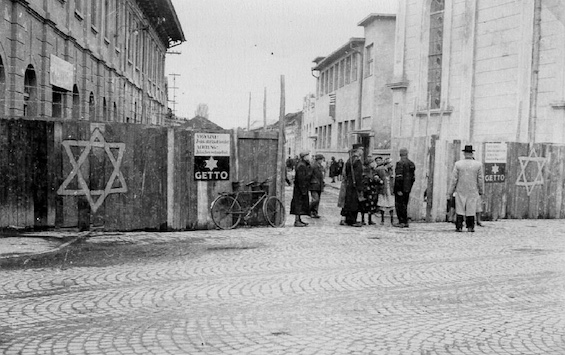
The historical context
Kershaw is careful to spell out the circumstances in which Wallenberg carried out his heroic mission. He surveys the territory in Hungary both before and after the war. And he follows the often tragic post-war lives of Wallenberg’s desperate family and those of several men and women Wallenberg saved from Eichmann. We get a clear picture of the scope of Nazi crimes in Hungary. And we learn about the many Hungarians, Swiss, and a handful of Americans who collaborated with Wallenberg. He never acted alone. In fact, Carl Lutz (1895–1975), the Swiss Vice-Consul in Budapest from 1942 to 1945, also saved tens of thousands of Jews in Hungary. Most sources credit him with saving 62,000.
A refuge for Jewish refugees until the tide turned
The big picture is this. Before World War II, Hungary housed a population of some 9.1 million people. Approximately 400,000 to 500,000 of them were Jews. But the number of Jews in the country doubled by 1944 to about 825,000. Their ranks were swelled by refugees fleeing Germany, Poland, Czechoslovakia, and other countries where large numbers of Jews had already been deported to the death camps. But Hungary’s wartime leader, Admiral Miklós Horthy (1868-1957) refused to accede to German demands that he send the Jews to their deaths.
Only when Adolf Eichmann arrived with the German occupation, and the dreaded Arrow Cross fascist regime came to power in Budapest, did the deportations begin on a large scale. Then, largely through Eichmann’s efforts, some 430,000 Jews were packed off in freight trains to Auschwitz. Only about 255,000 Hungarian Jews survived the Holocaust. (The numbers don’t match because some of the Jewish refugees from other countries also survived, probably because they fled Hungary too when the deportations began in earnest in March 1944.
About the author

Alex Kershaw has written a dozen nonfiction books to date, nearly all of them about World War II. He is British. Born in 1966 in York, he studied politics, philosophy and economics at University College, Oxford. He taught history before working as a journalist for several British newspapers, including The Guardian, The Independent, and The Sunday Times. He has an honorary doctorate in military history from Norwich University. Kershaw is a popular public speaker and designs and leads history tours around the world.
For related reading
I’ve reviewed two other excellent books about World War II by Alex Kershaw:
- Patton’s Prayer: A True Story of Courage, Faith, and Victory in World War II (The amazing story of how George S. Patton won the Battle of the Bulge)
- Avenue of Spies: A True Story of Terror, Espionage, and One American Family’s Heroic Resistance in Nazi-Occupied Europe (A revealing account of life under the Nazis in occupied Europe)
You’ll find other excellent books at:
- Good books about the Holocaust
- The 10 best novels about World War II
- 10 top nonfiction books about World War II
- 10 top WWII books about espionage
- The 10 most consequential events of World War II
And you can always find the most popular of my 2,400 reviews, and the most recent ones, on the Home Page.