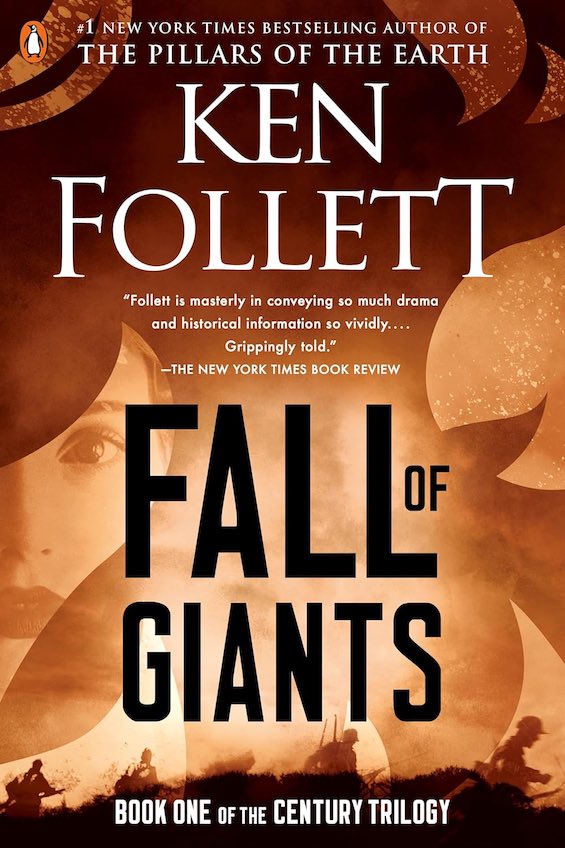
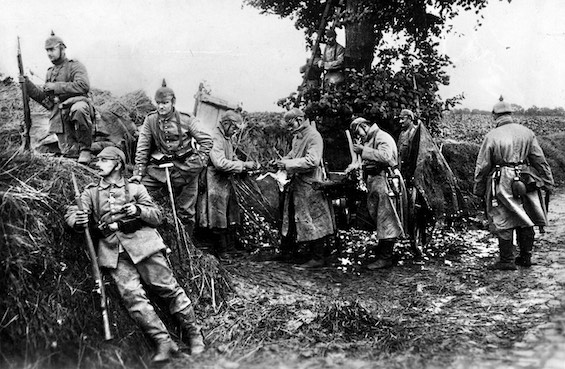
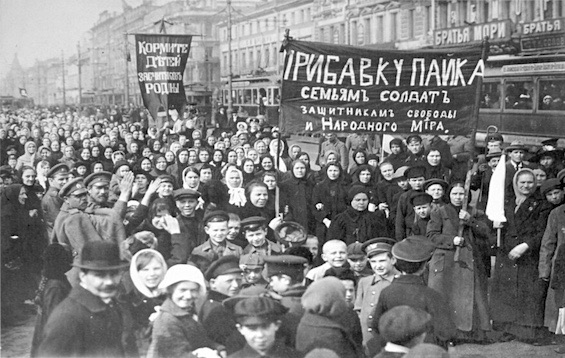
No one is still alive with any adult memory of World War I, which ended a century ago. So when we think of the events that have shaped the world we live in today it’s likely World War II looms large. But its antecedent three decades earlier may have had greater long-term impact. The “Great War,” as they called it at the time, destroyed the Russian, German, Austro-Hungarian, and Turkish Empires, weakened the British Empire, produced the Russian Revolution, thrust the United States onto the world stage, and laid the foundation for the rise of Nazi Germany. To convey how people living at the time experienced those changes may be impossible in a single novel. But the British literary phenomenon Ken Follett has attempted to do just that in Fall of Giants. It’s the first book in his Century Trilogy that chronicles the major events of the 20th century.
World War I and the Russian Revolution brought to life
To bring this monumental story down to a level comprehensible by mere mortals, Follett tells the tale through the experiences of six families. Two are British, one American, two Russian (including one Russian-American), and one German. Through their lives over the period 1914 to 1924, we gain insight into the First World War and the Russian Revolution. Ken Follett’s research is extensive, and it shows in the detail that brings the story to life.
Fall of Giants (Century Trilogy #1 of 3) by Ken Follett (2011) 1000 pages ★★★★☆
The six families who dominate this sprawling saga
As is the case in his doorstopping Kingsbridge cycle, Follett paints a compelling picture of both world affairs and domestic life through the interaction of a handful of families. The following are the six around whom the story is centered.
The Williams Family
A Welsh coal mining family from the town of Aberowen. The main characters are Billy Williams and his brilliant sister Ethel. Their father is both a fundamentalist preacher and the local leader of the miners’ union.
The Fitzherberts
British aristocrats who own the land where the town of Aberowen and the coal mine are located. The profoundly conservative Earl Fitzherbert and his suffragist sister Maud play leading roles in the story. The earl’s wife is an impoverished Russian princess with vast landholdings in het native country. There, thousands of destitute serfs labor for her family.
The Peshkov Brothers
Two poor Russian brothers, Grigori and Lev Peshkov, who both leave Russia. Lev thinks he is bound for America but ends up instead in Wales and unwittingly hires out as a strikebreaker when the miners in Aberowen walk out. Grigori becomes a revolutionary as he suffers from the tsar’s incompetence and the corruption and violence of his regime.
The Vyalov Family
A Russian-American family based in Buffalo, New York, originally from St. Petersburg. Lev Peshkov becomes involved with this family once he extricates himself from Wales and arrives in Buffalo, as intended.
The Von Ulrichs
German aristocrats. Otto von Ulrich is a prominent Prussian diplomat with close connections to the kaiser. His son Walter follows him into the diplomatic corps and, on a mission to England, becomes involved with the Fitzherberts in the months leading up to the war.
The Dewar Family
Wealthy and powerful Americans. Gus Dewar, the scion of the family, becomes an adviser to President Woodrow Wilson. He forges a friendship with Walter von Ulrich through his relationship with Maud Fitzherbert.
Looking to the future
It’s impossible to know how future historians will view the events of the 20th century. But today, as many of those events fade into what seems the distant past, we can hazard a guess. Mine is that the two world wars will be viewed as a single event like the Thirty Years War or the Hundred Years war of earlier centuries. And that the Russian Revolution will seem to be merely an extension of Russia’s centuries-long tsarist past and the prelude to its continuation in the 21st century by a newly expansionist Russia.
About the author

Ken Follett has sold more than 195 million copies of his thrillers and historical novels. His first great success came in 1978 with the publication of The Eye of the Needle. That book, and every one that followed it, was a bestseller. Other spy thrillers followed it in the 1980s. Then he turned to historical fiction with The Pillars of the Earth, which inaugurated the 5-book Kingsbridge saga.
Follett is Welsh. He was born in Cardiff in 1949 and attended University College London, where he studied philosophy and became active in centre-left politics. Follett worked as a reporter for several years, writing as a hobby in the evenings. He married early in his career and had two children with his wife. The marriage ended in 1985.
For related reading
I’ve read all five books in Follett’s Kingsbridge saga but reviewed only three, the prequel and the fourth and fifth books. (I had read the other two before I began writing reviews here.)
- The Evening and the Morning (Ken Follett sets up the Kingsbridge Trilogy in a prequel)
- A Column of Fire (Ken Follett’s 16th-century Kingsbridge saga: Christians killing Christians)
- The Armor of Light (The Kingsbridge Saga moves to the Industrial Revolution)
In addition to all the Kingsbridge historical novels, I’ve reviewed many of Ken Follett’s thrillers, including:
- Eye of the Needle (The 40th anniversary edition of Ken Follett’s classic WWII spy novel)
- Never (Is a new world war possible by accident?)
- Hornet Flight (The Danish Resistance and a secret Nazi base)
- The Man from St. Petersburg (A terrorist threatens a WWI British alliance)
- Paper Money (A clever heist story from Ken Follett)
And you can always find the most popular of my 2,400 reviews, and the most recent ones, on the Home Page.