Over the past quarter-century, the award-winning thriller author Dan Fesperman has captivated readers with fourteen novels. Most involve espionage. But they don’t resemble the run-of-the-mill spy stories of cat-and-mouse games between the KGB and the CIA or MI6, much less the superhero tales of Ian Fleming and his ilk. Fesperman’s books are interesting. And one of his more recent efforts, Safe Houses, is especially so. It’s a complex, dual-timeline tale involving the CIA and a shadowy, off-the-books intelligence operation at odds with the Agency. And the aspects of the story you’re likely to find most improbable turn out to be true.
Mumbo-jumbo and a violent rape
It’s 1979. Berlin. Helen Abell is a 24-year-old CIA officer two years into her first tour. The misogynistic chief of station has sidelined her into a desk job managing four of the Agency’s safe houses. And one evening as she makes a surprise inspection of one of the houses she observes two unscheduled events. An older man with a wheezy voice is lecturing a younger man named Lewis. What he says comes across as mumbo-jumbo. It’s about a pond and a lake and the hump and Vee people. Then, a little later, she overhears, then watches a senior operative raping one of his agents. She stops the rape. And, because Helen is testing the recording equipment at the time, she has taped both meetings. And those tapes will lead to her murder in Maryland in 2014.
Safe Houses by Dan Fesperman (2018) 416 pages ★★★★★

A shocking murder and an unexpected windfall
Helen is unable to learn the identity of the older man speaking mumbo-jumbo or that of Lewis, which is a code-name. But it doesn’t take long to discover that the rapist’s name is Kevin Gilley. However, her report to the chief of station about the rape goes nowhere. Gilley, it seems, is untouchable. He’s an Agency hitman and much too powerful. But when Helen learns that the young agent he’d raped had been murdered on the street a day later, Helen resolves to bring him down. And eventually she connects with two other women who work with her to amass the evidence that Gilley was, in fact, a serial rapist as well as a murderer.
Meanwhile, Fesperman shifts the scene to a small town in Maryland. There, Helen had long since married a farmer named Shoat and raised two children. The younger, Willard, is mentally challenged. And he has just murdered his parents and is in jail awaiting trial. But his older sister, Anna Shoat, now 30, doesn’t believe he could have done this on his own. And she enlists a young man named Henry Mattick to help her investigate. He’s newly arrived in town. And it turns out that Henry had been sent there by some government agency to watch Helen’s comings and goings and anyone who visits her. But Anna doesn’t know this. And she’s completely ignorant of her mother’s history in the CIA. Until a shocking phone call informing her that she will receive nearly $300,000 from the Agency as a death benefit.
There are wheels within wheels here. And the connections among the disparate facts we learn from the author won’t come together until the explosive conclusion. This is stay-up-all-night fiction.
The historical facts
“Yes, there really was an obscure U.S. intelligence agency once known as the Pond,” Fesperman writes in an afterword, “and pretty much everything [he writes] about its origins and its history is right on the mark. [An OSS officer named] John ‘Frenchy’ Grombach started the whole thing in 1942.” He ran the operation under the table until Allen Dulles shut it down in 1955. But Grombach may not have followed orders. The author’s story about the Pond’s operations long after 1955 may have been true, too. After all, it was a fiercely anti-Communist right-wing outfit. And there was no lack of likeminded people in the United States government and the corporate sector during the Cold War. Highly placed officers in the Pentagon or the CIA may well have protected Grombach’s operations in its guise as “corporate intelligence” funded by sympathetic companies.
Although Fesperman doesn’t mention it, another key element in his story may also be grounded on fact. Kevin Gilley is the Agency’s go-to-guy in Europe to arrange political assassinations. He’s a master at covering them up as accidents or suicide. Since we know the KGB staged such murders, is it too much of a stretch to imagine that the CIA did so, too? After all, it was a time when the stand-off between the US and the Soviet Union was viewed as a life-or-death struggle.
About the author
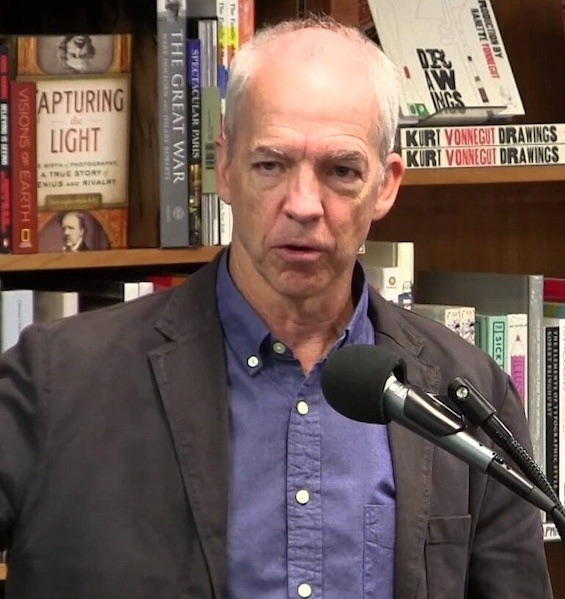
Dan Fesperman is the award-winning author of 14 spy novels to date. He is a former correspondent for the Baltimore Sun, reporting from Germany, Bosnia, Afghanistan, Pakistan, and the Middle East. Fesperman was born in 1955 in Charlotte, North Carolina, and is a graduate of the University of North Carolina. He now lives with his wife and two children in Baltimore.
For related reading
I’ve also reviewed four other novels by Dan Fesperman, all of which I enjoyed:
- The Cover Wife (This taut spy novel ends with a jaw-dropping surprise)
- Winter Work (Intrigue in East Germany after the Wall came down)
- The Letter Writer (Nazi saboteurs, the Mafia, and crooked cops)
- Pariah (The CIA recruits a disgraced comedian for a top-secret mission)
You’ll find other great reading at:
- The 15 best espionage novels
- Good nonfiction books about espionage
- Best books about the CIA
- The best spy novelists writing today
And you can always find the most popular of my 2,400 reviews, and the most recent ones, on the Home Page.