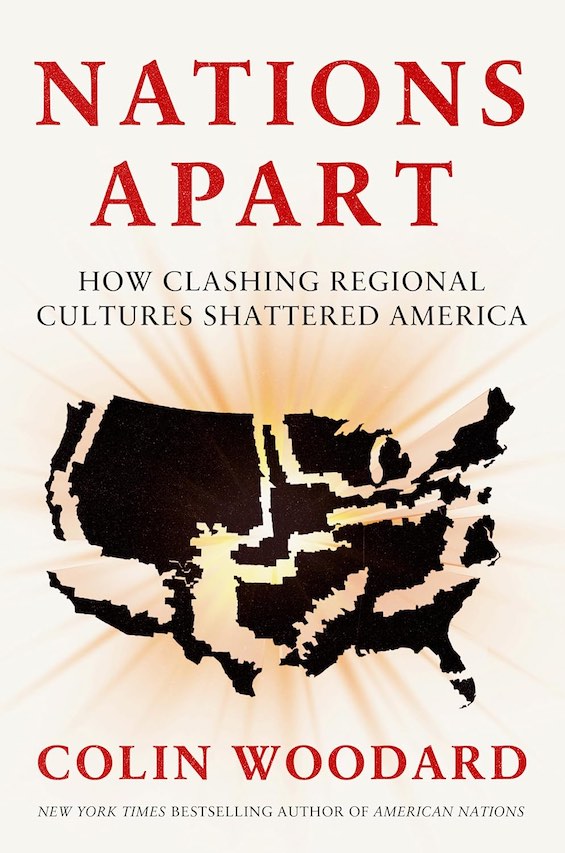
Most Americans came alive to the reality of polarization in our politics only recently. In the 1990s at the earliest, with the advent of Fox News and Newt Gingrich’s take-no-prisoners partisanship. But a remarkable book published in 2011 explained with faultless logic that the polarization began 400 years earlier. In American Nations: A History of the Eleven Rival Regional Cultures of North America, historian Colin Woodward demonstrated that diverse patterns of settlement had laid the foundation for regional cultures that differed in fundamental ways. And those differences fostered values that were incompatible from one part of the country to another. Now, in Nations Apart, he reveals how clashing regional values in America express themselves in dramatically different views on all the hot-button issues that roil our politics in the 21st century.
Distinctive regions with divergent political and social values
In American Nations, Woodard characterized the regional cultures that grew out of colonial settlement patterns as “nations.” He showed using the analytical tools of modern social science that each of these nations was dominated by a distinctive set of values. And that is the premise on which his argument rests in Nations Apart—that our political views are likely similar to those who live around us.
“Some of these ‘nations,'” Woodard writes, ”championed individualism, others utopian social reform. Some believed themselves guided by divine purpose, others espoused freedom of conscience and inquiry. [Others] embraced an Anglo-Protestant identity, others ethnic and religious pluralism. Some valued equality and democratic participation, others deference to a traditional aristocratic order modeled on the slave states of classical antiquity.” And these divergent values led to the Civil War, Reconstruction, the passionate differences over the New Deal, and, most recently, the polarization that divides us today.
Nations Apart: How Clashing Regional Cultures Shattered America by Colin Woodard (2025) 364 pages ★★★★☆
Regional differences that don’t match state borders or national boundaries
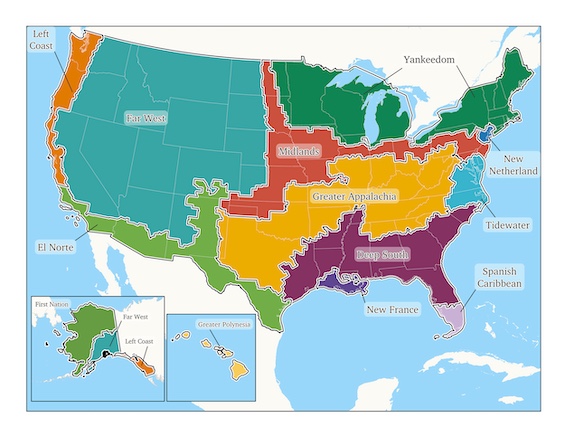
Woodard demonstrates how geography and migration patterns have influenced the shape of the divergent “nations” we live in. The upshot is that the resulting cultural boundaries don’t often match established state borders or even our national boundaries with Mexico and Canada. And the consequences have been profound.
“There’s never been an America,” he writes, “but rather several Americas, wrestling with one another over the destiny of our shared federation. Today’s North America includes nine major regional cultures that are located primarily within the current borders of the United States plus four smaller ‘enclaves’ that are the U.S. portions of regional cultures that are primarily located in Canada, the Caribbean, Greenland, and Oceania.”
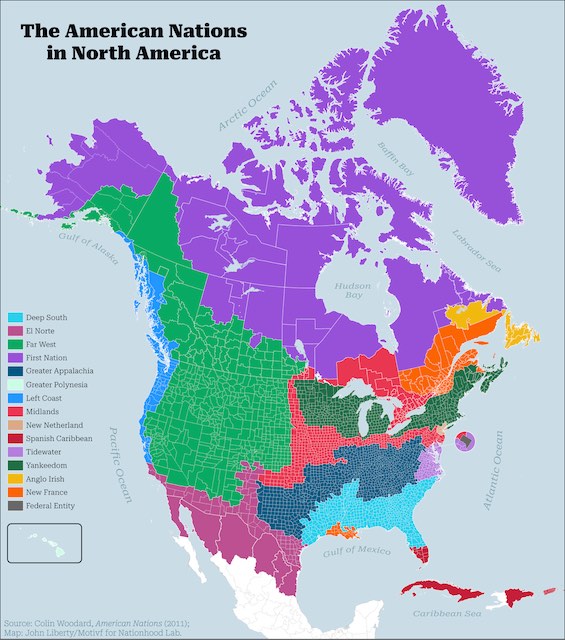
Conclusions firmly grounded in statistical analysis
Fair warning: if you’re among the many readers who shun charts, tables, and the extensive use of numbers, you won’t enjoy this book. I welcome their use. But even I grew weary of Woodard’s extensive use of the same polling and statistical analysis in chapter after chapter as he ticked off all the leading issues of the day. Guns, Abortion, Climate. Healthcare. And more abstract concerns such as democracy, authoritarianism, and how we interpret history. I got the point even before I’d read half the book. Of course, if you’re most concerned about an issue spotlighted in one of the chapters, you may feel differently. And if you have an academic interest, or are engaged in electoral politics, you may well want to slog through all the numbers. But any general reader is more likely to bog down after just a few chapters.
About the author

Most of Colin Woodard‘s seven books to date, all nonfiction, elaborate his thesis that historic and cultural differences among the many distinctive regions of the United States account for the political differences that now divide us. Nations Apart is the third in a series that began in 2011 with American Nations: A History of the Eleven Rival Regional Cultures of North America.
Woodard is an award-winning journalist as well as an author. He holds a BA from Tufts University and an MA in international relations from the University of Chicago. Born in 1968 in Maine, he is the founder and director of Nationhood Lab at Salve Regina University in Newport, Rhode Island, where he is a senior fellow.
For related reading
Years ago I reviewed the first of the author’s three books in this series, American Nations: A History of the Eleven Rival Regional Cultures of North America (Understanding America’s polarization and how we got to now).
A fascinating essay entitled “The Four Americas” by journalist Joe Klein appeared in the New York Times Book Review on October 17, 2021. It’s based on a 946-page book published in 1989 by David Hackett Fischer, Albion’s Seed: Four British Folkways in America. The book approaches much the same subject as Woodard’s but reaches slightly different conclusions.
For a pessimistic view of the consequences of the disunity Woodard portrays, see The Next Civil War: Dispatches from the American Future by Stephen Marche (Is a new American civil war inevitable?).
You might also be interested in:
- Top 20 popular books for understanding American history
- Top 10 nonfiction books about politics
- Gaining a global perspective on the world around us
And you can always find the most popular of my 2,400 reviews, and the most recent ones, on the Home Page.