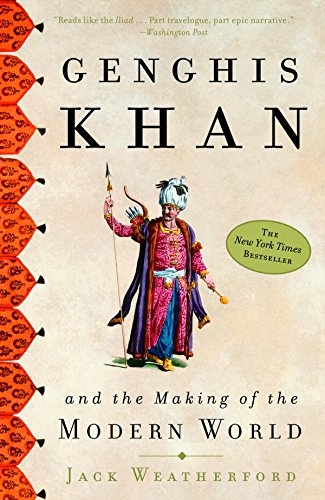
We study history to learn where we’ve come from and how we got to where we are. But we’re dependent on the politicians, scholars, and commentators to deliver an active account of the past. And few world leaders in our planet’s history have been more dramatically caricatured than the Mongolian warlord most of us know as Genghis Khan. Most accounts paint him as a bloodthirsty monster, although he was nothing of the sort. Ruthless, for sure. But he was in all likelihood the greatest military genius in all history and an equally brilliant political leader. He unified and managed the largest contiguous land empire ever created. And more than any other individual, then or later, he laid the foundation for our civilization today. Author Jack Weatherford tells the astonishing story of Genghis Khan and the Making of the Modern World.
He led the world’s first wave of globalization
What is most extraordinary about Genghis Khan and his successors’ accomplishments is that “the entire Mongol tribe under him numbered around a million, smaller than the workforce of some modern corporations.” Yet somehow they conquered lands housing more than 100 million people. And, as Weatherford reports, “The Mongols made no technological breakthroughs, founded no new religions, wrote few books or dramas, and gave the world no new crops or methods of agriculture. Their own craftsmen could not weave cloth, cast metal, make pottery, or even bake bread. They manufactured neither porcelain nor pottery, painted no pictures, and built no buildings. Yet, as their army conquered culture after culture, they collected and passed all of these skills from one civilization to the next.”
Genghis Khan and the Making of the Modern World by Jack Weatherford (2004) 352 pages ★★★★★
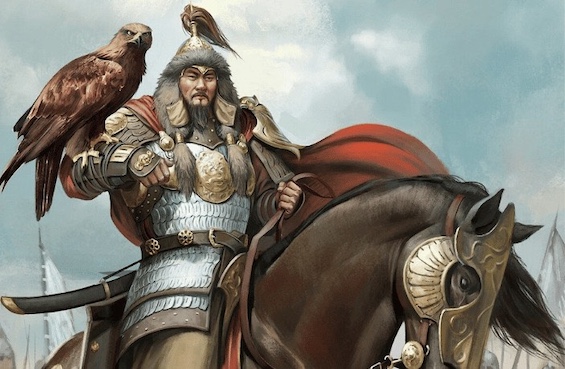
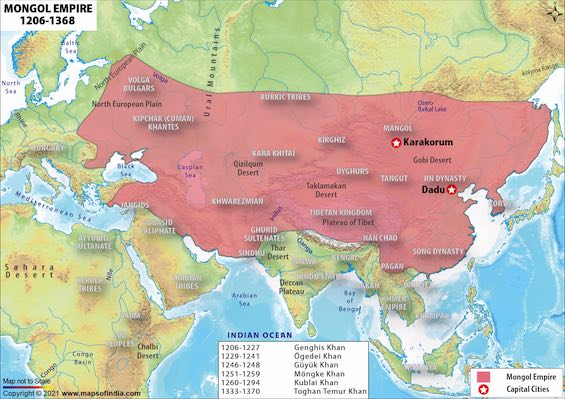
They dominated much of the world from 1206 to 1368
While Europe gradually reawakened in the High Middle Ages (1000-1250), the man who has come to be known to us as Genghis Khan methodically knitted together the tiny Turkic tribes of present-day Mongolia and Central Asia into a formidable empire. Then, as the High Middle Ages morphed into the Late Middle Ages (1250-1500), Genghis and his sons and grandsons pushed the empire’s boundaries west, north, and south to encompass much of the then-known Earth and all of its wealthiest civilizations. The impact on our lives today may seem incomprehensible. As Weatherford asserts, “Seemingly every aspect of European life—technology, warfare, clothing, commerce, food, art, literature, and music—changed during the Renaissance as a result of the Mongol influence.” Slightly exaggerated it might be. But in all essentials the claim is accurate.
What Genghis Khan and the empire he founded gave the world
Rather than attempt to summarize the takeaways from Weatherford’s book, I turned to Claude-AI. The result of my inquiry follows. As you’ll see, it’s no exaggeration to say that the Mongols laid the foundation for the modern world. We in the United States, with our Eurocentric view, tend to overlook how profoundly developments in Asia brought modern ideas and new technology to Europe. As Weatherford notes, “The Mongols swept across the globe as conquerors, but also as civilization’s unrivaled cultural carriers.”
The Mongol Empire made several significant contributions to world society, despite its reputation for conquest and destruction:
Communications and Trade
The Mongols established the Yam system, an extensive network of relay stations that enabled rapid communication across Asia. This infrastructure supported the flourishing of the Silk Road, creating unprecedented commercial connections between East and West. Merchants could travel safely under Mongol protection, and the empire’s policies actively encouraged international trade.
Religious Tolerance
The Mongols practiced remarkable religious pluralism for their era, exempting religious institutions from taxation and allowing diverse faiths to coexist within their territories. This openness facilitated cultural exchange and protected religious minorities.
Meritocracy and Administration
The empire promoted officials based on ability rather than aristocratic birth, incorporating talented administrators from conquered peoples. They adopted and spread useful technologies and practices from different cultures, including Chinese administrative techniques, Persian record-keeping, and various military innovations.
Cultural and Intellectual Exchange
By connecting distant civilizations, the Mongols facilitated the transfer of knowledge, technologies, and ideas between East and West. This included the spread of paper money, printing technology, gunpowder, mathematical concepts, and agricultural techniques. Scholars, artisans, and craftspeople moved across the empire, cross-pollinating ideas.
Legal Framework
The Yassa, their legal code, provided consistent governance across diverse territories and established principles like diplomatic immunity that influenced later international relations.
The Mongol Empire’s greatest legacy may be its role in creating the first truly intercontinental exchange network, fundamentally shaping the trajectory of global development.
An immeasurable contribution
The Mongols’ contribution to the world as we know it is immeasurable. The summary I’ve quoted above just scratches the surface. Consider the following, for example, as Weatherford reports . . .
“They sought not merely to conquer the world but to institute a global order based on free trade, a single international law, and a universal alphabet with which to write all languages. Genghis Khan’s grandson, Khubilai Khan, introduced a paper currency intended for use everywhere and attempted to create primary schools for universal basic education of all children in order to make everyone literate. The Mongols refined and combined calendars to create a ten-thousand year calendar more accurate than any previous one, and they sponsored the most extensive maps ever assembled.”
Admittedly, some reviewers charged Weatherford with overstating the Mongols’ contributions. That may well be the case in some specific areas. For example, he notes that they paved the way for the European Renaissance. However, while innumerable factors helped shape the rebirth of European scholarship in the 15th and 16th centuries, there is little question that influences from Asia played a major role—influences that stemmed directly from Mongol conquests.
About the author

Jack Weatherford authored 11 books of popular history published from 1981 to 2024 as well as innumerable articles, book chapters, reviews, and other works published in periodicals. He is an anthropologist who taught for 29 years at Macalester College in St. Paul, Minnesota. Weatherford holds a a graduate degree from the University of South Carolina and a PhD in in anthropology from the University of California, San Diego.
Weatherford was born in 1946 on a farm in South Carolina. He now lives in Mongolia, where he is the first foreigner to have been granted the nation’s highest honor.
For related reading
You’ll find other fascinating biographies and history books at:
- 25 top nonfiction books about history
- 12 great biographies
- Top 10 nonfiction books about politics
- Gaining a global perspective on the world around us
And you can always find the most popular of my 2,400 reviews, and the most recent ones, on the Home Page.