Three-quarters of a century ago, the United States embarked on a war on the other side of the globe that almost never enters the consciousness of living Americans today. President Harry Truman’s decision to undertake this “police action,” as he termed it. proved to be a strategic decision of colossal proportions. In his story of The Korean War, East Asian historian Bruce Cumings lays the decision at the feet of Truman’s Secretary of State, Dean Acheson (1893-1971). He posits it as Acheson’s rejection of George F. Kennan‘s (1904-2005) “containment” strategy, which advocated the use of diplomatic, economic, and political means to keep Communism in check rather than military force. And that decision ushered in the explosive growth of the military-industrial complex lamented by Truman’s successor, Dwight Eisenhower, a decade later.
The most consequential war in US history since World War II
As Cumings puts it, “The Korean conflict was the occasion for transforming the United States into a very different country than it had ever been before: one with hundreds of permanent military bases abroad, a large standing army and a permanent national security state at home.” Yet Acheson’s strategy failed. “It failed to win the wars in Korea and Vietnam, and it turned the United States into a country entirely remote from what the founding fathers had in mind, where every foreign threat, however small or unlikely, became magnified and the fundamental relationship of this country to the world was changed forever.” Thus, forgotten or not, the Korean War proved to be far more consequential than any other action the United States has taken in world affairs since 1950.
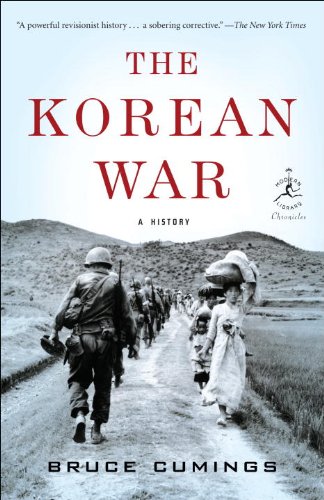
The Korean War: A History by Bruce Cumings (2010) 312 pages ★★★★☆
The major take-aways
With the assistance of artificial intelligence in the form of two chatbots, Anthropic’s Claude and Google’s Gemini, which helped me with research, I can identify six principal takeaways from Cumings’ book.
The Korean War was above all a civil war
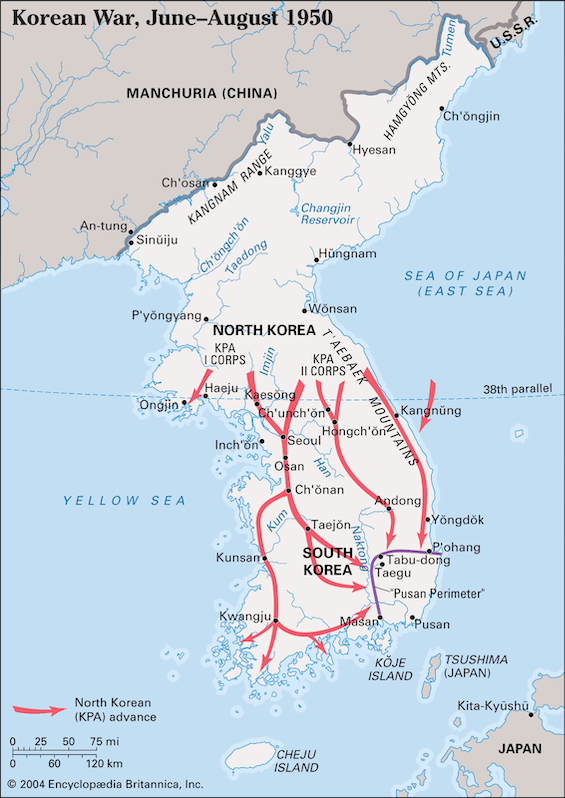
When North Korean troops crossed the 38th Parallel that divided North from South Korea on June 25, 1950, it was not an act of international Communist aggression. And Stalin did not order the attack. It was merely a continuation of a deeply rooted civil conflict that began with the end of World War II at the latest. In fact, its roots lay in the oppressive and cruel Japanese colonial practices that began in 1910 when Japan seized the Korean peninsula. And, contrary to the accepted wisdom, the South did provoke the attack.
For several years, South Korean troops and the administration of Syngman Rhee (1875-1965) salivated over the industrial riches that lay to their north—and frequently violated the 1945 truce line. The contrast between the two rump states could hardly have been stronger: the north was led by a revolutionary-nationalist movement, while a conservative administration dominated by former collaborators with the Japanese occupation governed the south.
Deep historical roots
The book devotes relatively little space to battle narratives—only about thirty pages to the back-and-forth fighting along the peninsula. Instead, Cumings focuses on the underlying social, political, and historical forces that made the conflict inevitable, including centuries of class tensions in Korean society as well as the trauma of Japanese colonialism.
US intervention in Korean began in 1945, not 1950
From 1945 to 1948, ostensibly to pave the way for democracy in Korea, the US military ruled South Korea. Local “People’s Committees” then were doing an effective job of managing local affairs throughout the South. But US troops suppressed these local, self-governing bodies, claiming that they were led by Communists under the direction of the North (and thus in effect the Soviet Union). This, despite the fact there was no evidence whatsoever of such connections.
Instead the United States backed the National Police, a collaborationist paramilitary force, which brutalized and often murdered large numbers of local leaders. Then, to establish the fiction of indigenous self-rule, the US installed as president an anti-Communist politician named Syngman Rhee, who had lived in the United States for 35 years. Rhee held the office for a dozen years until forced out as a result of his brutal and ineffective rule.
US complicity in civilian massacres
Cumings details the systematic slaughter of tens of thousands of suspected leftists by South Korean forces (often with U.S. knowledge or oversight). The attacks began well before the official start of the war, both before and after Syngman Rhee took office. And he reveals that many civilian massacres attributed to North Korea in American media were actually committed by South Korean forces. (This claim is not Communist propaganda, as American apologists asserted at the time. Recently declassified U.S. government documents support this assertion.)
A US bombing campaign shaped North Korea’s anti-American feeling
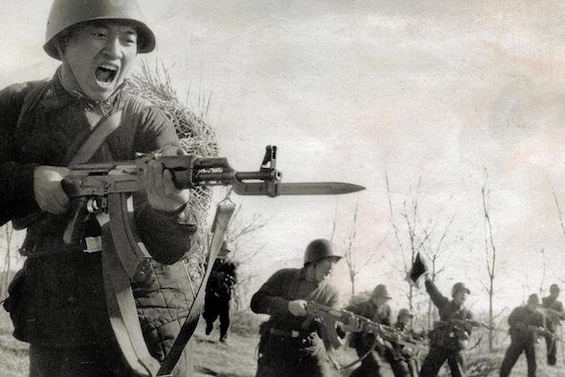
Cumings offers excruciating detail about the U.S. “scorched earth” bombing campaign in the North, which involved “oceans of napalm” and the destruction of dams and cities. In fact, he argues these actions bordered on genocide and left a permanent scar on the North Korean psyche. And it explains North Korea’s modern garrison-state mentality to this day. The bombing campaign is the source of the American belief today that the North is poverty-stricken and underdeveloped. But in 1950, it was nothing of the sort. In the North lay the peninsula’s industrial base and much of the country’s wealth. The US Air Force put an end to that. And bombing played a major role in increasing the human cost of the war. Between three and four million Koreans lost their lives in the conflict.
The “Party of Memory” vs. the “Party of Forgetting”
Cumings explores the psychological and cultural differences in how the war is remembered. In Korea, the Party of Memory is dominant. For both North and South Koreans, the war remains a vivid, unresolved trauma. He emphasizes that is a direct response to the near-total destruction it suffered. But in the USA the Party of Forgetting reigns. Here, the war is often viewed as an interlude between WWII and Vietnam and largely forgotten. Cumings argues this “national amnesia” prevents Americans from understanding North Korea’s contemporary behavior.
Required reading in American history
It’s difficult to imagine any history of the Korean War that could be more authoritative than this book. Cumings’ first book, published in 1980 (30 years before this one), was Origins of the Korean War, Volume I, which won a top history prize. And he has been writing about the conflict practically ever since. The present work did arouse criticism among Cumings’ contemporaries. But few if any had access to the wide-ranging sources, including previously classified US Government documents, that he did. The Korean War should be required reading for anyone who seeks to understand the history of American foreign and military affairs.
About the author

The historian Bruce Cumings specializes in Korea and is one of the nation’s leading authorities on its history. His 10 books include seven on Korean history. He teaches at the University of Chicago, where he chaired the department of history. Cumings was born in 1943 in Rochester, New York. He holds degrees, including a PhD, from Denison University, Indiana University, and Columbia University.
For related reading
Although this is the first book I’ve read about the Korean War, you’ll find other excellent books about America’s wars and related subjects at:
- 25 top nonfiction books about history
- Gaining a global perspective on the world around us
- Top 20 popular books for understanding American history
- Top nonfiction books about national security
And you can always find the most popular of my 2,400 reviews, and the most recent ones, on the Home Page.