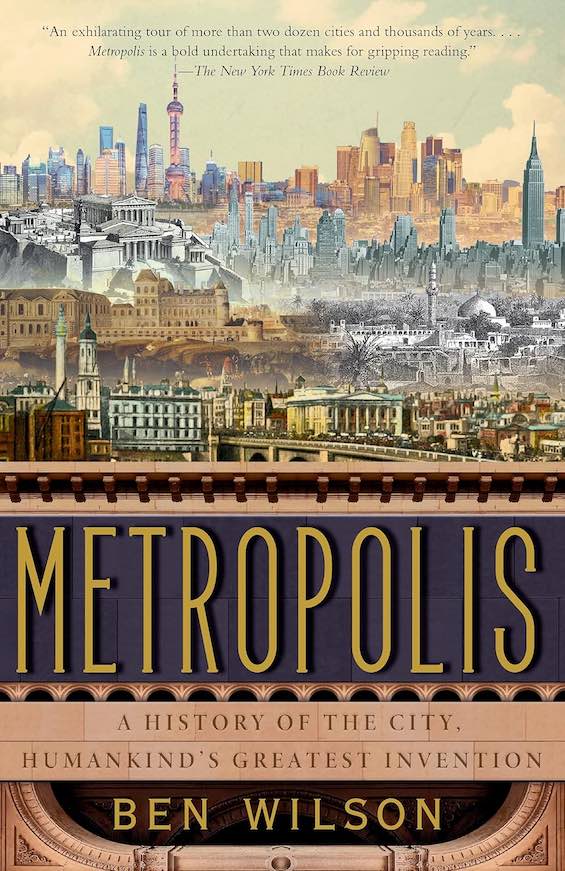
When I was born in 1941, about six months before the United States entered World War II, the world’s three largest cities were New York, Tokyo, and London (which had been #2 before the Blitz). None of the three housed even close to 10 million people. As of 2025, the three largest are Jakarta, Dhaka, and Tokyo. Each has a population of more than 36 million. New York City is number 22, London, 32. According to the UN, all 32 qualify as megacities with populations exceeding 10 million people. To explain this growth trajectory and lend perspective to the role of cities in history, historian Ben Wilson tells the revealing story of “humankind’s greatest invention” in Metropolis. It’s detailed and far-ranging in exploring how and why so many people have gravitated to cities over the past 6,000 years. History buffs will rejoice in this insightful study of urban life.
Where both good and ill have taken root
Wilson makes the case that cities have long been the primary source of the innovation and artistic expression that has elevated our lives. Cities have been magnets for the most creative and ambitious people as well as the most desperate. It’s in urban areas where the institutions that dominate our lives have taken shape. Yet cities have also fostered the epidemic disease that has plagued the human race for thousands of years. Today, Wilson notes, “The global economy is skewed towards a few cities and city-regions: by 2025, 440 cities with a collective population of 600 million (7% of all people) will account for half of worldwide gross domestic product.” In China, he adds, just three megacity regions [already] generate 40% of the country’s entire economic output.”
Metropolis: A History of the City, Humankind’s Greatest Invention by Ben Wilson (2020) 420 pages ★★★★★
A cornucopia of city lore
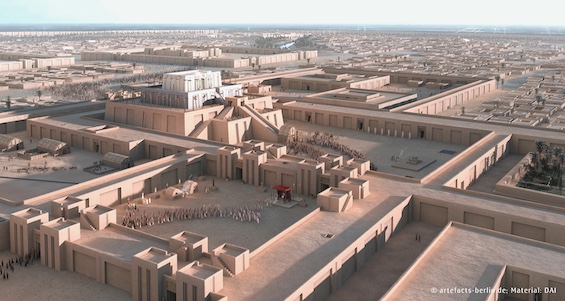
In Metropolis, Wilson tells his tale through the lens of the great cities that have most closely expressed the zeitgeist of the age of their ascendance. Uruk, 4000–1900 BCE. Harappa and Babylon, 2000–539 BCE. Athens and Alexandria, 507–30 BCE. Rome, 30 BC–537 CE. Baghdad, 537–1258. And so forth. New York, London, Shanghai, and Amsterdam all get their due. But so do Lisbon, Malacca, Tenochtitlan, Mumbai, and Lagos. Along the way, Wilson explores the social, economic, and artistic developments characterized by each of these cities as well as the quality of life of their people. You can’t read this book without gaining new perspective on our history as a species.

Cities in context
We live today in a world of megacities. In Asia and Africa a dozen cities top 20 million in population. And Beijing’s metro area population alone is 110 million. Well over half of humanity lives in cities today. So, it’s all too easy for us to imagine that it’s always been this way—and shocking to realize how recent is this phenomenon.
The first city to deserve the label sprouted in Mesopotamia (present-day Iraq) some 6,000 years ago. No more than 25 or 30 million people were then alive. Although a handful of cities housed a million people beginning early in the Common Era—chiefly Rome, Baghdad, and Xi’an, China—cities were by far the exception in a world that still lived largely on farms.
In 1941, less than 20% of the world’s people inhabited cities. By 1960, only one-third did so. The percent of urbanization on the planet passed 50% only in 2007. Some 58 percent do so now. And the trend appears to be locked in place. The United Nations projects that by 2050 68 percent, or more than two-thirds of the world’s population, will be urbanized.
Of course, there are scenarios that could put an end to this trend. A killer pandemic far more lethal than covid could rapidly depopulate the world’s cities. The Black Plague did so. Or, if we’re to listen to the doomsayers, it could be even worse. A killer asteroid. Or massive global flooding unleashed by the sudden melting of the icecaps, for example. But it’s a lot safer (and more reassuring) to assume that the trend will hold.
About the author

British historian Ben Wilson has written five widely praised books. He holds a BA in History from Pembroke College, Cambridge. Born i 1980, he contributes regularly to broadcast and print media.
For related reading
Previously I reviewed Four Lost Cities: A Secret History of the Urban Age by Annalee Newitz (Join archaeologists at work around the world) and A History of Future Cities by Daniel Brook (Urbanization, globalization and the future of humanity).
I’ve also reviewed two epic novels by Edward Rutherfurd chronicling the history of great cities: New York: The Novel (An epic historical novel about New York City) and London (A monumental historical saga of London spanning 2,000 years).
You might also find related material at: 25 top nonfiction books about history and Gaining a global perspective on the world around us.
And you can always find the most popular of my 2,400 reviews, and the most recent ones, on the Home Page.