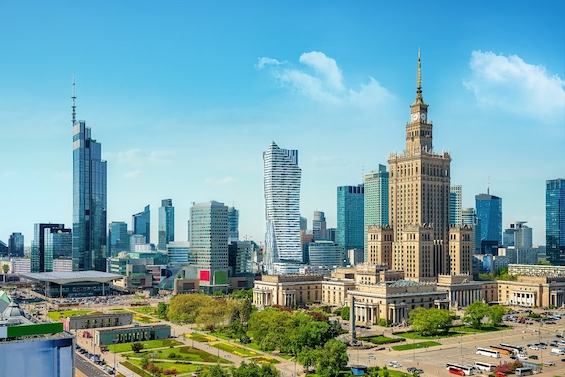
Over the course of two decades late in the 18th century, the neighbors of what was then called the Polish-Lithuanian Commonwealth progressively seized portions of its territory on three occasions. History records those actions as the three Partitions of Poland. The result was to eliminate sovereign Poland and Lithuania for 123 years until 1918. But it happened again barely 20 years later, when Nazi Germany and the Soviet Union conspired to divide Poland between them. Independent Poland reemerged only in 1945, when World War II came to a close. But hard bargaining by the USSR shifted Poland’s borders westward. And the country was in fact only nominally independent as a member of Stalin’s Warsaw Pact. The nation broke its bonds again only in 1989.
A monumental historical saga
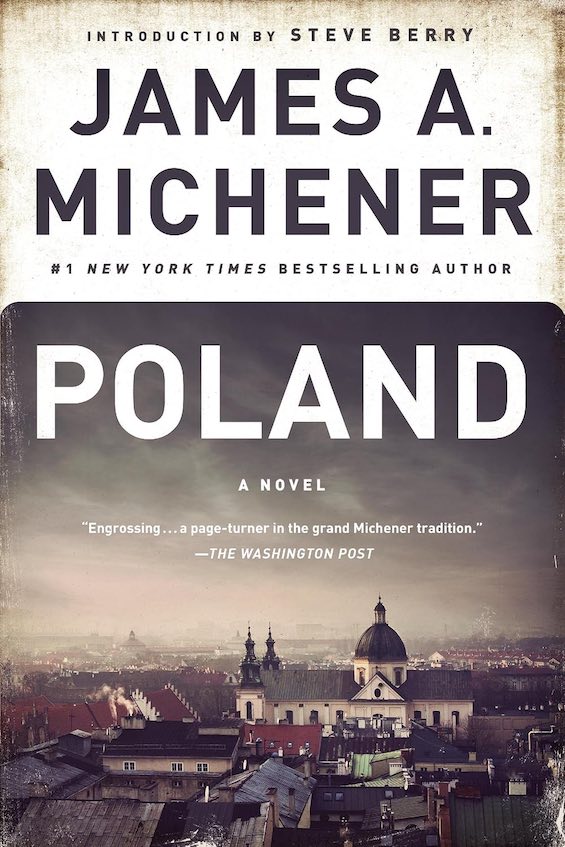
In fact, those four partitions were only part of the story. On three other occasions Poland’s neighbors invaded the country, reducing its towns and cities to rubble and killing millions of its people. The “Tatars” in the13th century. (They were Mongols, actually. Contemporaries misidentified them, and Michener repeats the error.) Teutonic Knights in the 15th. And the Swedes in the 17th. Not to mention the Soviet takeover in the 20th. Poland has been the whipping boy of Central Europe for nearly a thousand years. And still the nation endures. This is the central theme of Pulitzer-winner James A. Michener’s monumental historical saga, Poland. In 700 pages, Michener portrays the country’s history from the Medieval Era to 1981, when the Communist regime began to crack apart.
Poland by James A. Michener (1983) 700 pages ★★★☆☆
Three families interact from 1241 to 1981
Michener’s story sprawls across eight centuries. Numerous influential families enter the picture. But the principal storyline revolves around the interaction of three families who live in proximity to one another.
- The Lubonskis are aristocrats. They’re one of the princely houses whose wealthy patriarchs generally ruled from the seat of their many landholdings in a fortress named Castle Gorka. They own numerous villages and thousands of serfs. And they play a central role in the centuries-long dominance of the many noble families together called Magnates. These leading families ruled collectively, electing “kings” from foreign lands for lifetime appointments to largely ceremonial roles.
- The Bukowskis are petty nobles who owe allegiance to the Lubonskis. Their name is well-known and respected, but until the 20th century they are poor. Then the family’s eldest son marries the daughter of the immensely wealthy American ambassador. The strong-willing young woman invests millions in rebuilding the Bukowski castle into a showcase of invaluable art, overshadowing Castle Gorka.
- The Buks are impoverished peasants who eke out an existence as serfs on lands owned by the Bukowskis.
Throughout the generations, as their fortunes rise and fall, these families interact. Sometimes they’re allies, sometimes adversaries, The effect is panoramic.
Major historical events dominate this story
Michener makes no effort to chronicle the affairs of the three principal families from decade to decade, much less year to year. He skips through the centuries, highlighting the principal events that have shaped Polish history.
The novel opens and closes in 1981 with a meeting between Communist agriculture minister Szymon Bukowski and farm-union leader Janko Buk in the village of Bukowo. Alone, and together with a hard-line Communist theoretician and a Catholic bishop, they discuss agricultural problems and policies. The discussion revolves around the possibility of forming a farmers’ union analogous to the Solidarity movement—a development that is anathema to the government.
The narrative continues with major attention given, first of all, to the invasions of alien powers.
The invasions
- The earliest ancestors of the three families surface in the course of the Mongol invasion of Poland in 1240-41. Michener details the major battles that ensue, including the Siege of Kraków, the country’s historical capital city.
- Late in the 14th century the Teutonic Knights invaded. Only in 1410 did Polish forces manage to overcome them at the Battle of Grunwald—known in Germany as the Battle of Tannenberg.
- King Charles X Gustav of Sweden invaded Poland in 1655, triggering the Polish-Swedish wars. At the time, Poland and Lithuania were united. Together, they ruled much of Eastern Europe (including a great deal of present-day Ukraine). But the Swedes were more powerful militarily and managed to dismantle the Polish-Lithuanian Commonwealth.
- The massive Ottoman Empire threatened to devour all of Europe. Only the city of Vienna stood in its way. But a coalition of forces from throughout the continent, dominated by the Holy Roman Empire and Poland, stopped the Turks in the Siege of Vienna in 1683. The hero of the battle was King Jan Sobieski of Poland, who brilliantly led the combined armies.
Self-inflicted wounds
- The Magnates, as Michener titles them, enjoyed what they termed the Golden Freedom, which reached its peak in the 18th century. This, of course, was freedom for the wealthy aristocrats who ruled the country, while the masses of Poles labored as serfs on their estates. They maintained their control through the “liberum veto” system, under which a single aristocrat could deny the Parliament the power to act. They also elected the king, who was almost never a Pole but someone from one of the neighboring countries (Russia, Austria-Hungary, or Prussia) whose monarchs had managed to bribe the largest number of Magnates.
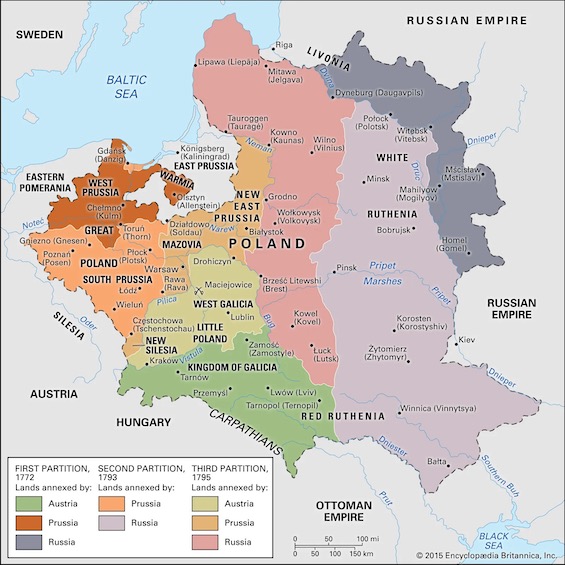
- The three Partitions of Poland in 1772, 1793, and 1795 were a result of the weakness guaranteed by the nobles’ domination of the country’s government and the self-seeking policies they promoted. By 1795, Poland’s neighbors had completely absorbed the nation despite a valiant effort known as the Kościuszko Uprising (1794), engineered by Tadeusz Kościuszko. (He was the military engineer who had served with George Washington in the American War of Independence.)
Of course, for six years from 1939 to 1945, Poland suffered the brutal Nazi occupation. Michener portrays life in the death camp of Majdanek in excruciating detail. He devotes unsparing attention to Nazi atrocities there and in the villages and towns. His rendering of the period is one of the most moving accounts of the Holocaust that I’ve ever come across.
About the author

For nearly half a century James A. Michener (1907-97) was one of America’s best-loved and bestselling authors. His career spanned the publication of Tales of the South Pacific in 1947, which won the Pulitzer Prize for Fiction, to historical sagas including Hawaii (1959), The Source (1965), and Alaska (1988). His novels sold an estimated 75 million copies worldwide.
Michener was born in 1907 in a small town in Pennsylvania and raised by an adoptive mother, never knowing his biological parents. He earned a BA in English and history from Swarthmore College and later studied for two years in Scotland at the storied University of St. Andrews. He taught English for several years and gained an MA in Education at the University of Northern Colorado, in Greeley, Colorado. And he served in the US Navy in the South Pacific in World War II and wrote about the experience in his Pulitzer-winning debut, Tales of the South Pacific. Michener was 38 when the book appeared.
For related reading
I’ve reviewed three other books about Polish history:
- The Warsaw Uprising, 1 August to 2 October 1944 by George Bruce (The Warsaw Uprising of 1944)
- Poland Alone: Britain, SOE and the Collapse of the Polish Resistance,1944 by Jonathan Walker (The tragic story of the Polish Resistance)
- The Polish Underground, 1939-1947 by David G. Williamson (They were Europe’s most effective anti-Nazi Resistance)
- The Book of Aron by Jim Shepherd (A brilliant novel of the Warsaw Ghetto)
Today, the best-known author of historical sagas is Ken Follett. I’ve read all five books in the Kingsbridge cycle, including The Evening and the Morning (Ken Follett sets up the Kingsbridge Trilogy). But I’ve also read the fourth book in the series, A Column of Fire (Ken Follett’s 16th-century Kingsbridge saga: Christians killing Christians), and the fifth, The Armor of Light (The Kingsbridge Saga moves to the Industrial Revolution).
Another popular author who writes historical, family-centered sagas is Edward Rutherfurd. I’ve reviewed four of his eight doorstopper novels:
- New York: The Novel (An epic historical novel about New York City)
- Russka (A journey through Russian history in fiction)
- China (Chinese history made fun and easy in a compelling novel)
- London (A monumental historical saga of London spanning 2,000 years)
You might also care to check out:
- Good books about the Holocaust
- 10 true-life accounts of anti-Nazi resistance
- 25 most enlightening historical novels
- Top 10 historical mysteries and thrillers
- The #1 top historical mystery series
- The 8 best historical mystery series
And you can always find the most popular of my 2,400 reviews, and the most recent ones, on the Home Page.