Nazi Germany reportedly dispatched as many as 135 spies to Britain during World War II. And, according to numerous historical accounts, every single one of them was either captured or turned themselves in to authorities. (At least one didn’t fit the pattern, though. He committed suicide instead.) And a unit of MI5 termed the XX Committee (the Double Cross System) “turned” many of them into double agents, a few of whom played central roles in the deception around the Normandy Invasion. But novelist Chris Nickson plays with history in No Precious Truth. He imagines that one of those spies who “turned” proved to be true to his German masters. He escapes, setting in motion a plot that might have helped Germany win the war.
A new WWII spy series debuts
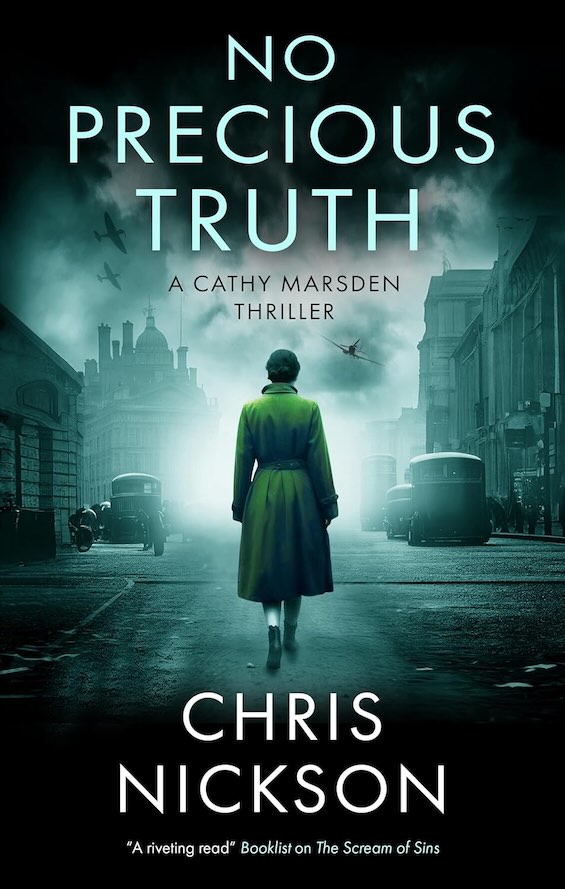
This novel is the inaugural entry in a new spy series starring a young police officer named Cathy Marsden. Now 26, she’d spent four years as a woman police constable, then two more as a sergeant. Then, in No Precious Truth, the police second her to the Special Investigations Branch (SIB). The branch exists to tackle serious crimes connected to the Army. And when word comes down that an escaped Nazi spy has made his way to Leeds, SIB assigns her to work with the XX Committee to chase him down. A fraught manhunt ensues in which the spy proves himself more than equal to the men sent in pursuit of him. But not, in the end, more than Cathy.
No Precious Truth (Cathy Marsden #1) by Chris Nickson (2026) 290 pages ★★★★☆

Her brother doesn’t hold a desk job. He’s a spy.
Leeds, 1941. As the novel opens, Cathy has settled into her job with SIB. She’s helping pursue a local racketeer and deserter. But everything changes when her brother turns up. Cathy had believed Dan held a routine Civil Service office job in London. In fact, as she now learns, he works for the XX Committee. The SIB’s new task is to find a traitorous spy who has escaped custody and is believed to be making for Leeds. And she’ll be working with Dan who’s in charge of the operation.
The spy is a Dutchman working for the Germans. He’s known as Minuit, and the powers that be in London have picked Dan for the hunt because he grew up in Leeds and knows the city. The stakes are high. There are several possible wartime targets nearby of strategic importance. Time is short, and the fugitive is carrying eight sticks of dynamite. It’s enough to slow the war effort for Britain by destroying any of several local armaments factories.
A brother-sister dynamic, the British class system, and wartime detail
The sibling relationship is the emotional core of the book. Dan was always the clever child who overshadowed Cathy no matter how hard she worked. Naturally, then, when he takes over command of her squad, her old sense of inadequacy returns. As the hunt goes on, Cathy comes to know her brother properly for the first time. And she sees how hard it has been for a working-class Leeds boy to fit in among the public-school toffs who run the show in London.
The novel abounds with wartime detail. Cathy worries about rationing. She lives with her parents, often spending nights in their backyard air raid shelter. She serves weekly as an air raid warden. And those details come into high relief in the book’s epilogue. It’s set on March 14, 1941, the night of the Leeds Blitz, the most destructive bombing raid in the city’s history.
About the author

Chris Nickson is a British novelist and biographer who was born in the UK in 1974 but lived in the United States in his 20s before returning to the UK in 2005. He has written 20 biographies of musical stars and nine historical mystery novels. He lives in Leeds, where most of his novels are set.
For related reading
Check out these other sources of great reading:
- The 10 best novels about World War II
- The 15 best espionage novels
- Top 10 historical mysteries and thrillers
- 10 top WWII books about espionage
And you can always find the most popular of my 2,500 reviews, and the most recent ones, on the Home Page.