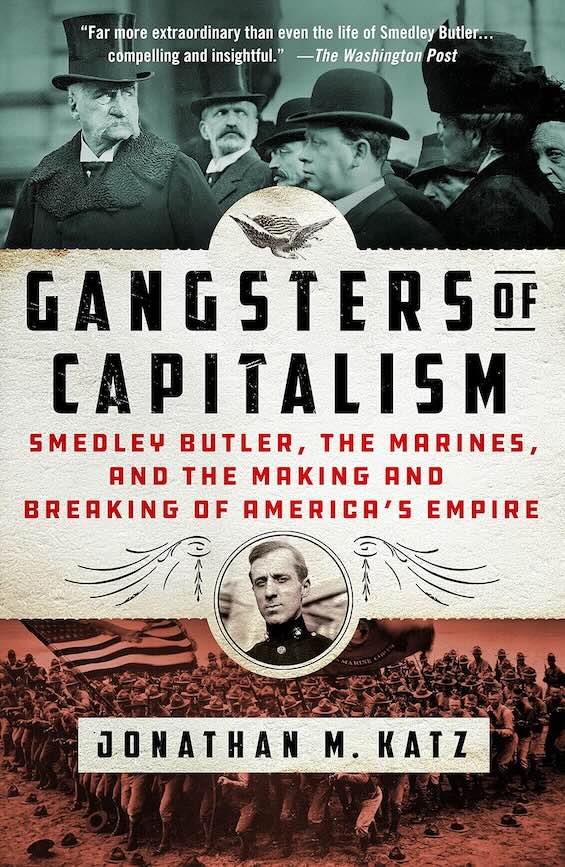
Few know his name today. But over a 34-year military career, Marine officer Smedley Butler (1881-1940) was for long America’s most famous soldier. He fought in the Philippine–American War, the Boxer Rebellion, the Mexican Revolution, World War I, and all of the USA’s imperial adventures in Central America and the Caribbean. Twice he won the Medal of Honor. But after he retired from the Marine Corps in 1931 as a major general, he became an outspoken opponent of America’s foreign policy and military interventions. Giving voice to the conclusions he had reached years earlier but couldn’t admit to himself, he saw his assignments on the fringes of American empire as being driven primarily by U.S. business interests. And author Jonathan M. Katz does him proud in his deeply researched biography, Gangsters of Capitalism.
America denied it had an empire. That was a lie.
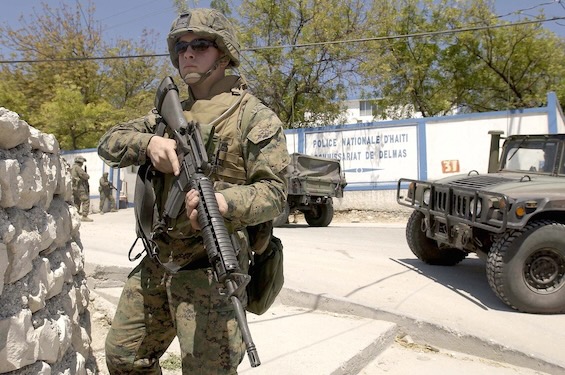
Following World War II, the United States gained a reputation as anti-imperialist. The Roosevelt, Truman, and Eisenhower Administrations played a leading role in dismantling the far-flung British and French overseas empires. And in the process most Americans lost sight of our country’s own history as an unapologetic empire-builder. Seizing Hawaii. Grabbing the Philippines and Puerto Rico from Spain and inheriting its dominant role in Cuba. Imposing unequal treaties on Qing-Dynasty China. Robbing Mexico of revenues from its oil. Carving out the Panama Canal on Colombian territory. And “intervening” again and again in the small nations of Central America and the Caribbean. And Smedley Butler helped lead many of these “interventions” (read: invasions) as a Marine officer.
Gangsters of Capitalism: Smedley Butler, the Marines, and the Making and Unmaking of the American Empire by Jonathan M. Katz (2022) 433 pages ★★★★☆
A privileged upbringing, and a major transformation
Smedley Butler was a Quaker, unlikely though that may seem. But he was Quaker “royalty,” the son and grandson of Congressmen. His father served as chairman of the House Naval Affairs Committee during the Harding and Coolidge administrations, with control over the Marine Corps’ budget during the years when Smedley was most actively engaged in the Caribbean. And there is little doubt that Smedley’s career benefited from his father’s influence.
Katz reveals how, early in his career, doubts began to surface in Butler’s mind about the wisdom of the orders he was carrying out. But for many years he suppressed them. It was only in 1931 as the Bonus Army marched on Washington that he finally faced up to the contradictions in his past. Retiring as a major general, he spoke out publicly at a gathering of thousands of veterans gathered in Washington. And he rebuked General Douglas MacArthur’s inexcusable use of extreme force to dispel the marchers (which MacArthur ordered in defiance of President Hoover’s admonition to avoid the use of force).
The far-reaching damage our imperial past inflicted
After his retirement at the outset of the Depression, Butler emphasized how the military interventions he led served American business interests. Marines protected the United Fruit Company and other overseas businesses, secured the route for the Panama Canal, and enforced the collection of debts for Wall Street banks. But those actions were consequential for several other principal reasons.
- Hundreds of thousands of people died in the military operations the US mounted (many of them in the Philippines). And the damage our forces inflicted has lived on in the memories of local people. Many of those memories still loom large in local politics there today.
- Long before the US government used the Cold War as an excuse to back repressive right-wing governments around the world, Butler’s Marines helped identify and send for training in the United States the men who enforced the will of dictators such as Rafael Trujillo in the Dominican Republic and Anastasio Somoza in Nicaragua. It was all, as he said, to benefit American corporations and Wall Street banks.
- Racism, pure and simple, lay at the heart of the justification the US offered for its interventions. This was consistent with the outsize influence of Southern Congressmen and Senators during the early decades of the 20th century. But Smedley Butler shared this prejudice. And it continues to infect Americans’ views of our neighbors to the south to this day. Many still regard the countries of that region as “banana republics.”
- What goes around comes around. The tactics and the assumptions our forces took overseas eventually came home to roost. To this day, how we view the history Smedley Butler played so large a role in shaping continues to influence our law enforcement practices, our politics, and our lingering blindness about our country’s own imperial past.
About the author

Jonathan M. Katz is an American journalist and author who has written two books of nonfiction. The other is about the response to the 2010 Haiti earthquake and cholera epidemic. Katz earned a BA in History and American Studies from Northwestern University in 2022 and an MA in Journalism from Northwestern’s Medill School of Journalism.
For related reading
Be sure to check out How to Hide an Empire: A History of the Greater United States by Daniel Immerwahr (A supremely entertaining history of American empire).
For a memoir that reflects many of Smedley Butler’s criticisms of US foreign policy, see Confessions of an Economic Hit Man by John Perkins.
I’ve reviewed four other good books on related subjects:
- The United States of War: A Global History of America’s Endless Conflicts, from Columbus to the Islamic State by David Vine (A powerful indictment of America’s permanent war)
- The True Flag: Theodore Roosevelt, Mark Twain, and the Birth of the American Empire by Stephen Kinzer (The racist origins of the American empire)
- The Imperial Cruise: A Secret History of Empire and War by James Bradley (Teddy Roosevelt and the dark side of American foreign policy)
- An Indigenous Peoples’ History of the United States by Roxanne Dunbar-Ortiz (Revisionist US history from an indigenous perspective)
You might also be interested in:
- Good recent books about American foreign policy
- Top 20 popular books for understanding American history
- Good books about racism
- 20 top nonfiction books about history
And you can always find the most popular of my 2,500 reviews, and the most recent ones, on the Home Page.