
For readers in the USA or Europe, it can be a challenge to understand law enforcement policies and procedures in countries grounded in non-Western values and assumptions. In China, for example. The Inspector Chen novels of the Chinese expatriate author Qiu Xiaolong show just how very different from ours is China’s legal system today. So, imagine how very alien law enforcement might seem to us in the China of 1,400 years ago. We can get only a glimpse of that long-ago scene from the work of the 20th-century Dutch “orientalist” Robert van Gulik. In 17 novels featuring a Tang Dynasty magistrate he calls Judge Dee, van Gulik projects the idiom of the modern detective novel into an entirely alien environment. Poets and Murder, the last of the 17 books, is a perfect illustration.
A model of sorts for Judge Dee
The main character of van Gulik’s books, Judge Dee, was based on the real statesman and investigator Di Renjie, who lived in the 7th century, during the Tang dynasty (618–907 CE). However, van Gulik added elements of Ming dynasty China (AD 1368–1644) in his novels. Reading between the lines, we understand that “Dee” was a mid-ranking Chinese court official assigned by the emperor to preside over the government of one county. So, when lower officials brought such matters as murder to his attention, he would lead an investigation to identify the killer. Much like a public prosecutor in France today. But with values and beliefs so dramatically different from those of modern times in the West, the analogy surely falls apart.
Poets and Murder (Judge Dee #17 of 17) by Robert van Gulik (1968) 186 pages ★★★☆☆
Famous visitors read poetry
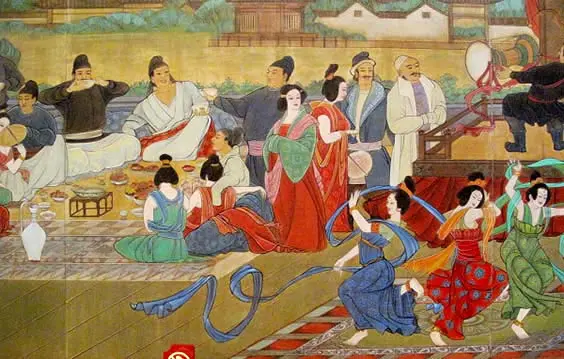
In Poets and Murder, “the Prefect” (a senior official) has summoned Judge Dee to the neighboring district of Chin-hwa for a conference. There, Dee’s friend, Lo Kwan-choong, an amateur poet, serves as Magistrate. Lo, in turn, has invited three senior figures to join them for a spirited discussion of poetry. And, to complicate matters, a famous female poet and actress will be spending a few days with them in Chin-hwa, too. She has been accused of a brutal murder and is on her way under escort to Beijing, to be judged in the imperial court. Then, as if this is not enough, a visiting scholar named Soong has been murdered. And Lo must drop everything and rush to the scene for Lo to investigate. Dee follows along.
What we have here is, of course, the makings of what my contemporaries might label a cluster**k. And van Gulik does not disappoint. Soong’s murder proves to be only the first. And everybody gets into the act as first one, then another of the famous visitors faces accusations of murder. Naturally, it’s Dee who sorts everything out in the end.
Ho hum.
About the author

Robert van Gulik (1910-67) was a Dutch “orientalist” (specialist in Asian affairs) and diplomat who was best known as the author of the Judge Dee mysteries. He based the “judge,” really an investigating magistrate, on the protagonist of an 18th century Chinese detective novel. Born in what was then the Dutch East Indies, he studied Mandarin and other East Asian languages. He earned a BA from Leiden University and an MA and PhD from Utrecht University.
For related reading
I’ve also reviewed two other Judge Dee mysteries:
- The Chinese Maze Murders – Judge Dee #8 of 17 (A fascinating Ancient Chinese detective novel)
- The Lacquer Screen – Judge Dee # 9 of 17 (A detective in Tang Dynasty China goes undercover)
You’ll find much better reading in this genre at The 8 best historical mystery series.
And you can always find the most popular of my 2,500 reviews, and the most recent ones, on the Home Page.