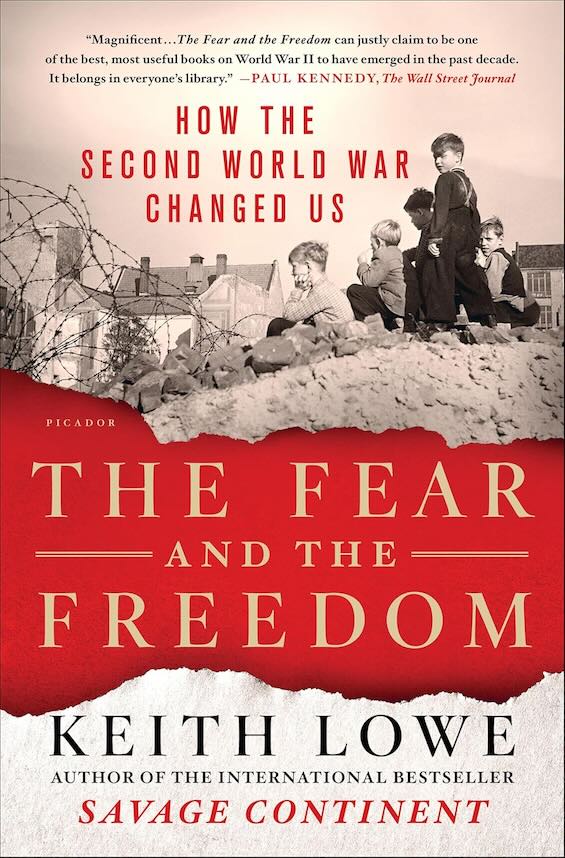
Is it too much to say that World War II “changed everything?” In The Fear and the Freedom, author Keith Lowe makes a strong case to justify the claim. As many as 80 million people died of a global population barely 30 times that number in 1939. Perhaps an equal number became refugees or “displaced persons.” Meanwhile, the war gave birth to an array of powerful international institutions and set the course for free trade worldwide. And it set in motion a new Cold War that divided the nations of the globe for four decades to come. All told, the Second World War upended the psychological, political, and social foundations of the pre-war world.
Heroes, martyrs, and monsters
Placing all these developments in context, Lowe susses out the fears and expectations of the Europeans and Asians most deeply affected by the war. In its immediate aftermath, a wave of unrestricted optimism swept over the globe. Utopian visions bloomed, endowing such institutions as the new United Nations and the World Bank with promise far beyond anything they could deliver. And new myths and legends sprang up, too, creating widespread belief in the heroes and monsters of the war years, many of whom never justified the labels. Then, in short order, reality intruded, exploding many of the myths.
Throughout his account, Lowe sprinkles the stories of individual men and women involved in every aspect of the conflict. We recognize few of their names. But in Lowe’s sympathetic treatment we come to understand how their individual experiences reflect the broader trends that swept the globe in those fateful years.
The Fear and the Freedom: How the Second World War Changed Us by Keith Lowe (2017) 576 pages ★★★★★
The major takeaways
I’ve struggled to sum up the major themes and conclusions Lowe advances in The Fear and the Freedom. It’s just too vast a picture, and my memory for detail isn’t up to the task. So I’ve turned to Claude AI for that summary. I’m including it below, with minor edits and additions. It’s a superb summing-up of Lowe’s perspective.
The war created enduring myths
Lowe opens with the stories societies told themselves afterward: myths of heroes, monsters, and martyrs. Nations cast themselves as righteous victors or innocent victims, and these narratives hardened into national identities. Lowe argues such myths, while comforting, distort history and continue to fuel grievances, from Eastern Europe to East Asia. Of course, the root of these trends lay in nationalism, which in the final analysis Lowe credits as the driving force behind the war.
Utopian dreams emerged from the ruins
The devastation inspired sweeping ambitions to rebuild the world better: through science, central planning, modernist urban design, and welfare states. The belief that expertise and rational organization could engineer a fairer society defined the postwar decades, for better and worse. It was 20 years or more before those ambitions began to hit the wall.
The pull between freedom and belonging is the book’s core
Drawing on existentialist ideas, Lowe suggests the war thrust an unsettling freedom on people, since old hierarchies, empires, and certainties had collapsed. That freedom was exhilarating but frightening. Many responded by seeking refuge in new groups: nations, ideologies, religions, and political blocs. This tension between the desire for liberty and the longing for security explains much of postwar history.
The dream of world unity collided with nationalism
The United Nations, international law, and the European project all grew from the conviction that nationalism had caused the catastrophe. Yet the war simultaneously energized nationalism elsewhere, driving independence movements across Asia and Africa and the dissolution of European empires. In 1939, there were just 77 widely recognized sovereign states in the world. Forty years later there were 166. Decolonization was prolific.
The world polarized
Wartime alliance gave way to the Cold War, as the United States and the Soviet Union each needed an enemy to define themselves against. Lowe shows how fear of a new “monster” replaced fear of the old one. And that fear persisted until the breakup of the USSR in 1991, only to be reawakened two decades later under new Russian and Chinese leadership.
Trauma and displacement outlasted the fighting
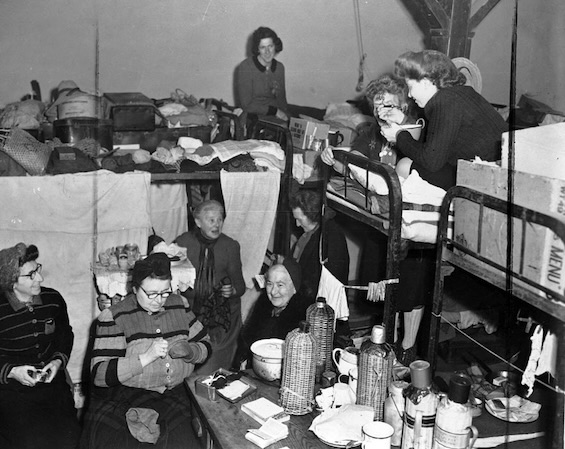
Mass migration, ethnic cleansing, the founding of Israel, the partition of India, and civil wars were all part of the war’s long tail. Individual and collective trauma passed down through generations.
The legacy persists today
Lowe concludes that contemporary politics, including populism, anxieties about immigration, and invocations of wartime glory, still draws on 1945’s emotional inheritance. Understanding the war’s myths honestly, he argues, is essential to escaping their grip.
The book’s overall lesson is that the postwar world was built equally on hope and dread, and we still live inside that inheritance.
About the author
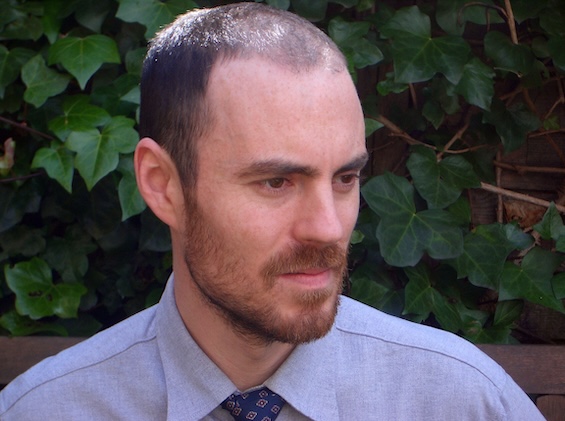
According to Google Books, Keith Lowe is widely recognized as an authority on the Second World War, and has often spoken on TV and radio, both in Britain and the United States. He has written five nonfiction books about the conflict. Lowe has lectured in Britain, Canada, and Germany. He lives in North London with his wife and two children.
For related reading
You’ll find other excellent books at:
- 20 top nonfiction books about World War II
- 10 top WWII books about espionage
- The 10 most consequential events of World War II
- Good books about the Holocaust
- The 10 best novels about World War II
And you can always find the most popular of my 2,500 reviews, and the most recent ones, on the Home Page.