From its early days following World War I, what Hitler later renamed the Nazi Party had a powerful political sponsor behind the scenes: the Thule Society. Hitler biographer Ian Kershaw notes that the organization’s “membership list … reads like a Who’s Who of early Nazi sympathizers and leading figures in Munich.” These included Rudolf Hess, Alfred Rosenberg, Hans Frank, Julius Lehmann, Gottfried Feder, Karl Harrer, and Dietrich Eckart, all of whom became prominent in the Nazi Party. But the biggest early influence on Hitler was Eckart, who introduced his protégé to his wide circle of wealthy and influential friends. Many of them contributed much-needed funds to the party. But General Erich Ludendorff was the connection to Hitler’s most important source of ongoing financial support. That was industrialist Fritz Thyssen. who met him after hearing him speak at a rally..
A marred effort to trace the sources of Hitler’s money
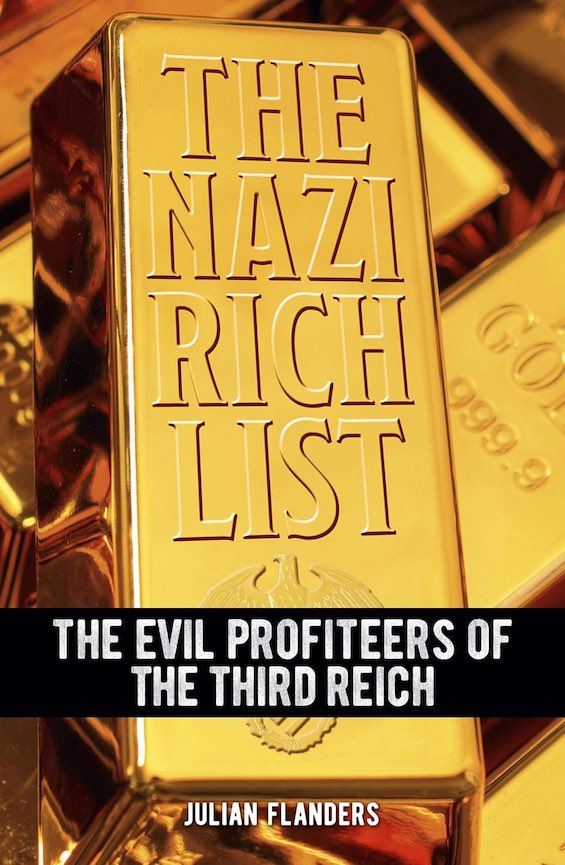
These connections come to light in Julian Flanders’ 2025 book, The Nazi Rich List. The title refers to the author’s lame attempt to identify the wealthiest among the top Nazis. In a final, unnecessary chapter, he provides estimates for their net worth. Although documentary evidence does provide some such information, the list is necessarily based on guesswork to a great extent. And that chapter cheapens what is otherwise an enlightening effort to trace the sources of Adolf Hitler’s and the Nazi Party’s sources of financial support. In that pursuit, Flanders does a creditable job.
The Nazi Rich List: The Evil Profiteers of the Third Reich by Julian Sanders (2025) 232 pages ★★★☆☆
When the floodgates opened for the Nazis
Over the years, Flanders makes clear, the biggest single source of the party’s (and Hitler’s personal) financial backing was the revenue from its rallies and other events. Individually, Hitler also earned large speaking fees and huge royalties from Mein Kampf once it became compulsory reading for party members. Eventually, he amassed a fortune in the billions. When he committed suicide in 1945, he was reputedly Europe’s richest man. (Flanders credits him with net worth of up to $6.5 billion, the equivalent today of more than $100 billion.)
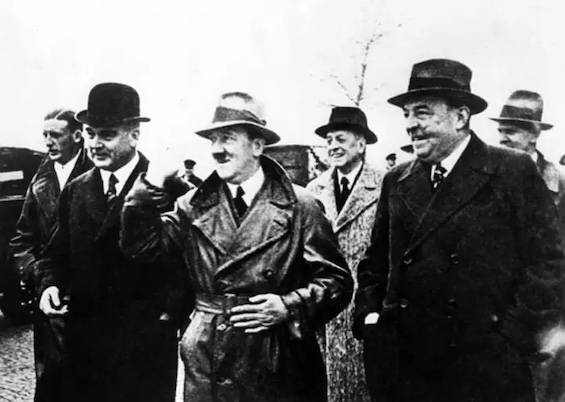
The turning point came at the end of the 1920s. As the frenzied prosperity of the decade collided with the Crash of 1929 and the Depression that followed, the party’s prominence grew. And with that its need for larger and larger sources of support. Income from rallies no longer sufficed. A few extremely wealthy businessmen like Thyssen were reliable backers for years. Some joined him by 1932. But it was only in 1933, when Hitler took power as Chancellor, that the German Establishment came aboard.
A better source for the details
That story is better told in Nazi Billionaires: The Dark History of Germany’s Wealthiest Dynasties by David de Jong. Backers included the owners and top executives of BASF, Bayer, Agfa, Opel, I G Farben, Siemens, Allianz, and Telefunken, names which remain recognizable worldwide to this day. In a fateful meeting with Hitler and Göring, the Nazis raised the funds they needed to move toward a dictatorship. Krupp was the biggest backer. But I G Farben also gave an enormous sum. “Much of it came from the company’s US subsidiary,” Flanders writes, “and must have been approved by the board, which included Edsel Ford, of the Ford Motor Company, directors of the Federal Reserve Bank of New York including Paul Warburg, the Standard Oil Company and even members of Franklin D. Roosevelt’s Cabinet.”
About the author
Although I was unable to locate a photo, Google Gemini turned up the following information about the author: Julian Flanders is an experienced British editor and author based in Kent, UK, who specializes in nonfiction subjects including history, politics, and sports. He has had a long career in publishing, including roles as an editorial director and manager for various UK publishing houses. Flanders is also the author of The Hitler Youth: How Germany Indoctrinated a New Generation.
For related reading
I’ve also reviewed Nazi Billionaires: The Dark History of Germany’s Wealthiest Dynasties by David de Jong (The Nazi war profiteers who exploited slave labor).
You’ll find other excellent books at:
- 10 top nonfiction books about World War II
- 10 top WWII books about espionage
- The 10 most consequential events of World War II
- Good books about the Holocaust
And you can always find the most popular of my 2,400 reviews, and the most recent ones, on the Home Page.