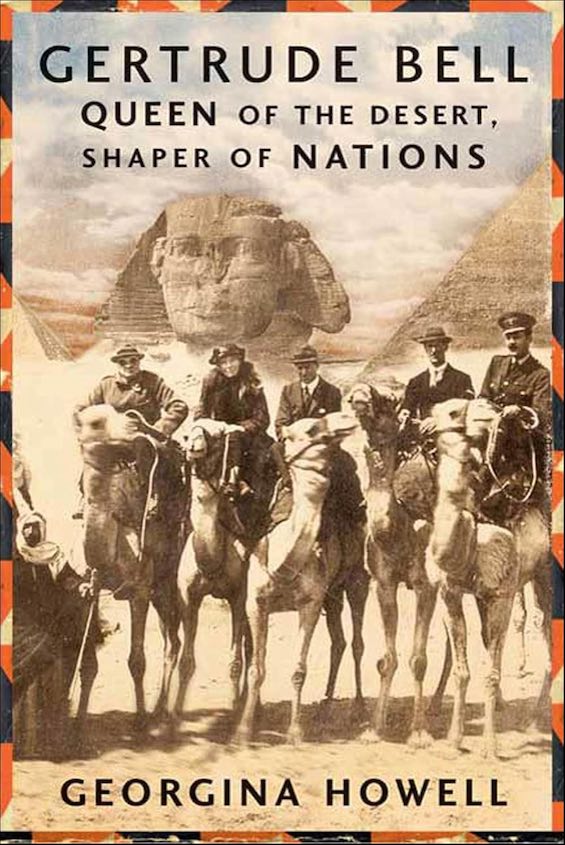
Gertrude Bell (1868-1926) was one of the most remarkable women of the 20th century. Or of any century, for that matter. Her life spanned the Victorian and Edwardian eras, the First World War, and its aftermath. She distinguished herself as an explorer, mountaineer, travel writer, political officer, administrator, and archaeologist. For two decades, she was the West’s leading expert on the Middle East and Arab affairs. Her fame dwarfed that of Lawrence of Arabia (1888-1935) until 1919, when American journalist Lowell Thomas made him famous. While Lawrence helped spark the Arab Revolt in 1916, it was Bell who had paved the way during two decades of exploration in the region. And it was she, not he, who engineered the formation of an independent Iraqi state under the leadership of her friend, its first king, Faisal I (1885-1933). Georgina Howell’s admiring biography of Bell tells the whole story.
An important historical figure who deserves a better biography
Not all historians or biographers are great writers. But nor are all writers capable of producing readable history or biography. Georgina Howell, a South African fashion journalist trained as a secretary attempted to do just that in Gertrude Bell: Queen of the Desert, Shaper of Nations. It’s a worthy effort, because she obviously took great pains to research her subject. But the result is garbled and lacks perspective. Howell leaves readers deep in the weeds of Gertrude Bell’s life. While Howell structured the book roughly structured along chronological lines, she jumps around in time so often as to muddle the story. It’s a pity, because Gertrude Bell was, truly, an important historical figure. She deserves better.
Gertrude Bell: Queen of the Desert, Shaper of Nations by Georgina Howell (2007) 540 pages ★★★☆☆
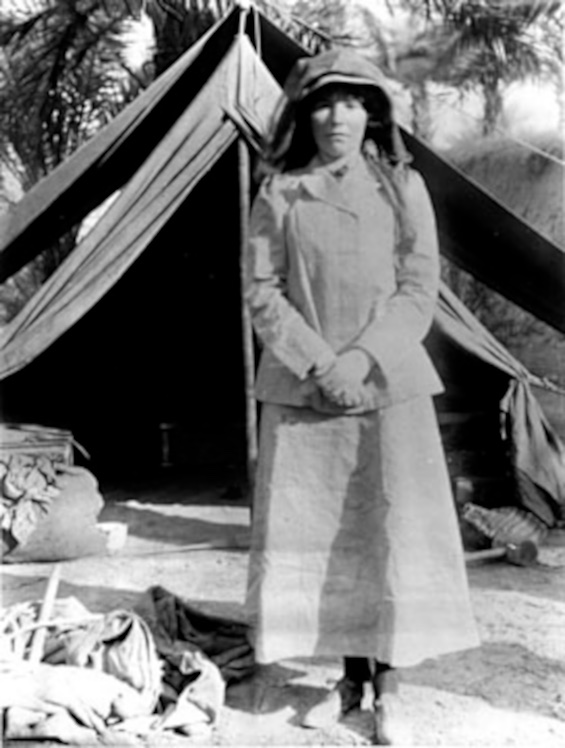
Gertrude Bell as a scion of her class
The English class system had its roots in the medieval world of nobles, merchants, and peasants. But its modern expression took shape in the Victorian Era and the Edwardian period that followed. This was a time when the British Empire reached its full extent, and Britain was still regarded as the most powerful nation in the world. Gertrude Bell was a child of that time. She was born into what was reputedly the sixth richest family in England and one of the most influential. Her grandfather had founded an iron and steel empire that continued to flourish under her father. Her extensive travels year after year with a large retinue were costly, but her loving father happily footed the bill.
She was an outlier, extremely well educated
Bell was exceptionally well educated, becoming the first woman to graduate from the University of Oxford with first-class honors in Modern History in 1888. She was fluent in Arabic, Persian, French, and German, and also proficient in Italian and Turkish. This facility with languages, and the self-assured, even haughty face she showed no matter the situation gained her access to Bedouin sheiks and government officials alike throughout the Middle East. This, despite the misogyny so deeply ingrained in the Arab culture of the time. And her decades of travel across deserts and mountains and careful observation enabled her to become the reigning expert on the politics of the region. And this made her invaluable to the British government, and especially the military, when World War I broke out between the Western allies and Turkey.
The British Establishment was slow to recognize her insight
Unfortunately for her, and for her government, there were at first few in the British Establishment who were willing to recognize her authority. Sexism was as deeply entrenched in Britain’s ruling class as it was in the Middle East. Again and again, she butted heads with headstrong and sometimes incompetent men assigned to manage her. Then, she invariably came out on the losing end. Only as the war progressed and her insight and wisdom became impossible to miss did the British government follow her advice. And that paved the way for her pivotal role in establishing the first independent Arab nation east of Suez. Later in life as a self-taught archaeologist, she also founded the Iraq Museum, determined that the country’s archaeological heritage remain on its own soil.
About the author

Georgina Howell (1942-2016) was a journalist and author who wrote several books, mostly on fashion. But her biography of Gertrude Bell was a hit. Werner Herzog adapted it to a film starring Nicole Kidman. Bell was born in South Africa in 1942 and educated in England. Her “alma mater” was the London School of Secretaries. She was married for a time and had one son.
For related reading
Check out 12 great biographies.
You might also care to see Lawrence in Arabia: War, Deceit, Imperial Folly and the Making of the Modern Middle East by Scott Anderson (Was Lawrence of Arabia the man you thought he was?).
For links to great reading, see 25 top nonfiction books about history and Top 10 nonfiction books about politics.
And you can always find the most popular of my 2,400 reviews, and the most recent ones, on the Home Page.