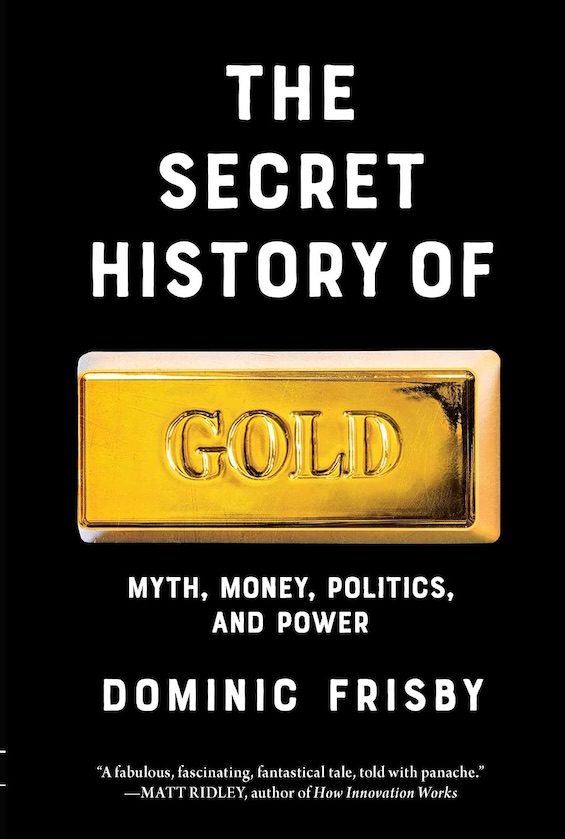
Just so you know at the outset, the author of The Secret History of Gold comes to the task with a pronounced set of biases. He is a gold bug who believes that shiny, indestructible element is the ultimate store of value. He believes governments in the past erred by taking nations off the gold standard. And he describes himself as a “right libertarian,” who believes private property rights and free-market capitalism require governments to spurn efforts to address economic inequities. But who else could bring to a history of gold’s influence in human affairs such passion to the task? Dominic Frisby certainly does that, and more. And he has written a book that’s full of surprises. His only error, so far as I can tell, is to give the book a misleading title. Because there’s nothing secret about this history.
It’s not all in Fort Knox or made into jewelry
Chances are, you never give much, if any, thought to gold. After all, so far as most people are concerned, gold exists as jewelry, in Fort Knox and other central bank depositories, and in the ground somewhere in South Africa. But the reality is much more complex. And Frisby does a superb job of giving us perspective on that reality.
According to the World Gold Council, all the gold that’s ever been mined in history amounts to some 220,000 metric tons (tonnes) of 2,204 pounds each. About two-thirds of that has been wrenched from the ground only since 1950. And it all exists to this day, because gold is virtually indestructible. But if you melted all of it down, it would fill only a cubic block measuring 73 feet on a side. Of course, it’s not in a single block. And where it can all be found today isn’t entirely clear.
The Secret History of Gold: Money, Myth, Politics and Power by Dominic Frisby (2025) 288 pages ★★★★☆
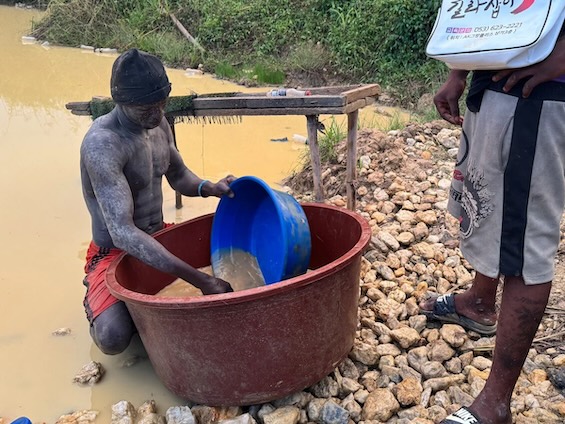
Where is all the gold today?
Surprisingly, private individuals own nearly half of all the gold in the world (about 95,000 tonnes). It’s in the form of jewelry, bars, and coins. And Indian and Chinese own more than half of that, a total of at least 55,000 tonnes.
Governments and central banks hold nearly all the rest. Official figures as compiled by the World Gold Council show the distribution of government stores of gold by country, with the top 10 holdings listed in the table below:
| 1. United States | 8,133 tonnes |
| 2. Germany | 3,350 tonnes |
| 3. International Monetary Fund | 2,814 tonnes |
| 4. Italy | 2,452 tonnes |
| 5. France | 2,437 tonnes |
| 6. China | 2,313 tonnes |
| 7. Russia | 2,305 tonnes |
| 8. Switzerland | 1,040 tonnes |
| 9. India | 880 tonnes |
| 10. Japan | 846 tonnes |
Other sources dispute the numbers
The problem with that table, as Dominic Frisby reveals, is that there are major questions about its accuracy. The figure for China may, in fact, be wildly underreported. After revealing the results of his research, Frisby notes that China owns anything from 13,000 to 20,000 tonnes, considerably more than the US’s 8,133 tonnes. And they’re hiding that fact, as they do other aspects of their economy, because disclosing it might disrupt world markets. Also, they may be looking forward to the day when the yuan displaces the US dollar as the world’s reserve currency. Moreover, there are questions about whether the US really does hold 8,133 tonnes of the metal. The stock in Fort Knox hasn’t been audited since 1953. And some US government gold holdings may not be of investment grade.
In fact, according to Alexander Hübbert, a doctoral candidate in finance at Stockholm University, “The World Gold Council puts jewellery near 97,000 tonnes, bars, coins and ETFs near 49,000, and central banks near 38,000. So private hands hold about two-thirds of your 220,000, and governments under a fifth.” In other words, the numbers reported above may be far off the mark.
The historical impact of gold
But all this about the distribution of gold in the world today comes toward the end of Frisby’s book. He sets out with an account of gold in the ancient world and traces its impact through the millennia, as it accumulated growing importance in financial affairs. Again and again, as the author sees it, gold played a major role in determining which nations rose to prominence and which fell as they acquired or shrank their holdings of gold. It’s hard to fault his account.
For example, Frisby notes that gold figured in the decline of the Roman Empire. “One hugely overlooked factor,” he writes, “must be the depletion of its mines, and the resulting shortage of gold and silver. When the mines were depleted, the money ran out.” And without money, Rome couldn’t pay the soldiers in its legions. Or finance the empire’s far-flung operations. He may be right about that.
What’s wrong with the gold standard?
Frisby laments the passing of the gold standard. which ended in the US and the UK early in the Great Depression. Had it not, the two nations would have had their hands tied in any efforts to revive their economies through government spending. The world’s supply of gold was growing very little in the 1930s, far from enough to match population growth. So, with gold unavailable to back the printing of new money, the two economies would have spiraled even deeper into deflation. And those falling prices would have driven even more businesses into bankruptcy and punished any private debtors by increasing the relative value of the payments they’d need to make to creditors. Only the creditors, already wealthy, would come out ahead.
But Frisby, and a few other right-wing advocates of gold, argue that enabling government to print money without the backing of gold leads to inflation and disadvantages savers and debt holders. For example, as money loses its value with prices rising, savings effectively shrink. The problem is, far more people are hurt by deflation, because it leads to unemployment and shrinks the business sector.
The upshot is that monetary policy is a hostage to geology. With little new gold coming on the market, governments’ freedom of action is constrained. And the resulting deflation can last for decades, as it did in the US in the late 1800s. Remember, that’s the time when the great Robber Baron fortunes were built. Meanwhile, most people suffered.
Surprises
Scattered throughout his book, Frisby surprises with curious facts and factoids associated with gold and money in general. The book is enjoyable in part as a result.
But there are bigger surprises in store for the reader. For example, it’s been years since South Africa was the world’s biggest gold producer. Today, the world’s major gold producers, according to the World Gold Council, are, in descending order, China, Russia, Australia, Canada, Peru, Ghana, USA, Uzbekistan, Mexico, Indonesia, and, lastly, South Africa, in 11th place.
And in a digression—one of many—Frisby reports the following. After reading millions of words about World War II, I was thrown for a loop. Here it is: “Japanese mass murder during the Second World War was a scale up from the Nazis’, hard though that may be to believe. The Nazis killed over 17 million. The Japanese slaughtered twice as many, including 23 million ethnic Chinese. If you were a Nazi prisoner of war from the Anglosphere, you had a 4 per cent chance of dying; held by the Japanese, the death rate rose to 30 per cent.”
About the author

Wikipedia informs us that “Dominic Frisby is a British comedian, author, and voice actor, known both for his satirical songs and his commentary on finance and economics.” He is also the author of seven nonfiction books, five of which are about finance. Frisby was born in the UK in 1969 or 1970 and educated at Manchester University and at an acting school. He describes himself as a right-libertarian, and it shows in this book. He’s based in London and is the father of four children.
For related reading
You might also be interested in Good books about finance and economics.
Also, check out:
- 20 top nonfiction books about history
- My 10 favorite books about business history
- Top 10 nonfiction books about politics
And you can always find the most popular of my 2,500 reviews, and the most recent ones, on the Home Page.