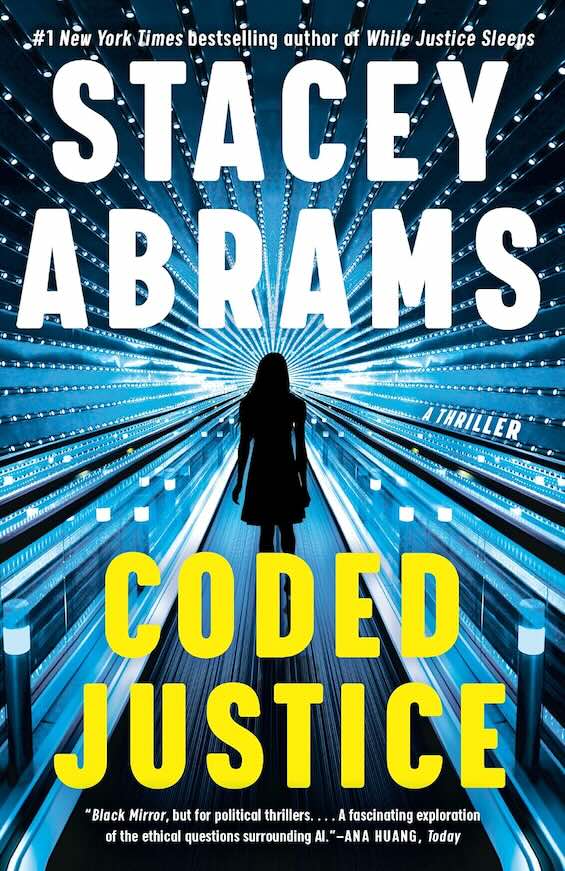
You can hardly scan the headlines in a newspaper or open a screen to a news program without coming across something about artificial intelligence these days. AI has become a dominant force in technology, science and mathematics, entertainment, and even the economy. But in no field does AI promise to become more consequential to our future than in healthcare. From robotics in surgery to drug discovery to diagnostics, artificial intelligence is fast entering the realm of modern medicine. And its collision with traditional methods of patient care is raising worrisome questions about technology run amok. Novelist and social activist Stacey Abrams explores some of these questions in Coded Justice, a hold-onto-your-seat thriller about a pioneering new approach to AI in healthcare.
The investigator is a prodigy
Coded Justice is the third entry in Abrams’ series of mystery novels featuring attorney-investigator Avery Keene. In this novel, her protagonist is just 18 months out of a Supreme Court clerkship. But she’s already compiled a headline-grabbing reputation for her prowess in thwarting high-profile criminals. Keene is now an associate in the law offices of Clymer Brezil, a prestigious boutique firm on K Street in Washington, DC. But when a multi-billion-dollar high tech firm named Camasca comes calling, it’s not the partners they ask for. It’s Avery Keene.
Coded Justice (Avery Keene #3) by Stacey Abrams (2025) 422 pages ★★★★★

A mysterious death at a high-tech healthcare firm
As Keene learns in short order after meeting Camasca’s brilliant founder and CEO, Dr. Rafe Diaz, one of the company’s top technicians has died in a mysterious accident. As he explains, the coroner and the police have ruled it an accident. But Camasca is on the verge of an IPO that will reap billions for its principals, and they want to be sure. So they’ve called in Keene to conduct an internal investigation under lawyer-client privilege in hopes of learning what really happened. But, of course, that was no accident at all. It’s obvious from the opening scene in the novel. But what isn’t obvious is who or what might have killed the technician. And that’s what Avery Keene sets out to find.
There’s no dearth of suspects in the technician’s death. Two colleagues who worked with him in the company’s Tiger Team. The owner of a troubled pharmaceutical company that has partnered with Camasca. Diaz’s second-in-command, the company’s chief counsel. A former employee. And the company’s AI itself.
An AI that may revolutionize medical care
Working with her three trusted colleagues, Keene begins to acquaint herself with the company’s revolutionary new technology. It’s named “Kawak—an AI neural network that had the mind of a quantum computer and the soul of Hippocrates.” To be more precise, “Kawak is a holistic AI system focused on medical care. At its core, it’s a neural network with a database of limitless capacity that can interface with your smartwatch or a doctor’s MRI. When fully functional, Kawak will mean having frictionless access to the world’s medical knowledge…to your entire health-care record…to your genetic history…and to hyper-personalized, life-saving treatments.” But does it work the way it should? And are patient’s lives in jeopardy?
As Keene’s investigation rushes forward against the imminent deadline of the IPO, more and more questions surface. And more bodies fall by the wayside. Someone, or something, seems desperate to sabotage Camasca and torpedo the IPO.
A word of caution
Stacey Abrams obviously did her homework about AI and its applications in medicine. Clearly, she knows more about these subjects than I do. A lot more. So, I can’t fault her on any of the technical details on which this story hangs. But she does commit two egregious errors of fact on an incidental matter. Both involve Native Americans.
One of the characters in Coded Justice refers to himself as a “Rosebud Sioux.” I find this very hard to believe. The indigenous people who live on the Rosebud Reservation refer to themselves as Lakota, not Sioux. Theirs is one of the three nations that outsiders call Sioux: Lakota, Nakota, and Dakota. Alternatively, they might call themselves Sicangu, one of the seven “council fires” of the Lakota. Many live on the Rosebud Reservation in southern South Dakota.
Elsewhere in the novel, Abrams refers to the Navajo Codetalkers for having broken a Nazi code. This is flat wrong. The legendary Codetalkers were a group of more than 400 bilingual Marines. They communicated for the US military in the Navajo language, which nobody in Japan could ever possibly understand. They worked in the Pacific Theater, not Europe. And they had nothing to do with breaking codes.
Clearly, nobody fact-checked the novel’s text. So, that gives me pause about the details elsewhere in the story.
About the author

Stacey Abrams is best known to the American public for her work to combat voter suppression through the organization she founded and led, Fair Fight Action. She served in the Georgia House of Representatives for a decade, mostly as the minority leader, and was a candidate for Governor in 2018. But Abrams narrowly lost the election.
However, in addition to her ongoing career as a Democratic activist, Abrams is also an accomplished author. She has written three nonfiction books, three thrillers in the Avery Keene series, and, much earier, eight romance novels.
Abrams was born in Madison, Wisconsin, in 1973. She holds a BA from Spelman College, an MPA from the University of Texas at Austin, and a JD from Yale University.
For related reading
Check out 10 great medical and biological thrillers and 30 good books about artificial intelligence.
You’ll find other great reading at:
- 10 top novels about private detectives
- 20 excellent standalone mysteries and thrillers
- Top 20 suspenseful detective novels
- Top 10 historical mysteries and thrillers
- The 8 best historical mystery series
- The six best police procedurals
And you can always find the most popular of my 2,500 reviews, and the most recent ones, on the Home Page.