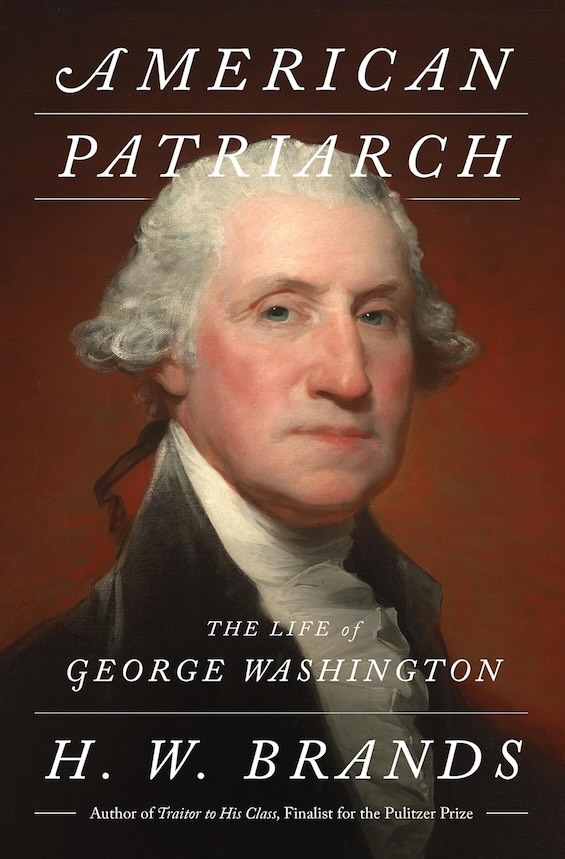
Myths and legends swirl around the life of George Washington. Remember that cherry tree? The wooden teeth? Throwing a coin across a wide river? The white wig? All of these widely accepted beliefs about our founding President are flatly untrue. And, just for the record, he was neither a winning general nor the fount of all wisdom as President. Oh, he was a great man, all right. And he deserves every encomium lavished on him through the ages. But George Washington was, after all, a man. He had his flaws as well as his celebrated strengths. And they all emerge clearly in historian H. W. Brands’ masterful one-volume portrait, American Patriarch.
Just a portrait of a remarkable man, blemishes and all
For starters, this biography is neither exhaustive in detail nor revisionist in its intention. There are no great secrets revealed here. The book is just an unvarnished account of one truly remarkable man who left his imprint on a nation and an era. And much of the text is in Washington’s own words, gleaned from his letters and speeches and the recollections of intimates. Brands rarely ventures into speculation about Washington’s motives except as he himself expressed them.
American Patriarch: The Life of George Washington by H. W. Brands (2026) 919 pages ★★★★★
The major takeaways
Washington was, truly, the “indispensable man”
Again and again, in Washington’s career as the colonies’ commanding general and as President, Brands makes clear that there was no one else who could possibly have done the job he did. During the War of Independence, other colonial generals maneuvered and lobbied for the top post. But Congress repeatedly refused to reject the one man who could successfully appeal both to the traders of Massachusetts and the planters of Virginia. And, as President, he alone could command the respect of both factions, the Federalists and the Republicans. (The phrase “the indispensable man” is from the title of James Thomas Flexner’s 1974 biography of the first President, Washington, the Indispensable Man.”)
Both at home and abroad, he was the icon of American nationhood
Other commanders won the big battles that secured America’s freedom from the British Empire. Horatio Gates (Saratoga, 1777). Nathanael Greene (southern campaign, 1780-81). And the French comte de Rochambeau and Admiral de Grasse (Yorktown, 1981), even though Washington was in overall command there and is usually credited with the victory. But none of the other men could have claimed the loyalty of the diverse and often contentious factions both in Congress and the Continental Army. And, later, as president of the Constitutional Convention and as President, Washington lent credibility to the new Constitution simply through the respect he brought to the new government.
He was always reluctant, and always willing, to serve
Citing long passages in Washington’s reports to Congress, in his speeches, and in his letters to his wife, Martha, Brands emphasizes that Washington wanted nothing more than to retire to his lands in Virginia, manage the farms he and Martha owned, and build his fortune. But duty called, and Washington answered. He reluctantly agreed to chair the Constitutional Convention, then reluctantly consented to serve as our first President. And he grudgingly admitted that there was no alternative but for him to serve a second term, however much he pined for the comforts of home in Virginia.
The book’s 919 pages in the Kindle edition I read are split into 100 bite-size chapters. The result is that the book is much easier to read than most nonfiction books, which tend to run-on chapters with few breakpoints in the text.
About the author

Henry William (H. W.) Brands Jr. holds an endowed chair in History at the University of Texas at Austin. He earned his PhD in history there after gaining a BA from Stanford, an MA from Reed College, and an MS from Portland State University. Brands has authored 42 books on U.S. history to date. Two have been selected as finalists for the Pulitzer Prize. Brands was born in Oregon in 1953. He has one son.
For related reading
I’ve also reviewed The First American: The Life and Times of Benjamin Franklin by H. W. Brands (A new Benjamin Franklin biography is a compelling read).
Be sure to check out 12 great biographies and Top 20 popular books for understanding American history.
And you can always find the most popular of my 2,500 reviews, and the most recent ones, on the Home Page.