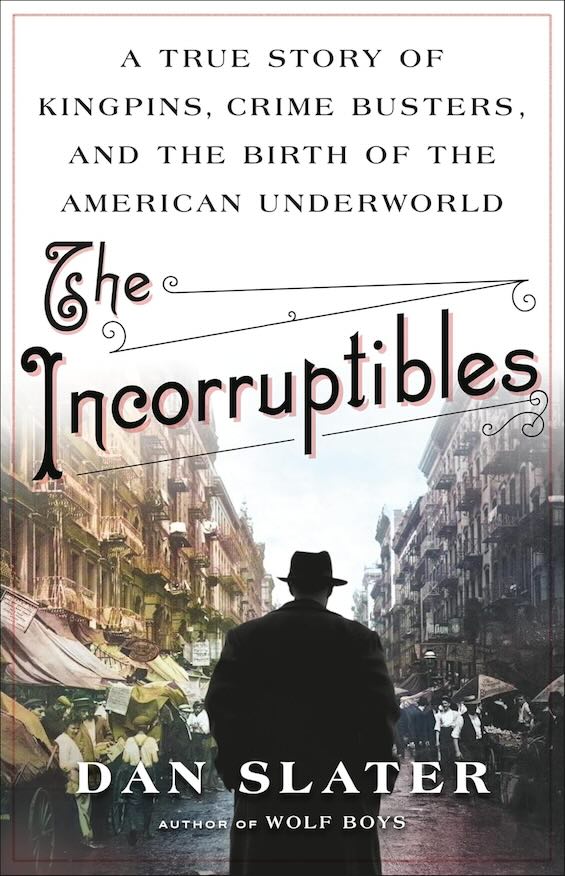
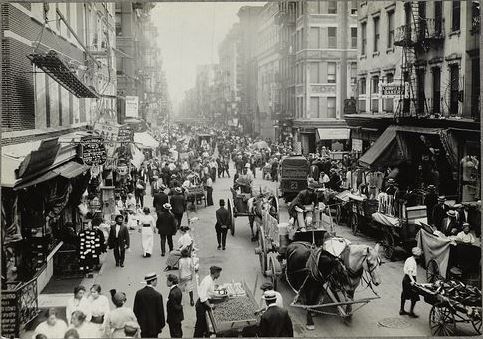
Crime in its innumerable manifestations has always been with us. But organized crime, American style—commanding the attention of government at the highest level—only came into existence in the US in the years leading up to the First World War. Then, immigrants on New York City’s Lower East Side protected by corrupt cops and Tammany Hall politicians ran prostitution, gambling, and protection rackets with impunity. But they were not Italian immigrants, as our popular media might lead us to believe. They were Eastern European Jews crowded into the squalor of the world’s most densely populated neighborhood. And in a brilliant and original book,The Incorruptibles, author Dan Slater tells their story in full for the first time. It’s inseparable from that of the wealthy German-Jewish reformers headed by an extraordinary rabbi named Judah Magnes (1877-1948).
The Mafia were late-comers to the control of the rackets
You might be wondering when the Mafia came into the picture. Of course, there were Italian crooks and gangsters back then, just as there were Irish, German, and other malefactors in New York’s many ethnic communities. But it wasn’t until Prohibition (1920-33) came into force and the reformers’ campaign to clean up the Lower East Side had fatally weakened the crime rings there that Italian immigrants we came to call the Mafia seized control of the rackets in the city. Slater writes about their coming-of-age in the 1920s. But he focuses tightly on the Jewish gangsters and reformers who dominated the story over the preceding decades.
The Incorruptibles: A True Story of Kingpins, Crime Busters, and the Birth of the American Underworld by Dan Slater (2024) 418 pages ★★★★★
A sprawling cast of characters
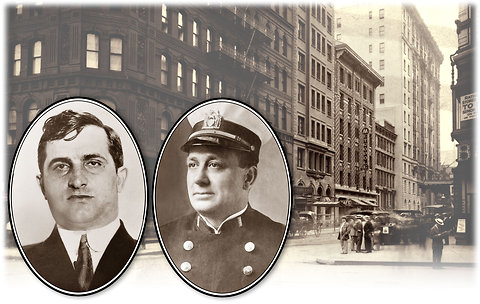
Slater populates The Incorruptibles with a huge cast of characters. Both reformers and mobsters crowd the pages of the book. Many recognizable names in the annals of crime enter into the picture. Lucky Luciano, Meyer Lansky, and Arnold Rothstein, for example. But a handful of individuals emerge as central to Slater’s story:
Abe Schoenfeld
Abe Schoenfeld (1892-1978) and Arnold Rothstein anchor the account. Schoenfeld was the principal investigator of the Lower East Side rackets on behalf of the Kehilla, a private organization funded by wealthy, uptown German-American Jews. Judah Magnes led the organization in its campaign to clean up the Lower East Side and helped engineer Schoenfeld’s appintment to a key position in the New York Police Department under a reformist mayor.
Arnold Rothstein
Rothstein (1882-1928), a compulsive gambler who fixed the 1919 World Series, was the undisputed kingpin of the rackets in the neighborhood. He mentored future gangster bosses Lucky Luciano, Meyer Lansky, Frank Costello, Bugsy Siegel and numerous others. As author Leo Katcher noted in his biography of Rothstein, he “transformed organized crime from a thuggish activity by hoodlums into a big business run like a corporation.”
Jacob Schiff and Felix Warburg
Jacob Schiff (1847-1920) and his son-in-law, Felix Warburg (1871-1937), bankrolled the Kehilla under Judah Magnes in its long-running campaign to contain crime on the Lower East Side. Schiff and Warburg in succession led the influentian investment banking firm Kuhn, Loeb, and Co.
Abe Cahan
Among the many other named historical figures who are prominent in Slater’s account was journalist Abraham Cahan (1860-1951). Cahan was a Lithuanian-born Jewish-American socialist who cofounded the country’s preeminent Yiddish-language newspaper, The Forward, and served for four decades as its editor-in-chief. Slater details Cahan’s consistent support for the violence-prone labor strikes that plagued the Lower East Side.
Slater’s connection to the story (and mine)
As Slater relates in a fascinating account of his research in his book’s final pages, his German-Jewish great-great-great grandfather founded a business called Klee and Company that union-affiliated gangsters firebombed in a famous incident. “Aside from my German-Jewish heritage, via my maternal grandmother,” he writes, “I knew that the other three branches of my family had been Russian Jews, tailors and ragpickers who fled the Pale of Settlement around 1900 and came to Boston and Baltimore.”
Similarly, my father’s family emigrated from the Pale (now Ukraine) in 1901 and settled in the Lower East Side. (My mother’s parents were German-Jewish from the Austro-Hungarian Empire.) Dad was born in 1909, but most of his eight brothers and sisters were older. I have no idea how they managed to survive. My grandfather was a glazier and cabinetmaker, so perhaps he earned more than the average in the neighborhood. But I do know that I inherited a pair of small ceramic alligators that my grandmother bought around 1919 for five cents. My father told me it was the very first thing she ever purchased other than food or clothing that the family needed to survive.
I can’t claim to have any other connection to Slater’s story, however indirect, other than a story my father told me and my brother when we were young. In the early 1930s, when he was an undergraduate at what was then the City College of New York (now the City University), he was paying for his keep by working a job as a bookkeeper at a garage in Brooklyn run by gangsters. He laughed about one stupid shtarker (a tough guy or thug) who checked the gas tank of a taxi to see whether it was full by holding a lit match near it. Fortunately, the thug, and my father, survived somehow.
About the author
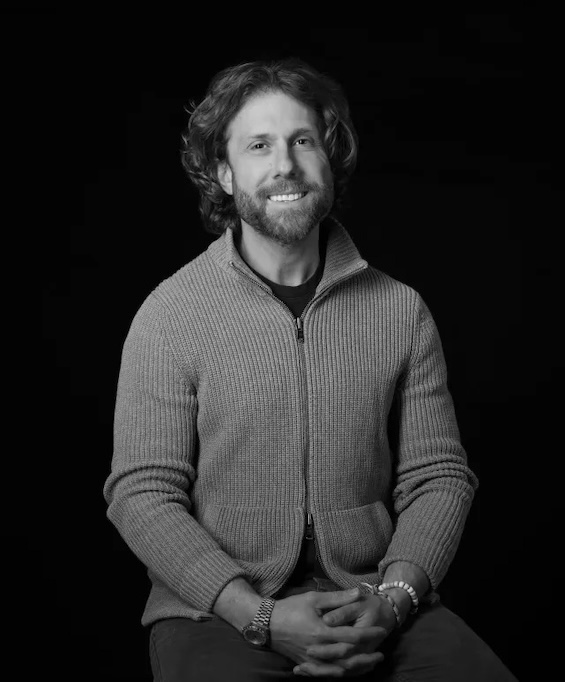
On his website, Dan Slater notes that he “is the author Wolf Boys, which was a Chicago Public Library best book of the year, Love in the Time of Algorithms, and The Officer & the Entrepreneur. His new book, The Incorruptibles, was selected as an editors’ pick by the New York Times Book Review. A graduate of Colgate University, New York Film Academy, and Brooklyn Law School, he has written for more than a dozen publications, including the Times, the Wall Street Journal, the Washington Post, New York magazine, the Boston Globe, The Atlantic, Texas Monthly, The New Yorker online, and GQ. Raised in Minnesota, Slater lives in New England with his wife and their two sons.”
For related reading
For background on crime in New York City in the Gilded Age that preceded the period in which this book is set, see:
- The Talented Mrs. Mandelbaum: The Rise and Fall of an American Organized-Crime Boss by Margalit Fox (She was organized crime’s boss in Gilded Age New York)
- The Alienist by Caleb Carr (In a classic whydunit, The Alienist makes his debut)
- The Murder of the Century: The Gilded Age Crime That Scandalized a City & Sparked the Tabloid Wars by Paul Collins (The Gilded Age murder that set off the tabloid wars)
- A Death of No Importance (Jane Prescott #1) by Mariah Fredericks (A mine disaster, and a murder, in this Gilded Age mystery)
- Hot Time by W. H. Flint (Teddy Roosevelt at the NYPD during the 1896 election)
You might also find useful references at Top 20 popular books for understanding American history or Top 10 nonfiction books about politics.
And you can always find the most popular of my 2,400 reviews, and the most recent ones, on the Home Page.