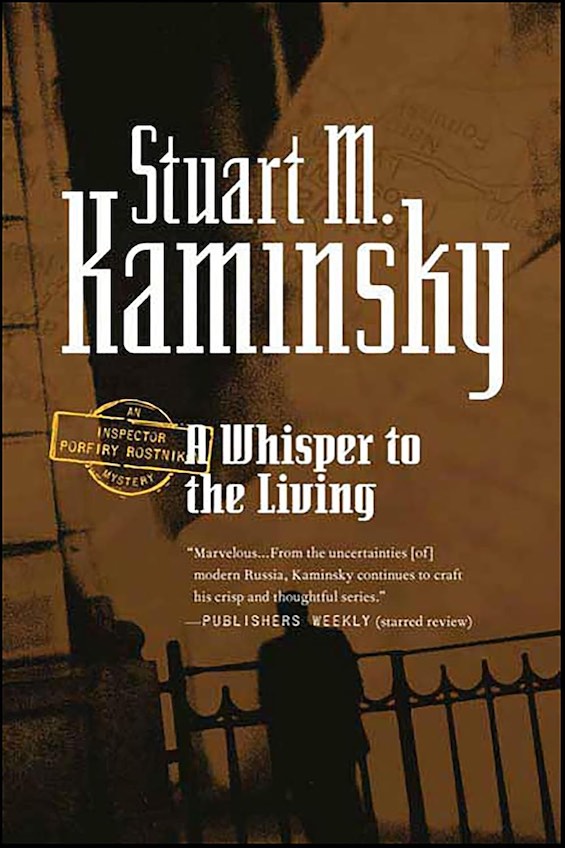
Before his death in 2009, the prolific detective novelist Stuart Kaminsky wrote 16 police procedurals featuring a Moscow investigator named Porfiry Petrovich Rostnikov. The books span the years 1981 to 2008. They encompass the final years of Communist rule and the first two tumultuous decades that followed. Kaminsky wrote three other series of detective novels. One ran much longer. So we can only assume that Porfiry Rostnikov might have continued to ply his trade for many years after 2009. But it was not to be. The 16th book in the series represents Porfiry Rostnikov’s last case. But A Whisper to the Living is a fitting conclusion to the long-running tale. It’s a story fraught with danger, suspense, and familial love. And it’s a skillful farewell from a Mystery Writers of America Grand Master whose stories were often compared to the pioneering police procedurals in Ed McBain’s 87th Precinct series.
A police procedural following three cases
As is true in nearly all the novels that precede it, Rostnikov and his team in the Office of Special Investigations take on three cases simultaneously. Their boss, now Colonel Igor Yakovlev (“the Yak”) passes all three along to Rostnikov. Rostnikov, in turn, divides his squad into teams of two. The three investigations run along parallel lines. Each reflects an important aspect of life in post-Soviet Russia nearly a decade after the ascension to power of Vladimir Putin. And everywhere the investigators turn they encounter the new style of corruption that is so much like the old style under Communism.
A Whisper to the Living (Porfiry Rostnikov #16 of 16) by Stuart M. Kaminsky (2009) 257 pages ★★★★☆

Three investigations running along parallel lines
A serial killer
Rostnikov teams up with Emil Karpo, a gaunt, almost cadaverous inspector nicknamed “the Vampire.” He’s a humorless, obsessive traditionalist whose Communist faith has outlived the Soviet Union itself. His terrifying appearance is often sufficient to subdue the most recalcitrant witness or suspect. Their two men’s task is to identify and arrest the “Bitsevsky Maniac,” a serial killer named after a Moscow park. There, many of his elderly victims have been found bludgeoned to death with a hammer. In Kaminsky’s omniscient third-person point of view, we follow the killer as well as both Rostnikov and Karpo.
A giant murder suspect
Rostnikov’s son, Iosef, and Akardy Zelach (“the Slouch”) hunt for a missing boxing champion known as “the Giant.” The boxer, who is 6-feet-10-inches tall and weighs 310 pounds, is suspected of murdering his wife and sparring partner. He’s an unusual challenge for the team. Zelach is no great shakes as an investigator. But he displays surprising skills and detailed knowledge about obscure subjects. All of which make him an ideal partner for Iosef, a former soldier who failed as a playwright following his departure from the army.
A prostitution ring
Inspectors Elena Timofeyeva and Sasha Tkach are an odd couple. She’s the daughter of the woman who once was Rostnikov’s boss, and she’s engaged to marry his son, Iosef. Sasha is a handsome young man whose womanizing has driven his wife and children back to her home town of Kiev. Meanwhile, he struggles with a domineering mother who is profoundly hard of hearing and is determined to make him resign his dangerous job with the police.
Elena and Sasha are assigned to protect Iris Templeton. She’s a British journalist investigating a lucrative, gangster-run Moscow prostitution ring. But that assignment unravels into a chain of murders reaching corrupt officials so powerful that pursuing them threatens the detectives’ careers and lives.
A pathologist lends a hand
No commentary on this novel is complete without a nod to Paulinin, a flamboyantly eccentric man who works in the lab beneath police headquarters. He’s a forensic scientist who talks to the dead. Not formally on the squad, but the team’s go-to for forensics across the series. They all turn to him rather than going through channels to the designated morgue. Paulinin considers the pathologists there to be incompetent, and he routinely turns up clues they’ve missed.
About the author

Stuart M. Kaminsky died in 2009 after a three-decade career as a crime novelist and film professor. He was the author of four series of detective novels and a number of other books. His three long-running series featured Toby Peters, a private detective in 1940s Hollywood (1977–2004); Inspector Porfiry Petrovich Rostnikov, a Moscow police inspector (1981–2009); and veteran Chicago police officer Abe Lieberman (1990–2007). All told, Kaminsky wrote 63 novels and 11 nonfiction books in addition to various other works such as short story collections, graphic novels, screenplays, television scripts, and theatrical plays.
Kaminsky was born in 1934 in Chicago and grew up there. He earned a BS in journalism and an MA in English from the University of Illinois and a PhD in speech from Northwestern University. Kaminsky taught film studies at Northwestern for 16 years, and then taught at Florida State for six years. He was married, but the couple was childless.
For related reading
All the novels in this series appear at Police procedurals spanning modern Russian history.
For more great reading, see:
- The six best police procedurals
- Top 20 suspenseful detective novels
- Top 10 historical mysteries and thrillers
- The 8 best historical mystery series
- 25 most enlightening historical novels
And you can always find the most popular of my 2,400 reviews, and the most recent ones, on the Home Page.