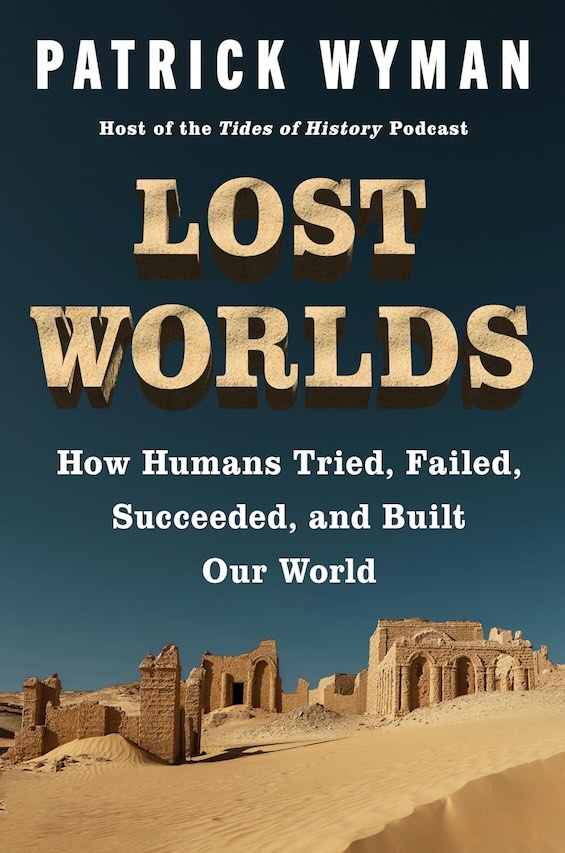
Biologically modern humans have roamed the Earth for some 300,000 years. Yet what we refer to as history dwells on the past 5,000 years or so, since writing was invented in ancient Sumer. Prehistory—what took place before then—was largely the subject of speculation until recently. But advances in archaeological science over the past several decades have been remarkable. They now allow us to piece together a detailed picture of human endeavor over the roughly 10,000-year period from the end of the last Ice Age about 11,700 years ago until the collapse of the Bronze Age in the Eastern Mediterranean around 1250-1150 BCE. And historian Patrick Wyman vividly paints that picture for us in his revisionist account of prehistory, Lost Worlds: How Humans Tried, Failed, Succeeded, and Built Our World.
An erratic, start-and-stop progression to the modern world
Wyman’s thesis is straightforward. The shift from the Paleolithic Era, when ice covered most of the world, to the Neolithic, a warmer period when humans settled down and adopted agriculture, was gradual. There was no smooth progression from hunting and gathering to farming. Both lifestyles coexisted for thousands of years in some places. And our history books—in the West, at least—are wrong to elevate the Fertile Crescent as the Cradle of Civilization.
Innovations such as farming and the building of cities independently emerged in at least 11 different regions across the globe within hundreds or a few thousand years of one another. And, once tried, neither farming nor the construction of urban centers necessarily took hold. Again and again, humans abandoned ancient settlements and agriculture, reverting to older ways. The linear logic behind the conventional wisdom about our past simply doesn’t hold true. We’re forced to acknowledge that history doesn’t move in straight lines.
Lost Worlds: How Humans Tried, Failed, Succeeded, and Built Our World by Patrick Wyman (2026) 467 pages ★★★★★
First, let’s get a few things straight
You may be as confused as I am about terms such as Paleolithic, Neolithic, Ice Age, Bronze Age, and so forth. So, here’s a lightly edited table prepared by the Anthropic chatbot Opus 4.8 that should help you get a clear picture of the timing involved . . .
| Term | System | Approximate dates | Principal developments |
|---|---|---|---|
| Paleolithic (Old Stone Age) | Technology (Stone Age) | 3.3 million – 10,000 BCE | Earliest chipped stone tools; control of fire; hunting and gathering; life almost entirely nomadic |
| Pleistocene / “Ice Age” | Geology / climate | 2.6 million – 9700 BCE | Repeated glacial cycles; megafauna (mammoths, giant sloths); low sea levels exposing land bridges; humans spread across the globe |
| Mesolithic (Middle Stone Age) | Technology (Stone Age) | 10,000 – 8000 BCE | Transitional post–Ice Age era; bow and arrow; foraging; first semi-permanent camps |
| Holocene | Geology / climate | 9700 BCE – present | The current warm interglacial; stable climate that made farming viable |
| Neolithic (New Stone Age) | Technology (Stone Age) | 10,000 – 3300 BCE | The “Neolithic Revolution”: farming, domestication of plants and animals, permanent villages, pottery, polished stone tools, early monuments |
| Chalcolithic (Copper Age) | Technology (transitional) | 5000 – 3300 BCE | Transitional phase using copper before bronze; growing villages and trade; often folded into the late Neolithic |
| Bronze Age | Technology | 3300 – 1200 BCE | Bronze (copper + tin) metallurgy; writing (cuneiform, hieroglyphs); cities, states, and empires; the wheel; long-distance trade |
| Iron Age | Technology | 1200 – 550 BCE onward | Ironworking spreads; alphabetic writing; new states after the Bronze Age collapse |
Keep in mind that the terms appearing above derive from two very areas of inquiry: the physical environment (climate and geology) versus the adoption of technology as viewed by archaeologists. Also, “Stone Age” is an umbrella term that covers the Paleolithic, Mesolithic, and Neolithic together. So those three periods are subdivisions, not separate from it.
The period covered in Patrick Wyman’s book is the first 10,000 years or so of the Holocene (see above), when the human race truly began to assert its primacy over the Earth.
The major takeaways from this book
(1) Civilization was not inevitable
The world we live in was built by trial and error. The human race did not march inexorably from hunting and gathering to farming, from wandering bands to cities, and from chieftains to kings. These far-reaching changes came about over a period of some 10,000 years in fits and false starts, in a process littered with failures, disasters, and the total collapse of complex societies. Wyman frames climate change, migration, population growth, and conflict as the forces that shaped the fate of early civilizations. And those same factors affect us, and our future, today.
(2) There was no cause-and-effect chain of “progress”
Farming didn’t always replace foraging. Settling in villages didn’t automatically spark agriculture. And cities didn’t necessarily fall prey to rigid hierarchies. For thousands of years, humans merely improvised. The changes wrought were dramatic, of course. By the end of the Bronze Age about 3,000 years ago, cattle and sheep had replaced mammoths and giant sloths. Millions lived in cities, although scattered nomadic bands persisted in many areas. And farming had spread to nearly every continent. But it was all hit-and-miss. The rise of states and steady food production wasn’t inevitable. It was the outcome of countless choices that reshaped the planet and made us who we are today. Again and again along the way, complex civilizations rose to prominence and power, only to collapse. Collapse is integral to the story, not an aberration.
(3) We owe our new understanding to breakthroughs in science
Ancient DNA
In recent decades, archaeological science has advanced by leaps and bounds. For example, we are rewriting prehistory today as a result of new developments in the study of ancient DNA. Recovering and sequencing DNA from old skeletal remains has reshaped our whole understanding of the whole period. The technique allows researchers to trace migrations, population mixtures, ancestry, kinship, and even ancient pathogens.
Climate science
The study of climate in millennia past has come into play as well. Researchers can now econstruct past temperature and rainfall from ice cores, lake and ocean sediment cores, pollen sequences, and cave formations. And isotope records let historians connect droughts and climate shifts to events like the Bronze Age Collapse and the rise and fall of early states.
Remote sensing
New excavation methods include remote sensing and survey methods such as LiDAR, satellite and aerial imagery, ground-penetrating radar, and magnetometry. These techniques reveal buried structures and whole settlement layouts without digging and help guide the digs themselves.
Isotope analysis
Isotope analysis of teeth and bone can tell us where a person grew up and how mobile they were. Skeletal study reveals health, nutrition, disease, and trauma from violence. And the plant food, grains, and meat consumed comes to light through analysis of seeds, starch grains, and animal bones. Supplements by analysis of the residue of lipids on pottery and proteins in teeth helps track the domestication of crops and livestock and the shift to dairying and farming.
Determining dates
Underpinning all of it is dating science, especially radiocarbon dating with modern refinements like accelerator mass spectrometry and Bayesian statistical modeling of dates, alongside tree-ring dating. The latter makes a tight 10,000-year narrative chronology possible at all.
About the author

Google Books tells us that Patrick Wyman is “one of the most popular history podcasters in the world. He is the host of Past Lives, Tides of History, and Fall of Rome, and the author of The Verge: Renaissance, Reformation, and Forty Years That Shook the World and Lost Worlds. Wyman received a PhD in history from the University of Southern California and has written for The Atlantic, Slate, and Mother Jones. On his LinkedIn page, Wyman claims a working knowledge or full proficiency in nine languages.
For related reading
For other great books that explore different aspects of the same big story, see:
- The Invention of Yesterday: A 50,000-Year History of Human Culture, Conflict, and Connection by Tamim Ansary (Understanding human history as an extraterrestrial might view it)
- Origin Story: A Big History of Everything by David Christian (A survey of Big History by the man who created the field)
- A Most Improbable Journey: A Big History of Our Planet and Ourselves by Walter Alvarez (The unlikely story of life on Earth)
- Against the Grain: A Deep History of the Earliest States by James C. Scott (This book will challenge everything you know about ancient history)
- Metropolis: A History of the City, Humankind’s Greatest Invention by Ben Wilson (How cities have built civilization and shaped human history)
- Four Lost Cities: A Secret History of the Urban Age by Annalee Newitz (Join archaeologists at work around the world)
You’ll also find related material at: 25 top nonfiction books about history and Gaining a global perspective on the world around us. Also, for good books in the emerging field of Big History, check out New perspectives on world history.
And you can always find the most popular of my 2,400 reviews, and the most recent ones, on the Home Page.