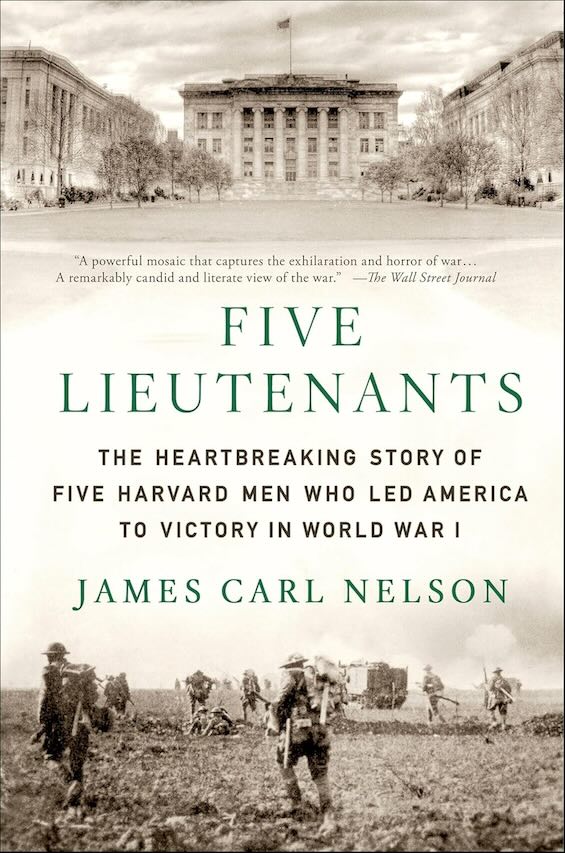
Twenty-nine-year-old Richard Newhall was teaching history at Harvard. Younger at 22, George Haydock, a Quaker, was a recent graduate, as was Alexander McKinlock a wealthy football hero. Younger still, William Morgan was an undergraduate there. By contrast, graduate George Redwood was a celerated journalist in Baltimore. And in 1917, these five Harvard men began their journey toward the Western Front in France. As lieutenants in the American Expeditionary Force, they helped lead soldiers even younger than themselves into battle in the final months of the war. Only one of the five survived the war unscathed. In Five Lieutenants, author James Carl Nelson follows them from their training camps to the front line. There, three died and one was grievously wounded. It’s a tragic story, well told. And it teaches us a lesson all over again about the utter folly of war.
An intimate, in-your face narrative
Nelson draws heavily on the men’s uncensored memoirs and letters to their sweethearts and families. Peering into their innermost thoughts, he traces their transformation from elite scholars into leaders charged with commanding rough, often illiterate doughboys in battle. Nelson uses this clash of cultures to probe whether their privileged education made them natural leaders. (It didn’t. But their intelligence often made the difference.) He describes their training, first in Plattsburg, New York, then in France, and their entry into the May 1918 battle of Cantigny. It was the first major American battle in World War I. And there three of the friends became casualties.
Five Lieutenants: The Heartbreaking Story of Five Harvard Men Who Led America to Victory in World War I by James Carl Nelson (2012) 381 pages ★★★★☆
The events in this book in context
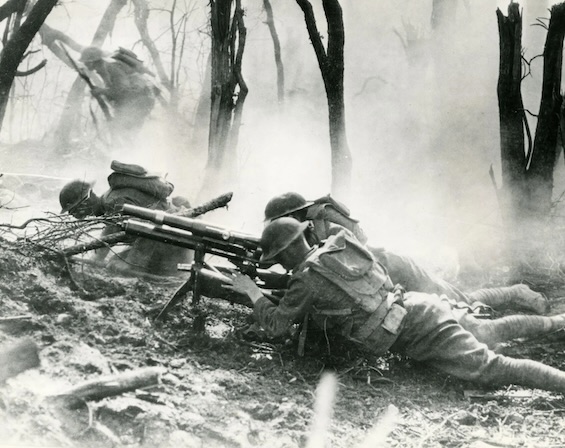
When we conjure up visions of the senselessness of war we often ponder life in the trenches on the Western Front in World War I. There are few other scenes in world history that more vividly illustrate the madness of warfare. Then, British, French, and German generals wedded to the tactics of the 19th century sent millions of young men “over the top” through No Man’s Land into withering machine gun fire that ended their lives in an unending bloodbath. Then, after three years of this madness, American troops began arriving in France to “make the world safe for democracy.” Under the command of General John J. Pershing, what eventually became 1.4 million American soldiers fought on the front lines. At the decisive battle of the Meuse-Argonne, they tipped the balance in favor of the Allies, forcing Germany to sign the Armistice that ended the fighting on November 11, 1918.
Putting it all in perspective
Now, in the opening decades of the 21st century, when Americans think of the formative events in our history, most of us dwell on World War II as pivotal. After all, when the guns stilled in September 1945, the United States emerged as the most powerful nation on the planet. And once the economy righted itself the country’s productive capacity propelled us to unparalleled prosperity. But for most of the world a war that ended 20 years earlier was the true turning-point. World historians credit World War I as the inflection point between the 19th and 20th centuries. For many Europeans in particular, the changes wrought then by the fighting and the unbalanced peace that followed made a bigger difference than did World War II. After all, the German, Austro-Hungarian, and Turkish Empires all perished, and the war fatally weakened Britain’s.
About the author

As his publisher writes, “James Carl Nelson has a bachelor’s degree in journalism from the University of Minnesota and has worked as a staff writer for The Miami Herald. He has since covered some of the major stories of the day, including the terrorist bombing in Oklahoma City; the massacre at Columbine High School in Littleton, Colorado; the arrest of the Unabomber; and the deaths of twelve coal miners at the Sago Mine in West Virginia in 2006. Nelson is an active member of the Western Front Association, which is devoted to the study of the Great War. He is the author of The Remains of Company D and Five Lieutenants.”
Google Books adds that Nelson “is an active member of the Western Front Association, which is devoted to the study of the Great War. [He] lives in Eden Prairie, Minnesota.”
For related reading
I’ve reviewed a number of other good books about World War I. Here are a few of the more interesting ones:
- To End All Wars: A Story of Loyalty and Rebellion, 1914-1918 by Adam Hochschild (Reassessing World War I: Learning history the hard way)
- 1919 Versailles: The End of the War to End All Wars by Charles L. Mee, Jr. (The World War I peace treaty that led to World War II)
- A spy novel: The Star of Istanbul (Christopher Marlowe Cobb #2) by Robert Olen Butler (An American spy in World War I takes on the German Empire)
- A mystery novel, Shoulder the Sky, by Anne Perry (World War I, up close and personal)
- A historical saga: Fall of Giants (Century Trilogy #1 of 3) by Ken Follett (Ken Follett’s monumental saga of the First World War)
For links to more great reading, see:
- 25 top nonfiction books about history
- Top 20 popular books for understanding American history
- 12 great biographies
And you can always find the most popular of my 2,400 reviews, and the most recent ones, on the Home Page.