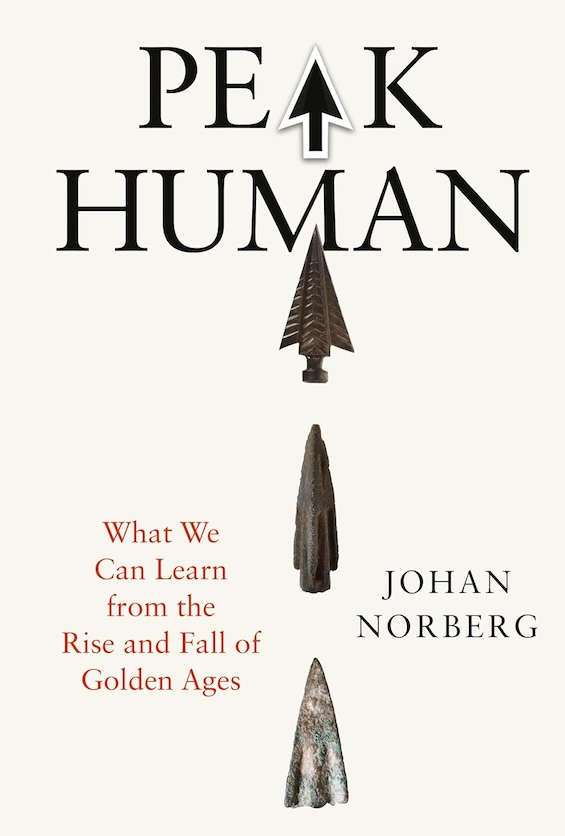
Some of us, schooled in idealized portraits of ancient civilizations such as Rome and Greece and China, jump to conclusions about how history is repeating itself when we see superficial similarities to what we think took place thousands of years ago. Of course, we do know that history doesn’t repeat. But perhaps Mark Twain was wise to observe that it often rhymes, revealing the same large-scale patterns we can discern in a careful study of the past. And the Swedish author Johan Norberg proves this point with his insightful study of seven “golden ages” over the past 2,500 years. His recent book, Peak Human, makes a compelling case that there are, indeed, patterns in history from which we can learn.
Seven “golden ages” of human history
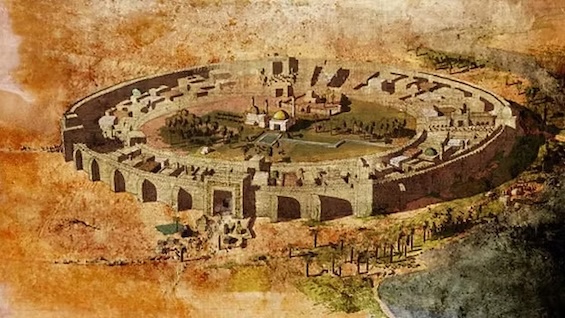
In seven brief periods over the centuries, in Norberg’s view, humanity has surpassed itself. In Ancient Athens. The Roman Republic. Abbasid Baghdad. Song China. Renaissance Italy. The Dutch Republic. And the Anglosphere. Spanning more than two millennia of human history, these Golden Ages of civilization are the stuff of which Swedish author Johan Norberg finds our species came closest to realizing the potential of the human spirit. He paints a picture of each, sussing out the values and official policies that contributed to its greatness. But what are those values, and what policies best exemplify them?
Peak Human: What We Can Learn From History’s Greatest Civilizations by Johan Norberg (2025) 501 pages ★★★★★
How do civilizations become great?
Norberg’s unifying thesis is openness. A society will flourish when it embraces openness to trade, ideas, and people. And it will decline when it withdraws from the world. He spells out the result in six dimensions:
Openness to trade and exchange
Free markets and international commerce brings a wider selection of goods into the economy and fosters wealth in the process. A civilization grows rich from its openness, creativity, and relatively free markets.
Openness to people through migration
Being open to the contributions of other civilizations is the quickest way to make use of other’s brains. Which is why a golden age often blooms at the crossroads of cultures. In every instance Norberg cites, a society benefits greatly from the inspiration brought about by international trade, travel, and migration. In Norberg’s words, immigration is “our most potent source of revitalization.”
Intellectual freedom and pluralism
The freedom to question, dissent, and experiment is central. And toleration of dissent, security of property, and intellectual pluralism lay the foundation for widespread prosperity.
Religious tolerance and the separation of religion from the state
Each of the seven societies Norberg profiles succeeded due to its openness, intellectual freedom, embracing of innovation, open trade, openness to creating a melting pot of cultures. But religious freedom, in his view, is also essential. This requires the absence of a state religion and ensuring the separation of religion from the state.
A culture of optimism and curiosity
For a culture to flourish requires a mindset that believes progress is possible. Every golden age Norberg studies is associated with a culture of optimism. This encourages people to explore new knowledge, experiment with new methods and technologies, and exchange the results with others. The enemy of this mindset is fear—the sort of fear engendered by religion that demands you never question anything or change anything.
Learning from predecessors
Each of the seven civilizations in Norberg’s book built on the achievements of those before it, borrowing and improving rather than starting from scratch.

The flaws in Norberg’s approach
Norberg, like every other observer of history, is biased. He writes as a classical liberal. His seven cases are all civilizations characterized by openness. To some degree, he shapes the evidence to support his worldview, attributing nearly every success to free markets and every failure to policy blunders or institutional sclerosis. And he fails to take into account such factors as geography and climate change.
For example, for two centuries America’s distance from the population centers of Europe and Asia, and our two-ocean navy, made the United States nearly impervious to attack from without. Geography matters. It helps to explain how the US gained its preeminence in world affairs. And that advantage only slipped away with the advent of intercontinental ballistic missiles and cyberwarfare.
To take a somewhat different example, China’s possession of most of the world’s rare earth deposits—its geography—is a major factor in its rise to global prominence. And it may help ensure its primacy over the United States if recent American missteps accelerate our weakness.
Climate change, too, has had profound impact on human history. Periods of warming and cooling throughout recorded history have had major impact on the rise and fall of civilizations.
Critics also cite Norberg’s failure to recognize how the distribution of economic resources within a society can make a difference. In his defense, however, he does mention economic inequality as a factor in some instances. But he attributes less weight to it than he might otherwise have done.
Lessons for Donald Trump’s America
As you might imagine, golden ages end, in Norberg’s view, if they ignore or undermine the values that explain the golden ages he cites. Consider, then, what’s happening as Donald Trump’s second administration less than two years old:
- Trump has ended the era of free trade with his aggressive policy of punitive tariffs.
- He has damaged, beyond repair, our close relations with long-standing allies, weakening the country’s standing in the world.
- Trump is choking off free immigration and attempting to deport millions of new Americans.
- With his campaign against “wokeness,” Trump is challenging intellectual freedom.
- His determined effort to root out Diversity, Equity, and Inclusion throughout American society is reversing the country’s historic trend toward greater pluralism.
- The Trump Administration’s dogged effort to institutionalize conservative Christian values is undermining the separation of Church and state.
- By shutting down scientific inquiry both in government and in elite universities, Trump is weakening the forces of innovation.
- Huge tax cuts by the Reagan, George W. Bush, and Trump Administrations have added trillions of dollars to our pubic debt, dramatically increasing wealth and income inequality.
- Trump’s denial of climate change, and its dogged efforts to undo efforts to address it, help ensure that the warming of the planet will make human existence more and more challenging in the decades ahead.
- Trump’s a-historic view, asserting that the US can make its way alone in the world as the planet’s most powerful nation, flies in the facts of history.
Under these circumstances, how can anyone believe that Donald Trump and the people around him are not fatally weakening the United States? And can we confidently predict that even a radical political reversal in 2028 or 2032 will help American society regain its enviable position in the world?
About the author

Johan Norberg is a conservative Swedish author affiliated with the US-based Cato Institute. His books promote classical liberalism and free-market economics. He is the author of 22 books, most of them in Swedish. Born in Stockholm in 1973, he graduated from the University of Stockholm with an MA in the history of ideas.
For related reading
For links to other great reading, see:
- New perspectives on world history
- 25 top nonfiction books about history
- Gaining a global perspective on the world around us
And you can always find the most popular of my 2,400 reviews, and the most recent ones, on the Home Page.