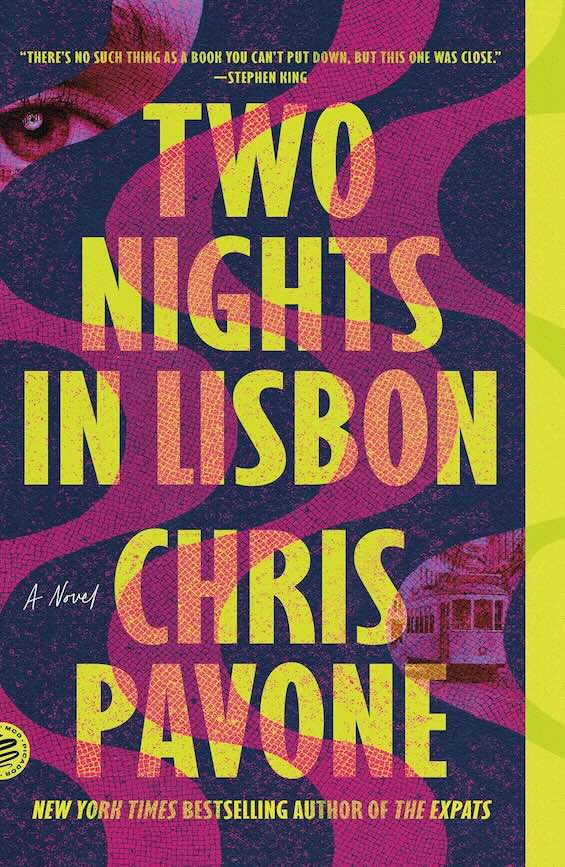
Ariel Pryce awakens to a sunny day in Lisbon only to find her new husband, John Wright, missing. After hours waiting for him to turn up, it’s clear something’s amiss. There’s no message, and no sign of him whatsoever. Fearing he’s fallen victim to an accident or been kidnapped, she turns to the American embassy. There, an unsympathetic consular official insists it’s much too early to worry. And when she approaches the Lisbon police, she encounters the same lack of interest. But on her own Ariel turns up evidence that John had walked out of the hotel early that morning and immediately been hustled into a passing car. And that consular official turns out to be more intrigued than he’d seemed. He reports the encounter to Nicole Griffiths, the CIA Chief of Station. Thus begins another of Chris Pavone’s compulsively readable thrillers, Two Nights in Lisbon.
The plot thickens, again, and again, and again
Most of the action in the novel takes place over the eponymous two nights (and days) in Lisbon. Hour after hour, we follow the story from Ariel’s perspective, interspersed with flashbacks to her life long ago and to her affair and marriage to John. Meanwhile, we witness the steps both the CIA and the Lisbon police are taking. Because, yes, both are in fact taking the case very seriously. Especially after they learn that both she and John had changed their names years earlier. Then Ariel receives a ransom demand for three million euros neither she nor John could possibly pay. Soon, Ariel turns for the money to a wealthy and powerful former business associate of John’s. Which launches us into dangerous, unknown territory.
Two Nights in Lisbon by Chris Pavone (2022) 450 pages ★★★★★

A convoluted story and an unpredictable conclusion
Two Nights in Lisbon is, above all, a twisty thriller. it’s a crime novel, but the CIA and Washington politics become deeply involved as well. And the whole convoluted story comes to an astonishing conclusion.
Ariel’s flashbacks are central. We learn about her trauma from years earlier involving a powerful, abusive man. And they show how that experience shaped the person Ariel has become—wary, resourceful, and willing to take drastic action to protect herself. It becomes clear that Ariel is far more capable and purposeful than the shell-shocked, grieving wife she initially appears to be. And the novel ultimately becomes as much a reckoning with abuses of power and the ways institutions fail women who report them, as it is a kidnapping thriller.
About the author

Chris Pavone has written six novels to date. Four of the others are spy stories. One is a more traditional, home-bound thriller (The Doorman). Pavone is a graduate of Cornell University and worked for decades as an editor at several publishing houses before 2012, when his first novel saw print. Pavone has won both the Edgar and Anthony Awards. He lives in New York City with his wife and his two children.
For related reading
I’ve reviewed all five of Chris Pavone’s other novels:
- The Expats (A truly suspenseful novel about cyber theft)
- The Accident (Rogue spies on the loose)
- The Travelers (A clever spy story that will keep you guessing)
- The Paris Diversion (The CIA, a crumbling marriage, and terrorist threats in Paris)
- The Doorman (Murder and intrigue at New York’s most famous apartment building)
You’ll find other great reading at:
- The 15 best espionage novels
- Good nonfiction books about espionage
- Best books about the CIA
- The best spy novelists writing today
- 10 top WWII books about espionage
And you can always find the most popular of my 2,400 reviews, and the most recent ones, on the Home Page.