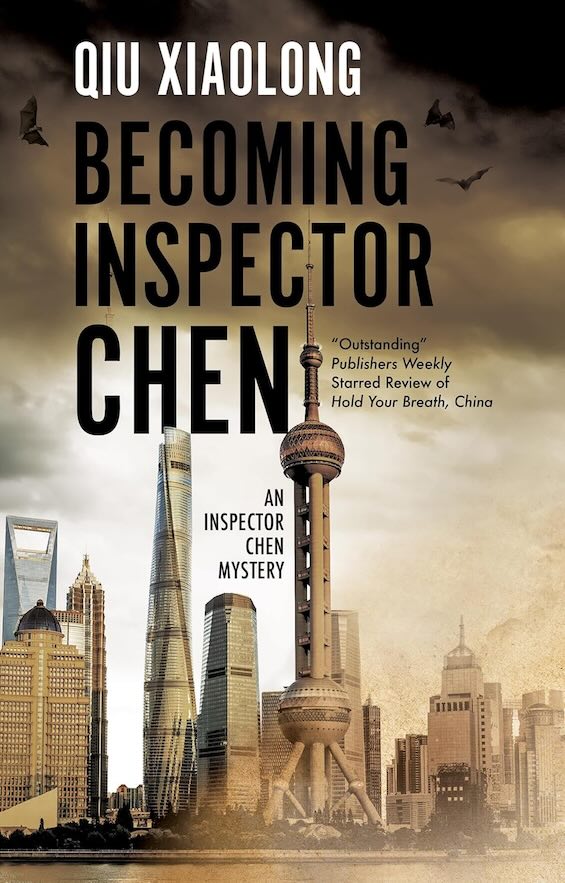
For years, Chief Inspector Chen Cao of the Shanghai Police Bureau had been widely celebrated as a “rising cadre” in the Communist Party. He was a man on his way up, rumored to soon be tapped as the Bureau’s Party Secretary. But his success has undone him. Chen has exposed too many influential men in his inquiries into corruption, and his connection with a powerful retired senior official in Beijing can no longer protect him. Party Secretary Li, no doubt acting under orders from the top, has removed him from his position as head of Special Investigations. But in Becoming Inspector Chen we look to the past, not the future, as Chinese-American author Qiu Xiaolong introduces us to Chen in his youth during the Cultural Revolution in the 1970s and his earliest days at the Bureau a decade later.
The backstory
Through flashbacks, Qiu revisits Chen’s childhood. Then, Red Guards branded him a “black puppy,” the son of an esteemed Confucian scholar deemed hostile to Mao’s leadership. He lived then near a street called Red Dust Lane, which housed a small bookstore that stocked foreign books. There, he found refuge in novels like Doctor Zhivago. Years after Mao’s death, Chen has graduated from college with facility in English and a love of poetry. He hopes to work as a translator. But the Party decrees otherwise. Chen is assigned to the Shanghai Police Bureau.
Party Secretary Li, the Bureau’s boss, wants nothing to do with Chen. He assigns him to translate English-language police procedure manuals into Chinese. But Chen’s long connection to Red Dust Lane secretly draws him into an investigation into the murder there of Mr. Fu, an extremely wealthy, eccentric, and elderly gourmet. The case is complex, with many suspects. But police officials arrest a convenient scapegoat, a former Red Guard known to be at odds with Mr. Fu. Chen doesn’t believe the official line. He surreptitiously pursues witnesses and eventually identifies the real culprit. And his success impresses Party Secretary Li, who welcomes him as an inspector.
Becoming Inspector Chen (Inspector Chen #11) by Qiu Xiaolong (2016) 256 pages ★★★☆☆
Another case in Red Dust Lane
In the present day, as Chen awaits possible disciplinary action, Party Secretary Li comes to him for help. The Bureau has been asked by Internal Security and the “Webcops” to assist in a politically sensitive investigation into an incendiary anti-Party poem posted on a popular online forum. And clues lead to a mysterious author who lives on Red Dust Lane. Which triggers Chen’s memories of the earlier events. Quietly working with his erstwhile partner, Detective Yu, Chen revisits the lane and begins to interview people who may be able to identify the author. But there is no conclusion to the case as the novel ends.
That lack of resolution, and Chen’s constant agonizing over the errors that have led to his removal from his job and his fears for his future, distract from the action. Unlike other books in the series, Becoming Inspector Chen is slow-moving. It’s a disappointing shift in perspective for Qiu.

What was the Cultural Revolution?
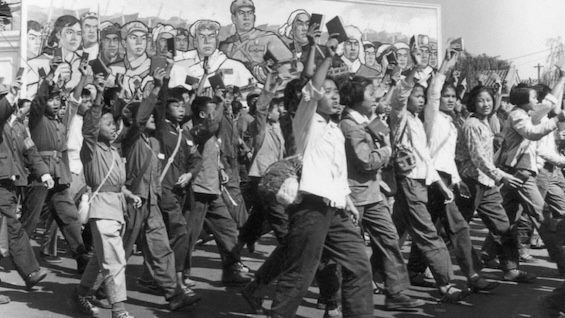
On May 16, 1966, Chinese Communist Party Chairman Mao Zedong launched the Great Proletarian Cultural Revolution, claiming that bourgeois elements had infiltrated the government and society with the aim of restoring capitalism. To combat this pernicious influence, Mao set off mass upheavals throughout China, forming batallions of teenagers and college students as Red Guards endowed with authority as his agents. Under his guidance, they attacked their elders for any hint of foreign connections, links to businesses however small, or mere signs of intellectualism or unwanted authority by teachers or managers.
Chaos reigned for a decade. All across China there were massacres, and millions died. Red Guards terrorized, beat, and sometimes killed millions of educated people in staged demonstrations. Schools and universities closed. Millions of young people were “sent down” to rural areas from the towns and cities to “learn” how to “live correctly” from peasants and workers. And Mao used the turmoil to mask his purge of senior officials who didn’t enthusiastically support his leadership.
The horror ended less than a month after Mao’s death on September 9, 1976. But the impact of the Cultural Revolution lives on to this day. And many of the novels in Qiu Xiaolong’s series reflect that sad reality. He himself was among the educated youth “sent down” to the countryside, his education interrupted for many years.
About the author

Beginning in 2000 with the award-winning Death of a Red Heroine, Qiu Xiaolong has written a total of 14 books to date about Inspector Chen Cao of the Shanghai Police Bureau. Qiu is a Chinese American poet, translator, critic, and professor as well as a crime novelist. He has lived in the USA since 1988, when he moved to St. Louis to write a book about T. S. Eliot. Qiu holds an MA and PhD in Comparative Literature from Washington University and served there for a decade as an adjunct professor. He and his family continue to live in St. Louis.
For related reading
You’ll find all the previous books in this series reviewed at The best Chinese detective novels.
For similar and related books, see:
- 30 insightful books about China
- The best mystery series set in Asia
- Top 20 suspenseful detective novels
- Top 10 historical mysteries and thrillers
- The 8 best historical mystery series
- The six best police procedurals
And you can always find the most popular of my 2,400 reviews, and the most recent ones, on the Home Page.