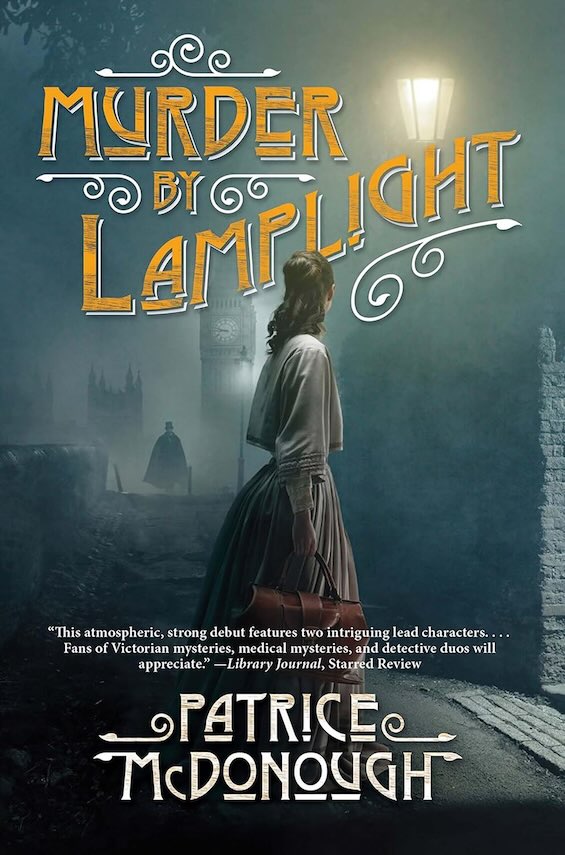
As a rule, I’m no fan of serial killer stories. The phenomenon is rare and heavily overused by authors of mystery novels. But author Patrice McDonough brings a new perspective to the genre with her riveting Victorian police procedural, Murder by Lamplight. It’s the first of a series of three novels to date featuring Dr. Julia Lewis, one of the first women to practice medicine in the UK. On her first-ever case as a medical examiner, her counterpart and reluctant partner at Scotland Yard is Detective Inspector Richard Tennant. He’s one of the Yard’s most celebrated investigators due to his arrest two years earlier of the notorious “Railway Killer.” But their collaboration blossoms into a full-blown partnership in the course of the novel. And the hostility of their first encounter gradually shifts, portending a sea change in their relationship.
Her first case is a gruesome murder
In 1866, when this novel is set, Britain does not yet allow women to study medicine in the UK. But Julia, daughter and granddaughter of physicians, was determined to find a way. With the support of her grandfather—her parents had died when she was very young—she traveled to Philadelphia. There, she earned a degree from a women’s medical college. Back in London, it’s she who responds to a summons from Scotland Yard that her grandfather, Dr. Andrew Lewis, is unable to fulfill. Someone has murdered and mutilated the corpse of a beloved parish priest. And the challenge of examining his body launches her career as a medical examiner. It’s there that she first meets Richard Tennant, who is in charge of the case.
Murder by Lamplight (Dr. Julia Lewis #1) by Patrice McDonough (2024) 323 pages ★★★★★
A worthy series starter
The murder of the priest, known as the “Saint of Spitalfields,” is only the first of many. And it soon transpires that the man (or woman) who killed the priest may also have been responsible for the victim ascribed to the “Railway Killer.” Which means that Tennant may have hanged the wrong man. And that increases the pressure on him that mounts as his boss grows increasingly impatient with the lack of progress in the series of murders now unfolding in East London.
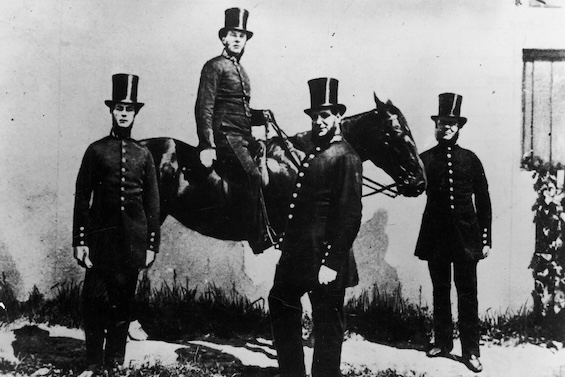
Tennant’s investigation swings into action. He engages not just his own small team of detectives but a growing number of bobbies for house-to-house inquiries. And gradually first one suspect then another and another emerge as the killer strikes again and again. At first, Tennant calls on Julia to examine the corpses. But soon she begins to receive letters like the taunting notes the killer sends to the Met. And Tennant then tries, without success, to sideline her as he grows convinced she might become a target for the killer.
McDonough writes convincingly of life in Victorian London. She has obviously done considerable research and offers intriguing details about police operations and England’s class system that don’t often crop up elsewhere. Murder by Lamplight is a worthy series starter and portends great reading ahead for those who continue reading the series.
About the author
Google Books tells us that “Patrice McDonough is a former educator who taught history for more than three decades. A member of the Historical Writers of America, the Mystery Writers of America, and the Historical Novel Society, she splits her time between New Jersey and the Florida Gulf Coast.”
The author adds on her own website that “I have a master’s degree in history from Rutgers University/NJIT, taught history for many years at Immaculate Heart Academy in Washington Township, NJ, a college preparatory high school for girls, and was named an Outstanding Educator by the Archdiocese of Newark.”
For related reading
I’ve reviewed several other mysteries set in Victorian London, including the following:
- The Laws of Murder (Charles Lenox #8) by Charles Finch (An engaging detective series set in Victorian London)
- The Murder of Patience Brooke (Charles Dickens Investigations #1) by J. C. Briggs (In 1849, Charles Dickens investigates a murder)
- An Echo of Murder (William Monk #23) by Anne Perry (Ritual murder and Hungarian émigrés in 1870 London)
You’ll find great reading at:
- 20 excellent standalone mysteries and thrillers
- Top 20 suspenseful detective novels
- Top 10 historical mysteries and thrillers
- The 8 best historical mystery series
- The six best police procedurals
And you can always find the most popular of my 2,400 reviews, and the most recent ones, on the Home Page.