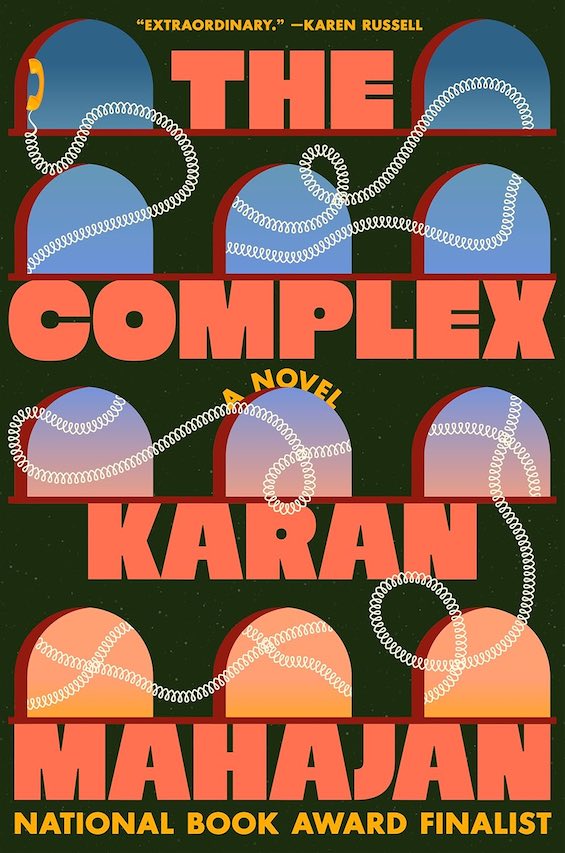
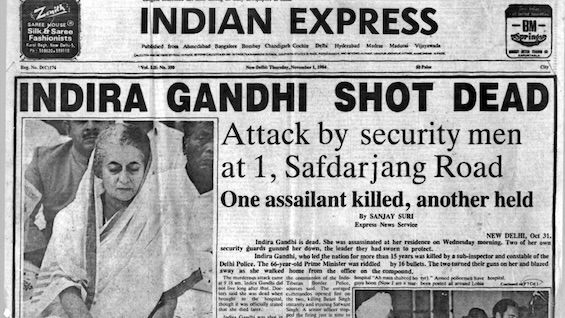
Indian Prime Minister Indira Gandhi died at the hands of her Sikh bodyguards on October 31, 1984. Violence erupted immediately. Anti-Sikh riots raged for four days, resulting in the deaths of thousands of Sikhs. Eight years later, in December 1992, an organized mob of 70,000 Hindu nationalists demolished the 16th-century Babri Masjid mosque in Ayodhya. The attack, years in the making, triggered months of violence across India. It led to the deaths of roughly 2,000 people, the vast majority of them Muslims. These two tragic events punctuate the compelling family saga that award-winning Indian-American author Karan Mahajan tells in The Complex.
Right-wing Hindu nationalism debuts on the national stage
Today, India is the world’s most populous nation, and it boasts the third largest economy by purchasing power parity (after China and the US). Its growth is phenomenal for a large economy, with IMF projections showing it continuing to post an annual growth rate of more than seven percent in 2026. But none of this is accidental. At the state level, many governments allied with the ruling BJP party are encouraging larger families. And Prime Minister Narendra Modi’s right-wing, Hindu nationalist regime is resolutely pro-business. He has orchestrated massive infrastructure investments, the ‘Make in India’ initiative to boost domestic manufacturing, and provided billions in subsidies to global and domestic firms. But the price of this progress is steep. Mahajan hints at what is to come in this searing novel.
The Complex by Karan Mahajan (2026) 443 pages ★★★★☆
An ambitious family saga
Mahajan’s third novel, The Complex, is an ambitious family saga and unsettling political drama. It spans a decade and a half of life in India, from 1980 to the mid-1990s. The setting is a Delhi compound (or colony) that houses the extended family of the Chopra clan. They’re the descendants of SP Chopra, one of independent India’s founding political architects.
The story follows some of SP Chopra’s progeny as they seek their own ways forward during a transformational period in Indian history.
- Son Laxman Chopra emerges over the years as the strongman of the Complex. He is, pure and simple, a sociopath who preys on women and bullies whoever stands in the way of his unbounded ambition. Unsurprisingly, he drifts away from the reformist Hindu sect in which SP was a major figure. Pivoting, he turns to the violence-prone, right-wing Hindu nationalist movement that has come to dominate contemporary India through the BJP, the Bharatiya Janata Party, or Indian People’s Party. As an early adherent, he gains national renown in the party.
- Grandson Sachin Chopra and his bride Gita emigrate to Midland, Michigan to escape the suffocating pressures of the family compound. But Gita is unhappy. She soon begins to lobby Sachin to return to Delhi despite her terrifying run-in with Laxman, who had raped her. Their difficulties intensify when Gita is targeted by Laxman again after their return.
- Meanwhile, Laxman’s unmarried sister Vibha tries to hold the fading family reputation together while dealing with her own internal isolation and her brother’s abusive behavior toward others in the family.
During the years that elapse in the story, India erupts as right-wing Hindu nationalism seizes hold of the country. It’s a nation in turmoil, the family’s disintegration writ large.
About the author

Karan Mahajan is an Indian-American novelist, essayist, and critic. His second novel, The Association of Small Bombs, was a finalist for the 2016 National Book Award for Fiction. He was born in 1984 in Stamford, Connecticut, but grew up in New Delhi, India. Mahajan studied English and Economics at Stanford University, before earning an MFA in fiction from the University of Texas, Austin.
For related reading
I’ve reviewed the author’s earlier novel, The Association of Small Bombs (Islamic terrorism, from the inside and out).
You’ll find great reading at:
- Good books about India, past and present
- 25 most enlightening historical novels
- Top 10 historical mysteries and thrillers
And you can always find the most popular of my 2,400 reviews, and the most recent ones, on the Home Page.